
OTD in early British television: 29 March 1939
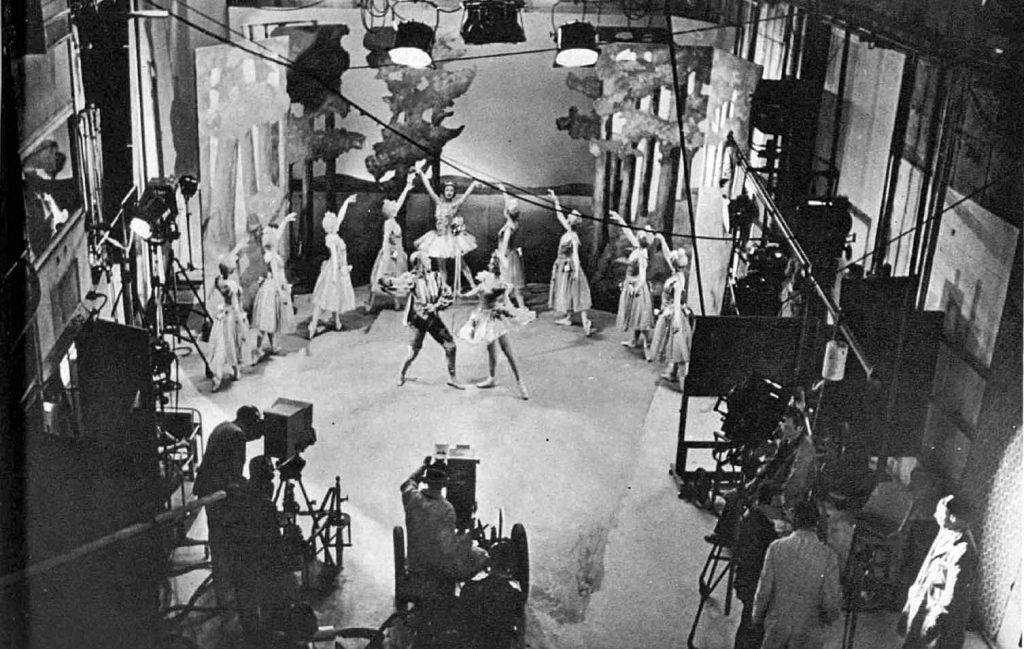
John Wyver writes: In mid-March 1939, Alexandra Palace rolled out a metaphorical red carpet for the state visit of France’s President and Madame Lebrun. Alongside an outside broadcast of the King and Queen greeting the visitors at Victoria Station, the schedules featured L’Avare, Lady Gregory’s version of Molière’s The Miser; a News Map edition about France; and Les Jeux d’Eau, an elaborate assembly of French music and songs.
The real world schedule of the republic’s representatives also included an evening with the royals at Covent Garden. There the full Vic-Wells Ballet gave a command performance of acts 1 and 3 of a new ‘pared down and low-budget’ production of Tchaikovsky’s The Sleeping Princess (also known as The Sleeping Beauty).
Three days later, on Saturday 25 March, and then again on Wednesday 29 March, acts 1 and 2 of this elaborate staging was given across both studios at AP. Marius Petipa’s original 1890 choreography had been revived by former Maryinsky Theatre ballet master Nicholas Sergueff, and Nadia Benois had designed costumes.
The sixty-plus company of dancers featured Margot Fonteyn as Princess Aurora, Robert Helpmann as Prince Charming and Frederick Ashton as Carabosse. Constant Lambert conducted an augmented BBC Television Orchestra, Elizabeth Cowell contributed narration, and the occasion was enhanced with Gaumont-British newsreel of the gala guests arriving at Covert Garden as well as dubbed-in applause from sound effects discs.
The set was replicated as a model, complete with the princess asleep; a camera shot dissolved to a hold on it, so that the studio could be reset for the scene of the awakening. Overlaying two camera channels also made the Lilac fairy magically fade in and out.
One critic hailed producer D.H. Munro’s 80-minute broadcast as a ‘technical as well as artistic triumph’, noting that, ‘Two years ago six dancers shown together were too much for the cameras. Now really big crowds can perform without any apparent loss of detail.’ Writing much later, Janet Rowson Davis concluded that, ‘The ballet itself marked a summit of achievement for the [Vic-Wells] company’, just as ‘the television production [did] for the medium.’
A fortnight after the transmissions, The Bystander magazine devoted a full page to the studio during the broadcast (below), with glorious photographs by ‘Rodger’, presumably the great photojournalist and founding Magnum member George Rodger. After extensive travels, he worked on occasion for The Listener in the mid-1930s and for the Black Star photo agency. He would go on to be depict the horrors of one of many the concentration camp at Bergen-Belsen in 1945.

One of the photographs features a named camera operator, Mr Needer, lining up a shot with Margot Fonteyn, and another shows Arthur Osmond, wearing headset and dark glasses against the glare of the lights, setting a mark for one of the dancers on the studio floor. The wide shot in the main image, which is also featured as the header, is among the most evocative images of AP in action before the war.
Leave a Reply