
OTD in early British television: 9 September 1936
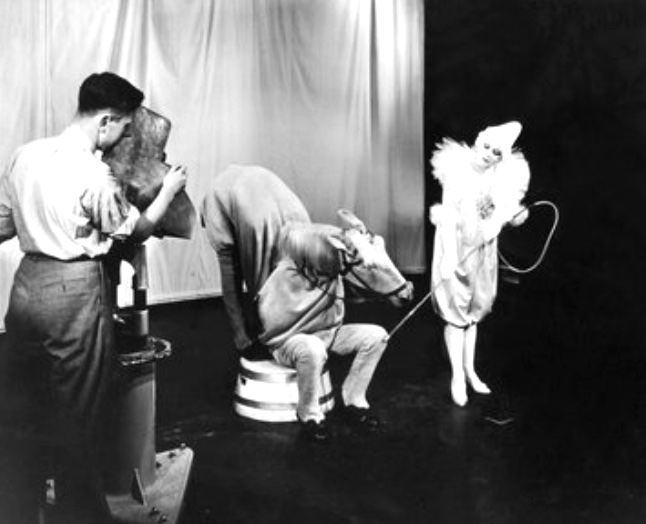
John Wyver writes: As promised yesterday, this is the fascinating text of Grace Wyndham Goldie’s LIstener column, ‘The Drama of Television’, dated 9 September 1936, with her first thoughts about the new medium. As the weekly’s radio drama critic, she had seen a demonstration during the Radiolympia broadcasts arranged ahead of the BBC’s ‘high definition’ service going on air on 2 November 1936.
What is television going to do to radio drama? Change It? Obviously. Revolutionise it? Probably. Kill it altogether? NO. You have only to watch the first television programme put out from Alexandra Palace for this to be perfectly, hearteningly clear.
I had been told that television was too raw for it to be worth bothering about yet; that the small size of the pictures made them difficult to watch and that the things seen flickered so much that a great strain was put upon the eyes. Most of this is nonsense.
Television is more advanced than [radio] broadcasting was when we first heard it and more advanced than the talkies were in 1he days of Sonny Boy. I daresay that the high price of receiving sets and the fact that reception is limited for the present to a twenty-five mile radius means that televised drama will not replace ordinary radio drama for a little time yet.
But televised drama is coming. And soon the kind of radio drama we now hear over the air will be as dead as the silent film. That was to be expected. But I was afraid that television would do more than this, that it would kill every kind of radio drama and substitute for it talkies in the home. I said to myself, ‘Talkies are moving pictures plus sound. Television gives us moving pictures plus sound. Therefore televised drama will be the same as talkies’.
And I was totally wrong. For the most astonishing thing about 1his first televised programme is that the direct television is much more satisfactory than the televised talkie and that direct television has an appeal of its own which is quite different from that of 1he talkie.
Before I go on let me explain that this first televised programme consists of two pans. One part is made up of televised films or excerpts from films. We are given a new film about books [Paul Rotha’s Cover to Cover], scenes from ‘As You Like It, from the new Paul Robeson film, from Rembrandt,, and so forth.
The other part is what is called direct television. A complete variety entertainment performed in the studio is photographed and transmitted directly to the television audience. The Griffiths brother who plays the back legs of Pogo the Horse kicks the Griffiths brother who plays the front legs [above, centre, with Miss Lutie] and we, looking at our receiver, see this fraternal action at the actual moment it takes place. And so on.
Now this variety entertainment was produced under extremely experimental conditions. Everything was on trial — the kind of make-up needed, the kind of colours required for clothes and background, the ways in which shots should be taken and camera angles used. In all the paths where the talkie walks securely as a result of the experience of years direct television was feeling its way. And yet direct television was more effective than the televised talkie.
This was partly because of the small size of the receiving screen. The films were produced to be seen on a large screen and on the small one they looked cramped and crowded. Whereas the direct television was produced from the first for a small screen and looked right.
This is important, since the screens of domestic receiving sets must always be small. But far more important is another point. And this is that the direct television was effective because it was done to the audience. The announcer seemed to be speaking to me specially, the variety artist doing his tum for me specially. And this made them seem real.
The characters in the films, even Paul Robeson ‘s strong personality in a close-up, seemed far away. Robeson was accing to someone within the film, not ro me. I got little of the illusion that the cinema gives. I was looking at an animated picture.
The only film which did not give me this impression of distance and unreality was the book film, in which Mr. Huxley, Mr. A. P. Herbert and othen spoke direct to the audie11ce. I am sure that this is going to be the secret of televised entertainment.
Characters will have to make contact with the audience and not remain within the picture frame as they do in the cinema and in the modern theatre. This means a return to the methods of the Elizabethan. theatre plus something else, the in1imacy which comes from a performance given to one or two people in a small room.
The possibilities are enormous, the difficulties colossal. But above everything stands out the important fact that what we are about to sec is not the death but the rebirth of radio drama; the end of the drama of pure sound but the beginning of a new dramatic form of which radio drama is one parent and the cinema the other.
[OTD post no. 266; part of a long-running series leading up to the publication on 8 January 2026 of my book Magic Rays of Light: The Early Years of Television in Britain, which can now be pre-ordered from Bloomsbury here.]
NOTE that the Illuminations website will be offline for up to 24 hours on Wednesday 10 September to allow us to migrate to a new server.
Wow! She saw it all, right at the outset. What TV drama wouldn’t be, but could be. What TV could do that no other medium could – speaking directly to us. Amazing foresight: no wonder she ended up working in it…