
The Sunday dozen
John Wyver writes: As part of the overall re-boot of the blog, let’s see together whether it is interesting once again to share a dozen recommendations from my reading (mostly) and viewing (minimally) this past week. For new readers, this is an ancient Sunday morning ritual that I am considering re-instating on a regular basis.
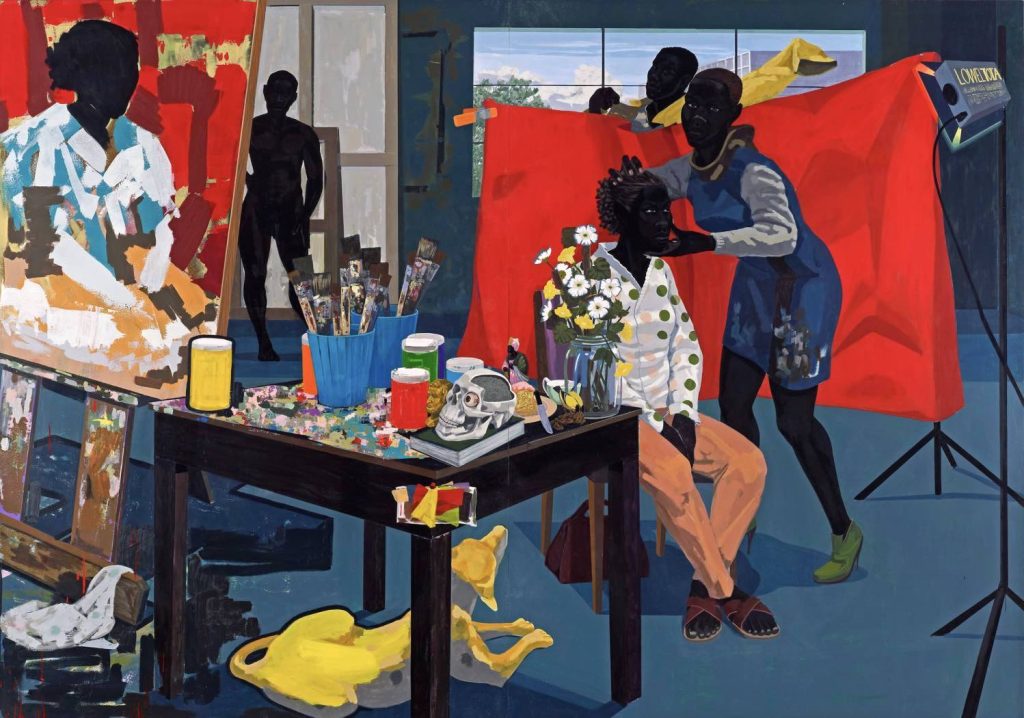
• 10-minute challenge: a modern master takes us inside an artist’s studio: I am a huge fan of The New York Times‘ focus challenges, and this latest one composed by Larry Buchanan focuses on Kerry James Marshall’s huge 2014 ‘Untitled (Studio)’, reproduced above; see this and much more of this great artist’s work in the current exhibition at the Royal Academy.
See also Can you stare at a work of art for 10 minutes?, a report by Sarah Bahr on the first year of the ’10-minute challenge’ initiative.
• 10 great Hollywood melodramas of the 1940s: linked to the current — and terrific — BFI Southbank and BFIplayer season, Too Much: Melodrama on Film, here is Pamela Hutchinson’s list of essential women’s pictures from the 1940s.
• Commercials at the end of history: for Mubi Notebook, this is a facinating essay by Sarah Pettingell, illustrated with numerous examples, about television advertisements made during the final moments of the Soviet Union.
• Saturdays at the sewage works: Rosemary Hill is terrific on photographer Martin Parr for the London Review of Books [£, but limited free access].
• How brutalism became both a utopian dream and a dystopian meme: Sotheby’s is this week re-opening Marcel Breuer’s 1966 masterpiece in Manhattan that was built as the Whitney Museum of Modern Art, and Michael Kimmelman for The New York Times is very good on the make-over [gift link], while this recommendation is Kate Wagner’s rich contextual essay, published on the auction house’s website, about the history of the architectural style.
• Impassioned ferocity: Jed Perl for The New York Review about the responsibilities of the critic today, with reflections on recent writing by Andrea Long Chu, Becca Rothfeld, T.J. Clark, Jonathan Kramnick and Lauren Oyler.
• Any revival of Sunday links needs a contribution from The Boss, and here he is in a comparatively recent video, directed by Thom Zimny, for ‘Open All Night – Nebraska Live’:
• Reckoning With empire at Britain’s Imperial War Museum: for Jacobin, Erik Linstrum responds to the IWM’s recently-opened display, Emergency Exits: The Fight for Independence in Malaya, Kenya, and Cyprus:
What makes Emergency Exits a worthy experiment, despite its shortcomings, is the willingness of its creators to present an anti-heroic narrative of British warfare to a popular audience.
• The case that AI is thinking: I’m doing my best to keep up with some of the flood of writing about AI, and this long New Yorker essay by James Somers is exceptional.
• Literature Is not a vibe: on ChatGPT and the humanities: for LA Review of Books, Rachele Dini on OpenAI’s ‘A Machine-Shaped Hand’, published by the Guardian in March, and the deep troubles of academia in Britain and beyond.
• The X effect: absolutely exceptional reporting from Sky News about the pernicious ways that El*n M*sk is boosting the far-right in Britain.
• The Authoritarian Stack: how tech billionaires are building a post-democratic America — and why Europe Is next: brilliant research from Professor Francesca Bria with xof-research.org, imaginatively and compellingly presented:
This project maps the “Authoritarian Stack”—a network of firms, funds, and political actors turning core state functions into private platforms. Based on an open-source dataset of over 250 actors, thousands of verified connections, and $45 billion in documented financial flows.
See also How Silicon Valley became a center of reactionary, anti-democratic politics by Jacob Silverman for Literary Hub.
• Revolutionary escalation, semi-authoritarian “normalization,” or a democratic turnaround?: a year on from probably the most consequential election of our lifetimes, there is no shortage of whither-the-world, and Thomas Zimmer’s exceptional analysis is one that demands to be read.
… and finally, the great jazz drummer Jack deJohnette died this past week; here he is with the Charles Lloyd Quartet in 1966 on ‘East of the Sun’, with Charles Lloyd, tenor saxophone; Keith Jarrett, piano; and Cecil McBee on bass.
Leave a Reply