
The Sunday dozen
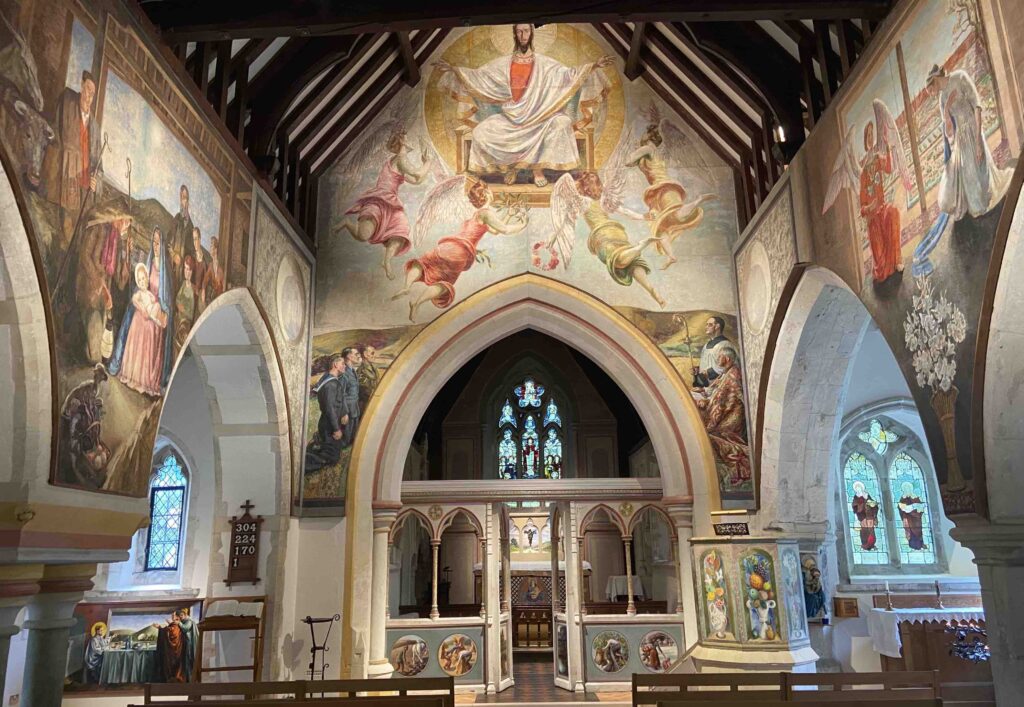
John Wyver writes: a modest but I hope rewarding holiday selection this week, somewhat dominated by the culture of the United States. The image above is my photo of the interior of St Michael & All Angels, better known as Berwick Church on the Sussex Downs, with murals by Duncan Grant, Vanessa Bell and her son Quentin Bell.
• How Gaza broke the art world: a compelling Equator article by David Velasco about the fall-out from the publication on 19 October 2023 by Artforum, where he was editor-in-chief, of an open letter from culture workers in support of Palestinian liberation and a ceasefire in Gaza; he reflects on his subsequent dismissal and on the wider ramifications across the art world:
The past two years have given the lie to any wisdom that the art world constitutes the progressive avant-garde. I can count acts of bravery from less-visible artists, but a fog of silence continues to dominate the field: few expressions of solidarity forthcoming from institutions, and too few artists willing to speak out via social media, much less their own work. What do we make of this depressing amalgam of fear and apathy? How many will it take to break the art world’s attitude of mute acquiescence?
• Room tone 2025: simple, lovely, from The Criterion Channel (and only viewable there).
• Made in America: Having watched and hugely enjoyed Josh Safdie and Timothée Chalamet’s epic over the Christmas, it was really good to read Sam Bodrojan on Marty Supreme and its marketing, for The Los Angeles Review of Books:
This is a film destined to be major. Major, yes—but not necessarily cool. Because Marty Supreme is not cool. Its New Wave needle drops and coy political provocations have lost their chic luster. Like so much pop culture, it is a rehash of formal tics that tipped into the oversaturated and passé years ago, stuck awkwardly between unfalsifiable existentialism and unevenly sanded-down edgelord schtick. But make no mistake: Marty Supreme’s uncoolness is key to its dogged, four-quadrant appeal.
• Inside how Josh Safdie filmed the ping-pong matches in Marty Supreme: a terrific BTS feature by Chris O’Falt for IndieWire, with an introduction to ‘Diego Schaaf, who, along with his wife Wei Wang (a Chinese-born American table tennis player who represented the U.S. at the 1996 Olympics), developed the niche of being Hollywood’s preeminent table tennis experts.’
• Two Prosecutors: the trailer for the bleakest film I saw in 2025, Sergei Loznitza’s brilliantly controlled parable set in the Soviet Union in 1937, to be released in the UK on March 27 by Curzon Artifical Eye.
• Text of light: an interview with J. Hoberman: for ReverseShot, Jordan Cronk speaks with the veteran critic about his latest book, Everything Is Now: The 1960s New York Avant-Garde—Primal Happenings, Underground Movies, Radical Pop.
• The overlooked queer history of five titans of American postmodernism: I missed this Kate Brown artnet review back in July, and I’ve missed the show that it’s about (which I deeply regret): Five Friends — John Cage, Merce Cunningham, Jasper Johns, Robert Rauschenberg, Cy Twombly.
• This museum housed 120,000 works of art. Now it’s empty: I loved Catherine Porter’s report for The New York Times [gift link] on the removal of the art in the weeks Paris’ Pompidou Center closed its doors for restoration; photos and excellent videos by Dmitry Kostyukov.
• The empire gives back: Susan Tallman reviews Who Owns Beauty? by Bénédicte Savoy, in collaboration with Jeanne Pham Tran (translated from the French by Andrew Brown) and Dan Hicks’ Every Monument Will Fall: A Story of Remembering and Forgetting for The New York Review [£; limited free access] and asks what a fair policy of museum repatriation might look like.
• What if the London Ringways had been built?: rich urbanist history from Lewis Baston.
• Fatal realism: Andrew O’Hagan for the LRB [£; limited free access] on Walter Lippmann, ‘called the greatest journalist of his age, but his claims as an original thinker rest on his book Public Opinion, published in 1922′; the essay is a review of Tom Arnold-Forster’s Walter Lippmann: An Intellectural Biography.
• The new way of seeing: In Anya Berger’s archives: Emily Foister for The Paris Review on the lost history of Ways of Seeing and more:
Anya Berger (1923–2018) is most famous for being the wife and ‘muse’ of art critic and novelist John Berger. In 2018, after both John and Anya Berger were dead, their daughter Katya Berger was with John’s archivist and biographer, Tom Overton, when they unearthed paper records in the family’s basement. These suggest that the work published in John’s name during their relationship, from 1958 to 1973—The Success and Failure of Picasso, Ways of Seeing, G., and A Fortunate Man: The Story of a Country Doctor—could be considered joint projects.
• England’s MCG triumph is a genuine coup – and a picture of what might have been: I tend not to highlight Guardian articles here (too familiar) nor cricket reports (too niche?), but I do want to recognise the excellence of Barney Ronay’s analysis throughout this crazy and – let’s face it – disappointing Ashes series; this is perhaps the peak of his writing to date.
• And finally… not sure when it’s from, but it’s great:
Leave a Reply