
Magic Rays of Light, by the numbers
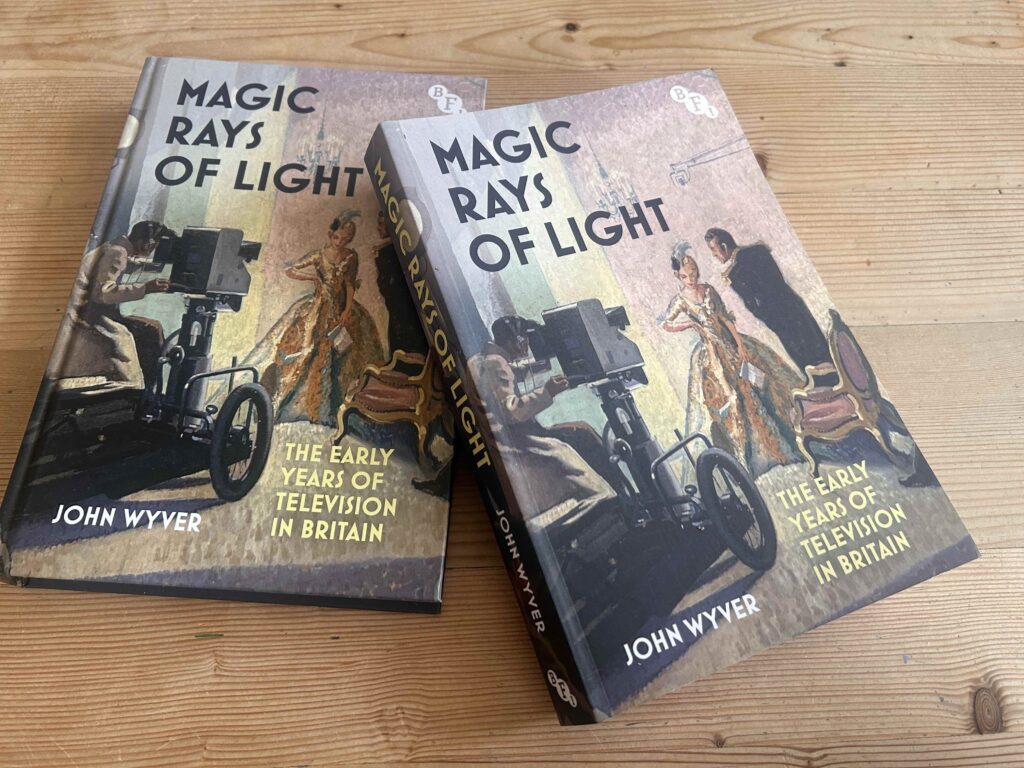
John Wyver writes: Publication day! And just in time, my copies of Magic Rays of Light: The Early Years of Television in Britain arrived yesterday. Unsurprisingly perhaps, I am thrilled. The book feels substantial but not (I hope) intimidating; the photographs have reproduced well; I really like the lay-out, the font and the weight of the paper; and the cover, with a detail of Harry Rutherford’s Starlight, 1937, looks gorgeous.
Tonight we start a season of screenings at BFI Southbank, and on Monday evening in the BFI Reuben Library I am discussing the book with Television Curator Lisa Kerrigan; there are still some tickets available. Today, in part because this is the kind of information that is rarely made public, I thought I would sketch what it has cost me to get to this point.
Of course there’s the time taken to research and write the book, but that’s a given, and for much of the past years I have been fortunate to have been supported by Illuminations, by the University of Westminster where I am privileged to have a fractional post, and by some freelance work, as well as by my friends and family.
Bloomsbury, and especially editor Rebecca Barden and copy and production editor Liz Hudson, have been absolutely great to work with, and I’m very happy that, just as we agreed at the outset, they have published the paperback and e-book with reasonable pricing alongside the hardback. But as is the case in academic publishing, there was no advance. Nor do I expect to get rich from the royalties.
There were significant costs to visit archives: numerous trips to Reading for days at the BBC Written Archives Centre at Caversham. Ditto frequent train travel to Kew for The National Archives. Plus, day trips to Oxford, Bradford and Sheffield. Not to mention the bus and tube fares (at least until I got my Freedom Pass) for the British Library, the London Library, the Post Office and BT archives, the RIBA Library and others.
More specific costs were the permissions, for the images and for quotations from BBC copyright material. Even with the academic discount, thirty BBC images cost me £1,001.50 including VAT. Thanks to the welcome deals that Bloomsbury has with the photo libraries Getty Images and Alamy, reproducing a further eleven images from these sources, again including VAT, cost £198.48 (which is around half the cost, you’ll note, of the BBC’s).
One image from the Mary Evans Picture Library set me back £132. And for the remainder of the pictures for which I paid, including kind permission from the estate to reproduce Harry Rutherford’s Starlight on the cover as a detail, and in full inside, the total cost was a round £500.
I should stress, however, that two invaluable sources made no charge for the reproduction of their images, for which I am most grateful.
All of that is to be expected, and I’m thankful that Bloomsbury permitted me (at my cost) to have double the number of images we contracted for (there are 57), and just over a third again as many words as agreed (205,000 eventually, plus the Index).
The number that grated, however, was the £270 that I had to pay to the BBC to reproduce copyright material from the Written Archives Centre. This was calculated on a word count of material drawn from memos and letters and press releases from the 1920s and ’30s. Material that I was highlighting the significance of. Material that I was bringing into a scholarly discourse. Material that I was using to uncover and explore and for the most part to celebrate the BBC’s own history.
No other archive in which I have worked makes such a charge. Not the Post Office nor the BT archive. Not the British Library for manuscript materials (although of course unpublished texts may require permission from external copyright holders). And most certainly not The National Archives at Kew.
Regulars here will know the issues I and others currently have with the BBC Written Archives Centre, which I firmly believe is not operating in the way that a responsible archive of a public body should. And the charge for text reproduction is a further, inappropriate imposition on researchers.
One other point. I also had to submit my manuscript for scrutiny by WAC, with the unpublished quotations highlighted. It was passed without any imposed redactions, as I gather is usually the case, but again no such stipulation is made when I quote from comparable memos, minutes and letters held by The National Archives or the other sources I worked with.
Reverting back to the numbers, all told, and leaving aside time and travel, I’m down £2,111.98. Will I make that back from royalties? Perhaps on the day I see airborne swine above Broadcasting House.
Leave a Reply