
Returning to Coventry Cathedral
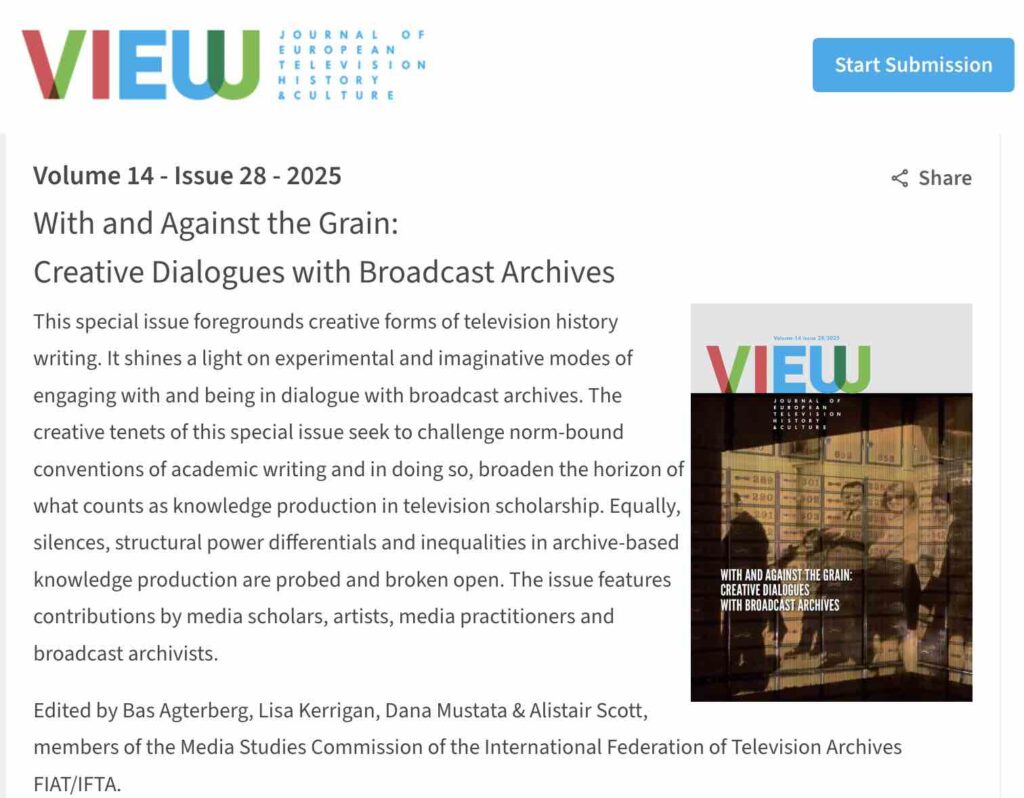
John Wyver writes: Taking a break from posts about Magic Rays of Light, I am delighted to highlight another article of mine that has just been published in the latest edition of VIEW: Journal of European Television and Culture.
Online and fully open access, issue no 28 collects a rich group of exceptional contributions under the title, ‘With and Against the Grain: Creative Dialogues with Broadcast Archives’. And my essay, which is illustrated with a couple of archive extracts and a number of framegrabs, revisits the 2021 film Coventry Cathedral: Building for a New Britain that I made for BBC Four with Todd MacDonald, Ian Cross and Helen Wheatley.
I was interested in trying to tease out some of our thinking and practice in developing a highly reflexive screen language to organise and assemble the rich archival film material that documented the post-war construction of Sir Basil Spence’s great building. (The film is no longer on BBC iPlayer, but it might well be available elsewhere online.)
The essay can be read and downloaded here, and this is the abstract to give you a slightly fuller sense of my argument:
Employing an extensive and diverse range of archival material, Coventry Cathedral: Building for a New Britain chronicles the planning and construction in the 1950s and early 1960s of a modernist replacement for the medieval cathedral almost entirely destroyed in 1940.
Drawing on a breadth of archival elements from a wide range of sources, the production team sought to develop a reflexive screen language that acknowledged the materialities of these elements, highlighted the production processes that created them, and located them in a screen language of spatial montage and distinctive graphics.
Centred on a close reading of the opening sequence, the article explores the ways in which the film worked to develop William Wees’ conception of collage ‘to invest found footage with new meanings’. Those meanings in this case included the idea of the construction of the film as an allegory of the construction of the cathedral and the reconstruction of post-war Britain.
I’ll return to the issue when I have read the other articles, and of course I would be delighted to hear your thoughts about my essay.
Leave a Reply