
Close reading paintings
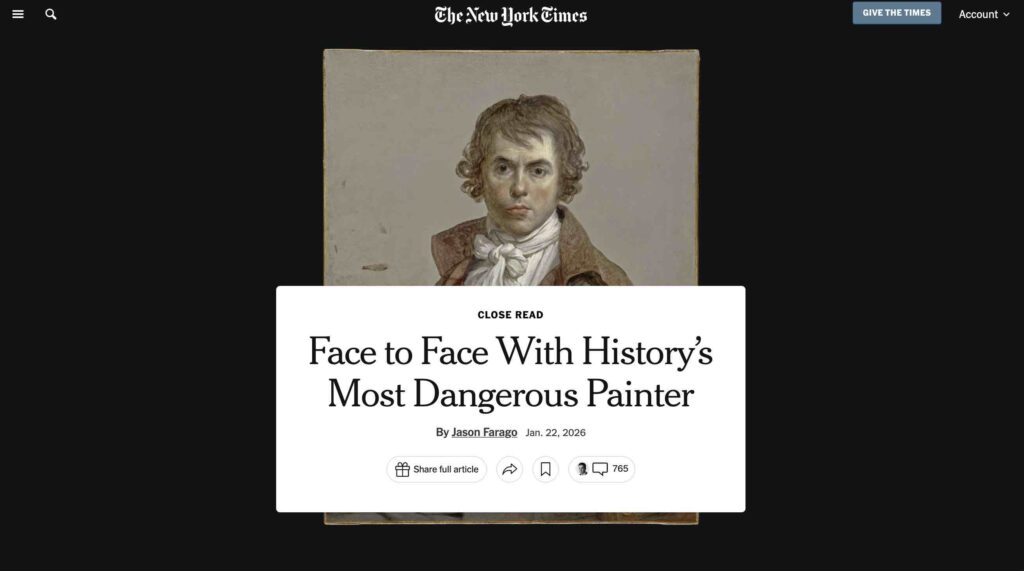
John Wyver writes: Over the past five years, at the online Arts & Design pages of The New York Times, Jason Farago and colleagues have been reinventing visual arts criticism. Their latest offering in the series of interactive animated features that they call Close Read is Face to Face with History’s Most Dangerous Painter [gift link], about the work of Jacques-Louis David.
The form is a simple scrolling web page with a succession of short text elements that appear from the bottom of the screen and leave from the top. Synchronised to the texts are images set behind the texts. At times the images are replaced one after the other, but more often the page zooms in, to frame a detail, or pulls back to reveal a wider shot or to retreat from an artwork entirely, isolating it in the space of the page.
You can see I’m using filmic language of ‘shots’ and ‘zooms’, since the experience is strikingly like watching a short film created with a rostrum camera (in the olden days) or with digital manipulation. The author/filmmaker is directing your eye and making connections between the text (which in a film would have been voice-over narration) and the specific image.
What this does for the reader/viewer is to focus her attention, but – because she is in control of the speed of thre scrolling – without entirely determining what meanings are offered. The feature proposes how to look, and to look closely, enhancing that looking with information and interpretation, but the experience as a whole remains open and suggestive.
The visuals combine full-frame reproductions of paintings and drawings with shots of the works in situ, in this case in the Louvre’s recent David retrospective. The narration, at least in this case, is written in an idiosyncratic, highly personal way, as with Farago’s introduction to David: ‘This is him. My No.1 guy, my problemtic fave.’
With David the technique is especially effective with the 1794 Self-portrait, painted while the artist was imprisoned for his revolutionary activities. This is shown before and after its recent cleaning, and the details revealed by the feature’s primarily visual interrogation are revelatory.
What the feature lacks, which would be essential for a short film for television these days, is an emotive music score. Instead, it is a (literally) quiet reflection shared in a modest but entirely memorable manner.
Leave a Reply