
Mañana, the production
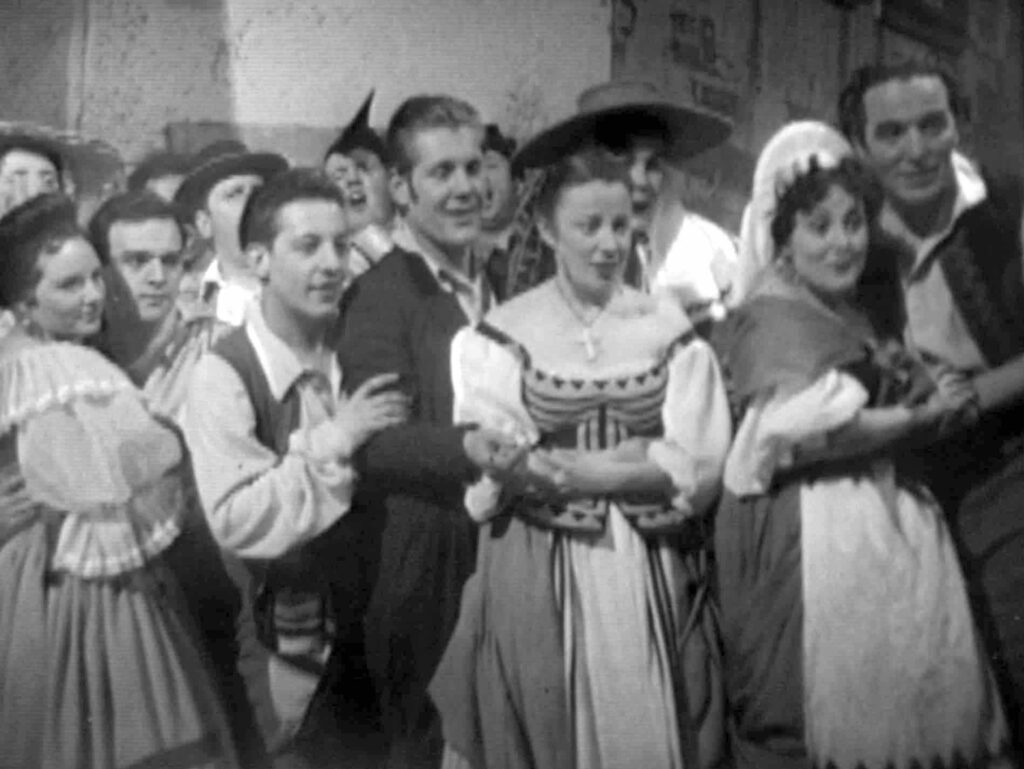
John Wyver writes: In a previous post I sketched the backstory of the BBC-commissioned opera Mañana, composed by Arthur Benjamin and produced for television in February 1956. Thanks to the seventieth anniversary, a digitally restored version of this transmission was shown on BBC Four and is available on BBC iPlayer for a short time only. Here, I want to offer some thoughts on the production as television; I would love it if someone more qualified than me could write about the music and performances.
The live transmission begins with an overture, a title card and a slow camera move over what I take to be a model of the village where the opera is set. Producer George R Foa explained that such a model was constructed to help plan camera and mic positions, and for scripting and shot set-ups. It may be that this moving shot was created on film, although the shakiness towards the end suggests that in fact that, like the rest of the broadcast, it was achieved with an electronic studio camera.
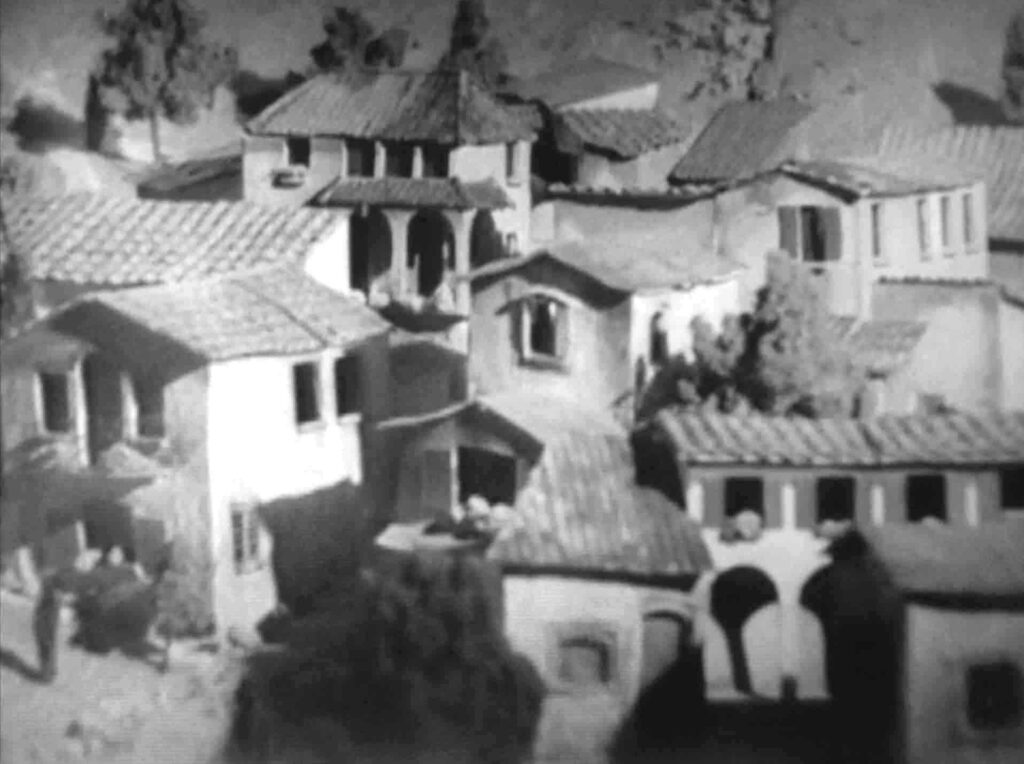
At the close of the transmission a zoom out over the model is accompanied by spoken cast and production credits (there is no roller); and the model is also seen the central interlude. The only graphic is the opening card with just the single word title, which means that, I think, there is no credit anywhere to the composer.
The music is inflected with flamenco guitar and castanets, while a cross-fade takes the viewer from an overhead shot of the village’s central square, with a shrine on one wall, to the shrine realised in the studio set. A camera move turns a corner to reveal steps leading up and out of the square. Moving from the rocks above the village the Wise Man enters and begins to interact with a number of the villagers.
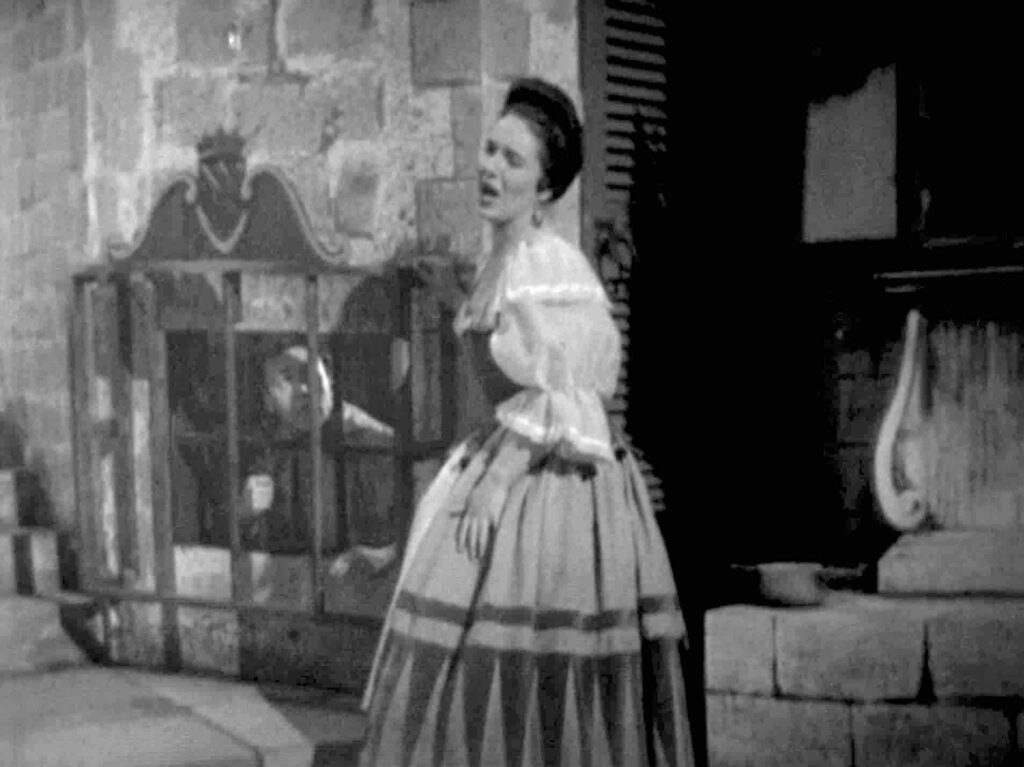
A young boy, Carlos, is curious about the shrine, and opens it to stare at, and caress, the statue of the Virgin Mary. Cut to an interior where the Widow is seated, and then back to the square where Luisita is singing to her lover, Pedro, incarcerated behind bars in a basement. From her window the Widow rebukes Carlos for his curiosity, and directs similar spleen towards also a flamenco dancer, who is revealed in a striking shot in depth through a window.
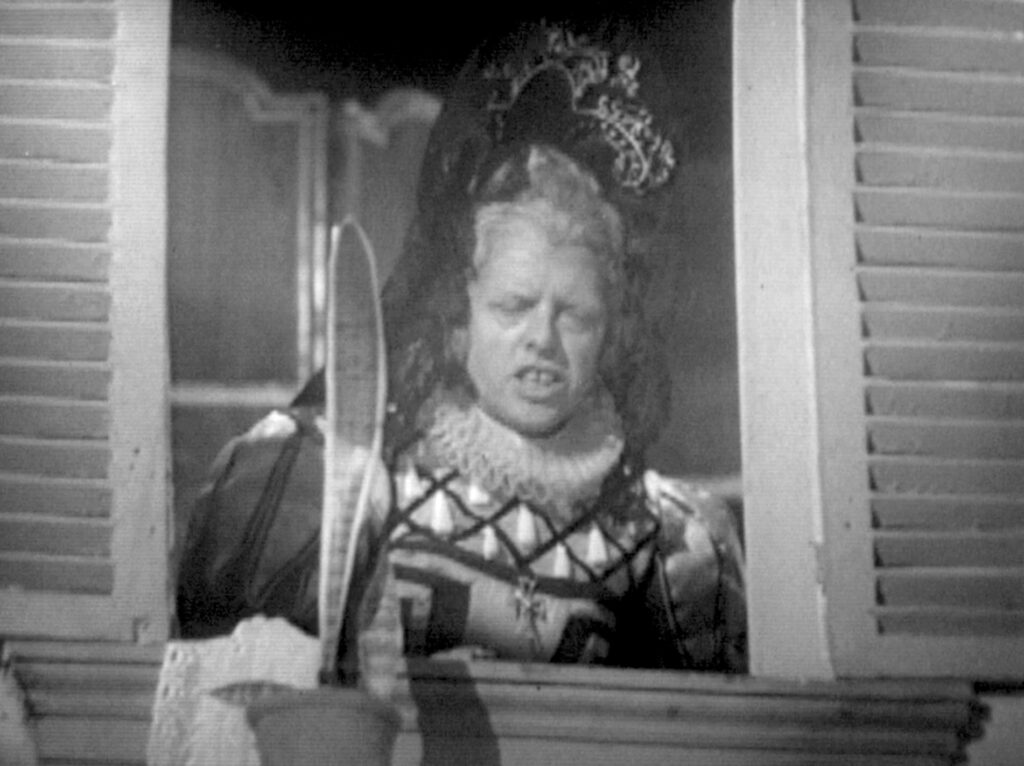
A sense of village life is built up with a rich variety of camera angles and compositions. Throughout there is far more of a sense of space created in three dimensions, and explored by the cameras in three dimensions. In this, the production seems significantly more sophisticated than the 1953 The Lady from the Sea, which I wrote about recently, and which is also on iPlayer, where the space appeared to be created in two or three narrowly defined planes and with everything played frontally.
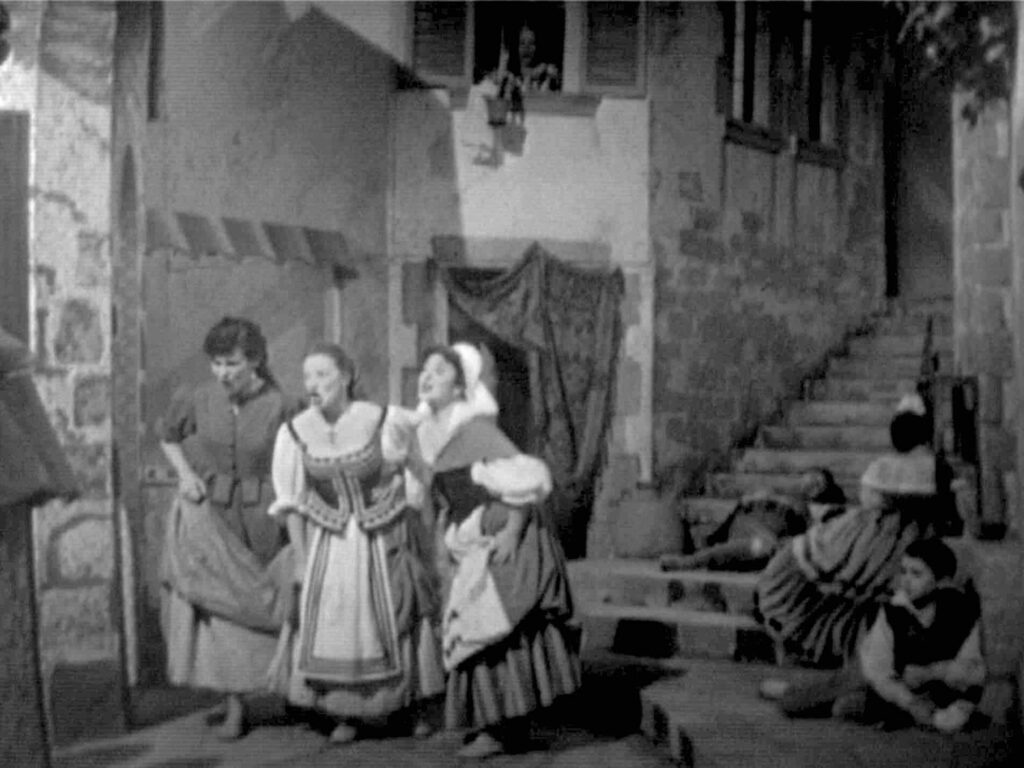
The interfering Widow continues to preside from her window, while washerwomen below rue their subservience to her. Luisita, who is revealed as the Widow’s neice, sings of her sadness at having lost her mother, and then seeing the family pearls appropriated by the Widow. But the Widow, who claims that Pedro stole the jewels, sings to Luisita that all of the estate will be hers if only she will break from Pedro.
Luisita, however, in perhaps the finest passage of music and of singing, declares her love for Pedro, and gives him food and drink through the bars of his cell. The Wise Man, meanwhile has discovered the statue broken by the now-frightened Carlos, who runs off into the rocks.
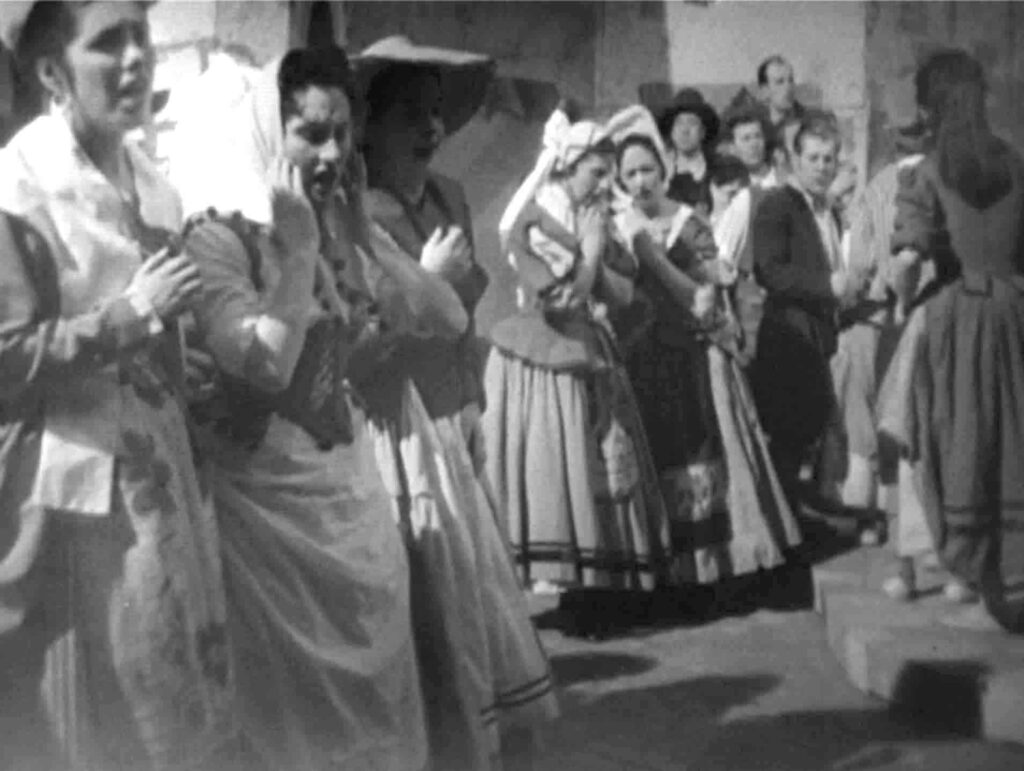
Although the production was clearly shot in a relatively constrained space, the multi-level set is solid and mostly convincing (although not the mountain backdrops behind), and it offer a wide range of exterior and interior angles, including ones composed in depth. A host of shots feature numerous figures from the Glyndebourne Festival Chorus doing sterling work. There are notable reverses also, from behind Pedro in his cell for example, and from the top of the steps looking down into the square.
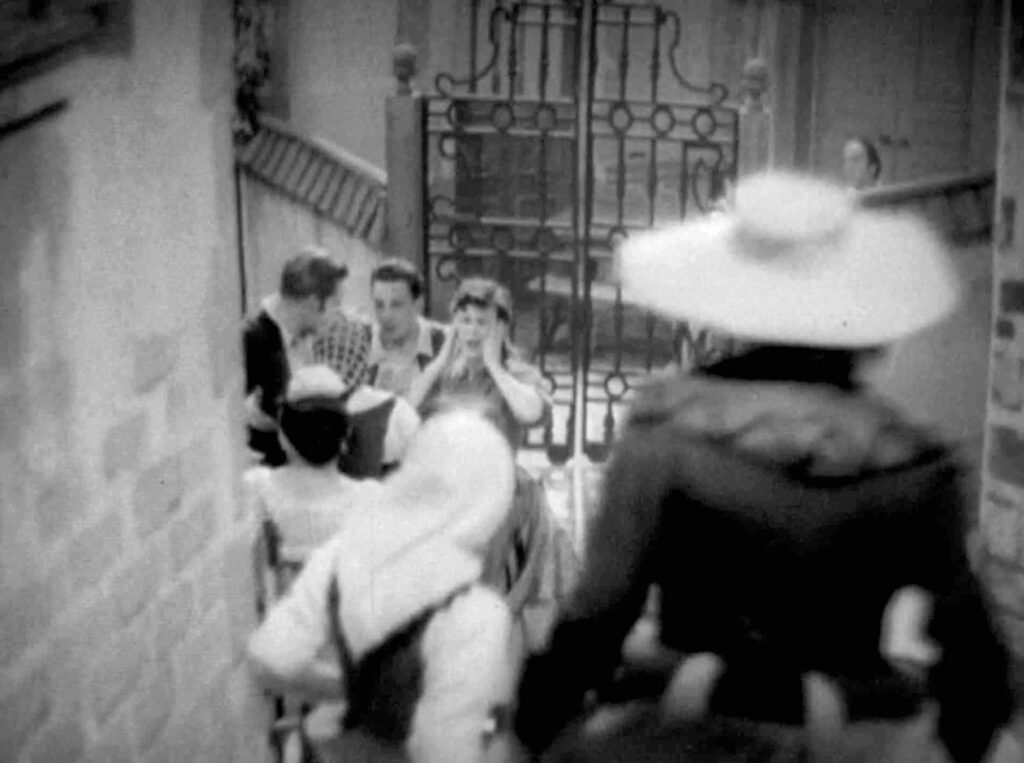
Producer Foa also keeps the shot rate high, with very few compositions held for more than a few seconds. Again, this is distinct from the studio language less than three years earlier of The Lady from the Sea.
Discovering that, in a departure from their usual charity, the villagers have not left him anything to eat or drink (or perhaps because Pedro has been given this repast), the Wise Man in his anger punishes the locals by prophesying that the sun will not rise tomorrow. Rather, Judgement Day will bring about the end of the world. The credulous villagers believe him and begin to pray for their sins to be forgiven.
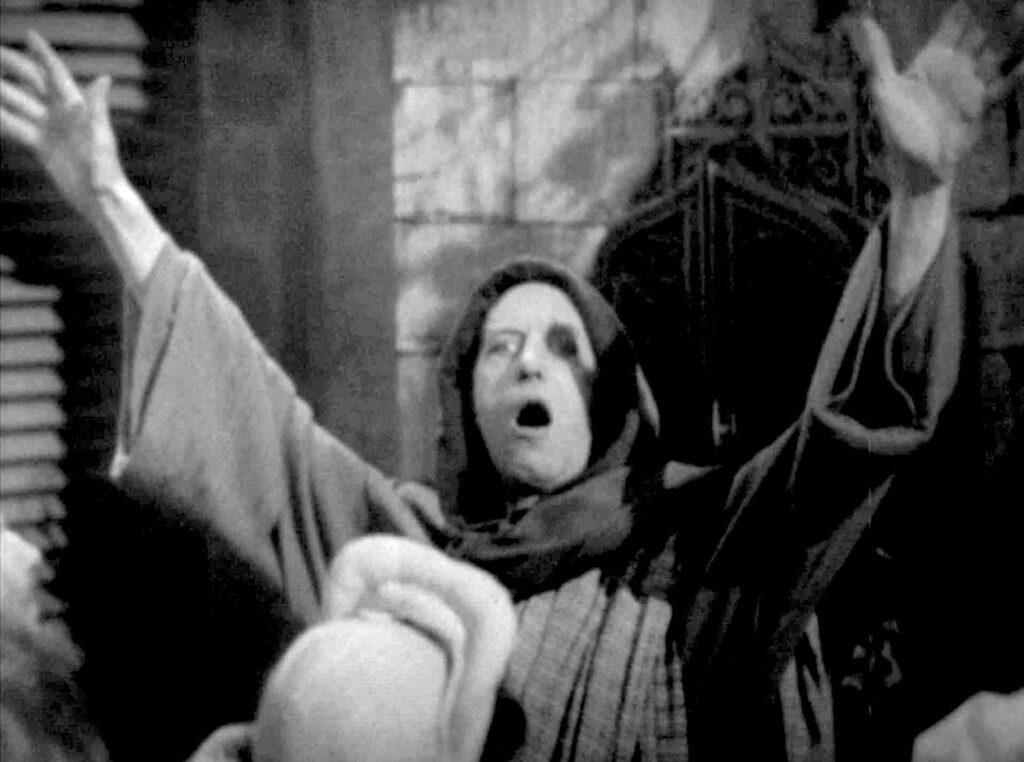
With the apocalypse imminent, Luisita persuades the Mayor to release Pedro, and as the villagers disperse to prepare for the end, the couple kiss tenderly. Which sets up an orchestral interlude, over which we see a montage of mimed activities, as well as Carlos climbing into the rocks and the Wise Man at work in his cave there.
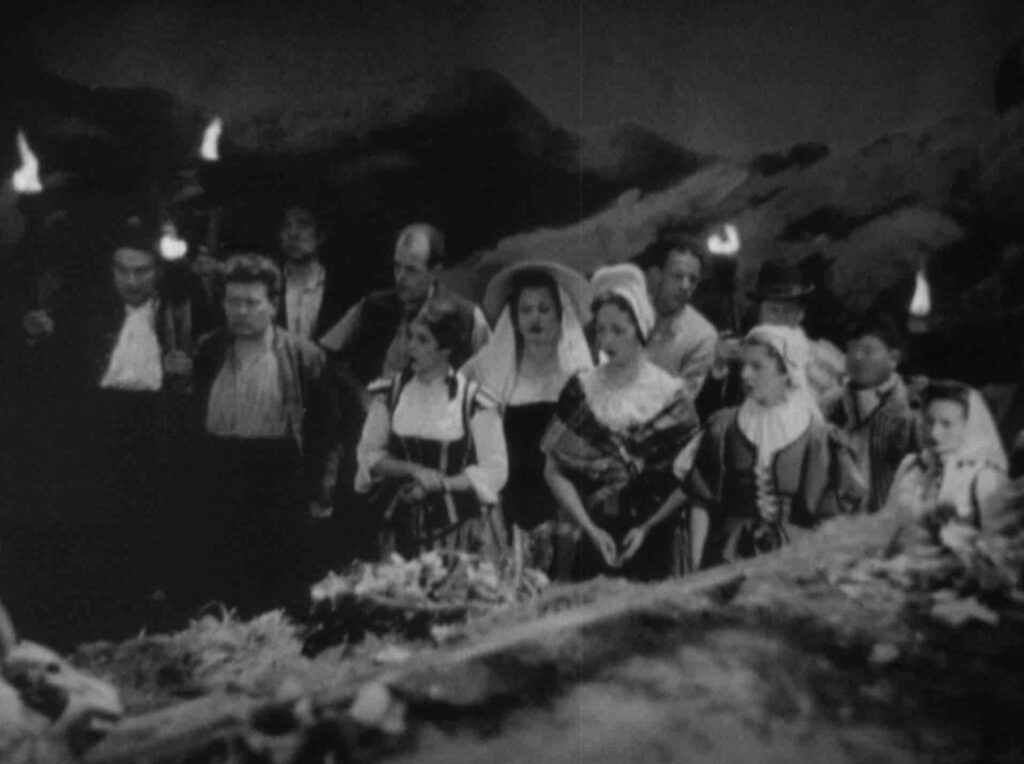
A procession with flaming toches passes through the square and past the shrine, which now has its door shuttered, and then climbs the steps to the rocks. They address the Wise Man, begging for another chance, before Carlos turns to see that in fact, contrary to expectations, the sun is rising. ‘Light! Light!,’ they sing, as the set is flooded with illumination.
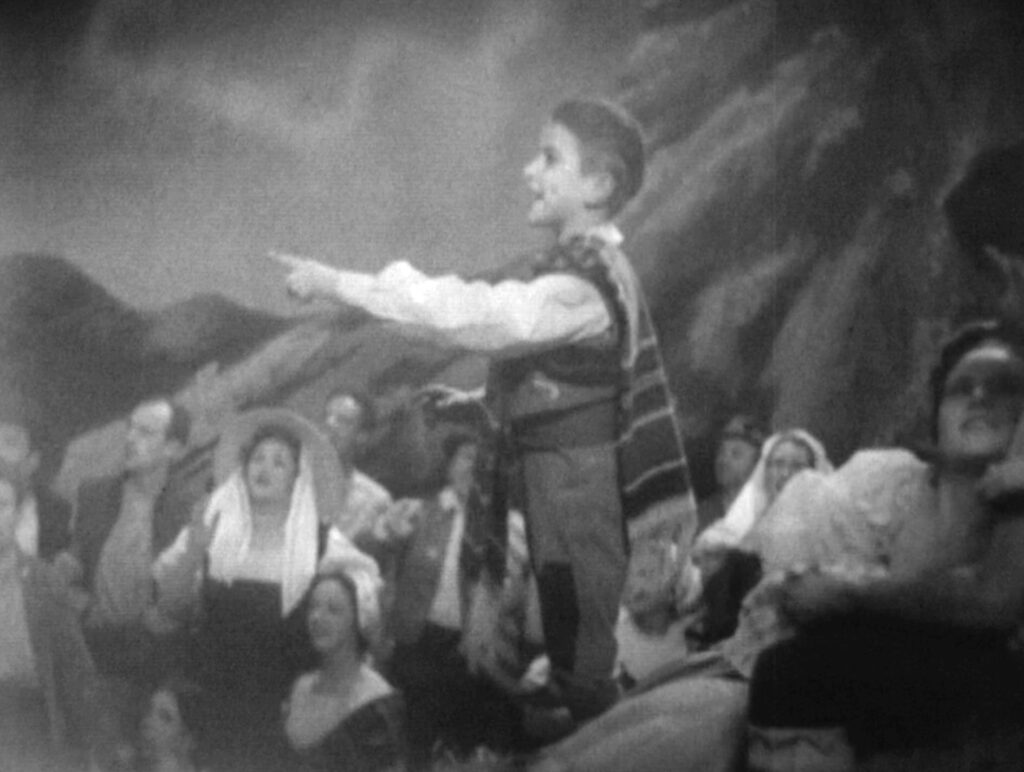
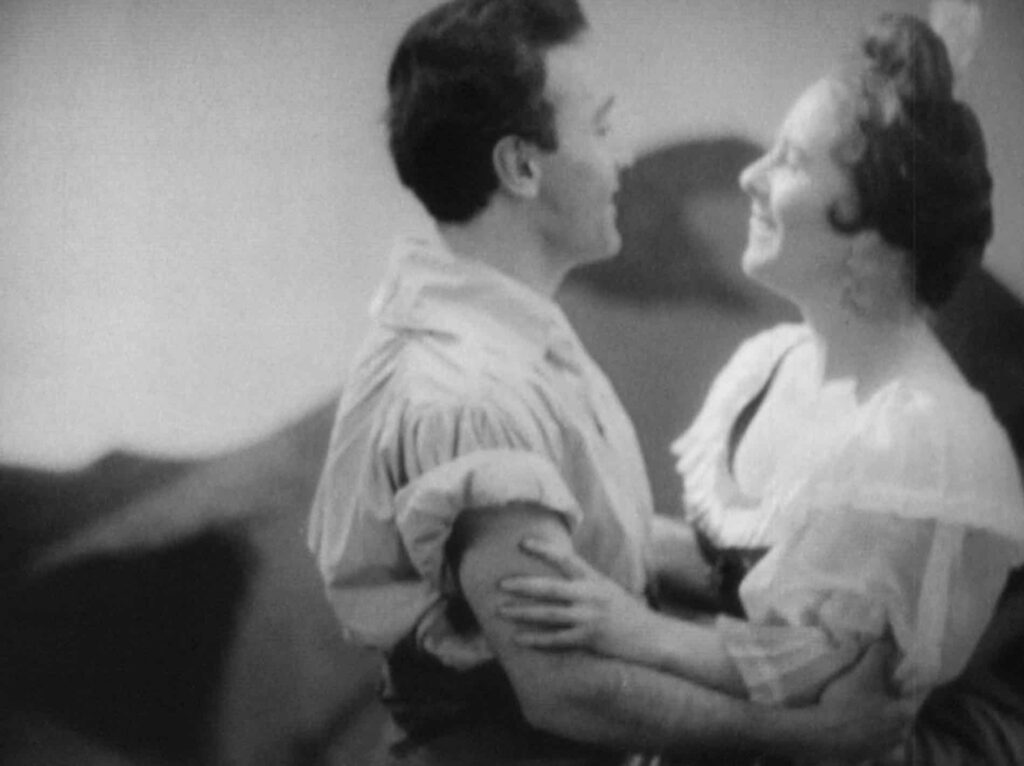
Led by the Widow, the villagers turn on the Wise Man, but he defends himself by claiming that he misled them for their own good, and that they will now appreciate their life more than ever. ‘You don’t get new worlds given to you every day,’ he extols.
Meanwhile, the Widow once again demands her stolen jewels, which are in fact Luisita’s, from Pedro, who continues to proclaim his innocence. Then, providentially, the jewels are shaken loose from the Widow’s elaborate costuming, and Pedro is seen to be telling the truth. The Widow’s excuse is that she was simply protecting family heirlooms, while Luisita decides to gift the jewels to the Virgin Mary, as thanks for the village being saved.
She wants to gift to be made by innocent hands, and so asks Carlos to do the honours, but he recoils knowing that by opening the shrine he will reveal the broken statue. The villagers, however, together with the Wise Man, urge him on, suggesting that this is a day of miracles.
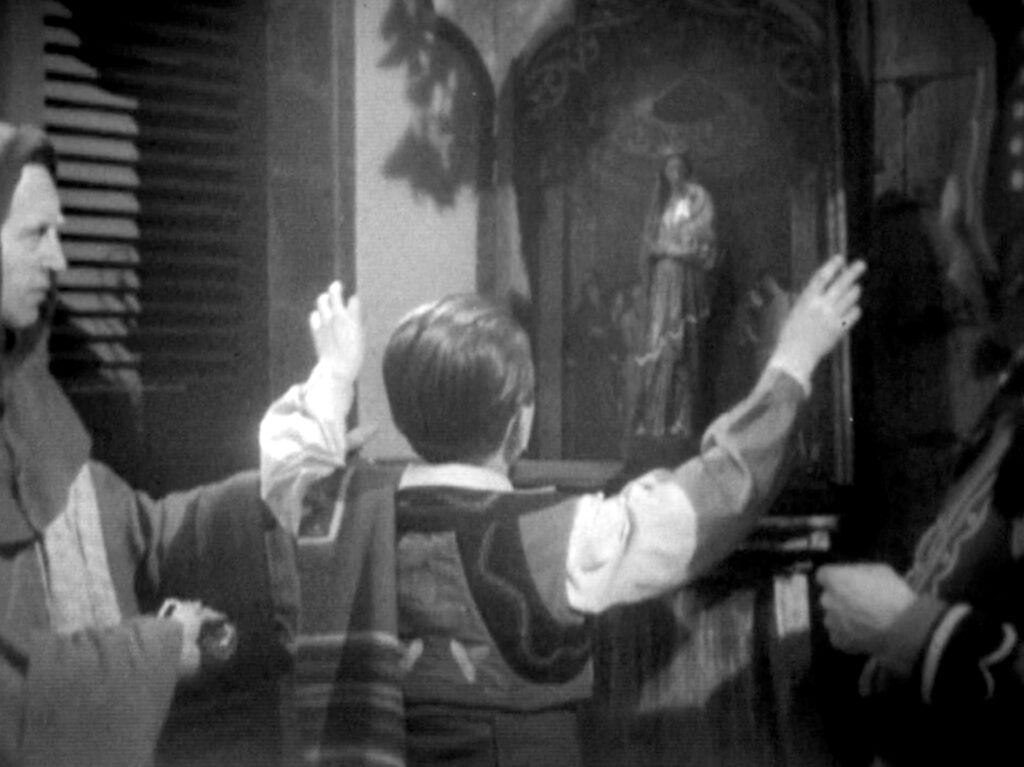
When Carlos does finally pull back the doors, the statue is revealed as whole again, albeit with a prominent mend across it,. The Wise Man, the visuals suggest, undertook this task during the night. All is well again, and the natural order of village life is restored.
My limited knowledge of twentieth century opera suggests that the whole might be compared to Benjamin Britten’s compic portrait of English village life in Albert Herring, and perhaps the music and vocal style has some similarities too. But I will offer the expert opinions of others in a third blog post shortly.
Seen today, Mañana is hardly a compelling hour and a quarter of television. Yet as an archival trace from seventy years ago, and approached with an understanding of its context and a sympathetic engagement with the aesthetics of the television studio, it is entirely fascinating.
So we should be immensely grateful that BBC Archives committed resources to restoring and presenting it. The telerecording has gone through a kind of smoothing to remove much of the video line effect, especially in the seconf half, that is usually so prominent in material from this time.
The low-contrast visuals have a not-unpleasant softness, and while there are some modest signs of damage, the production appears to be in remarkably good shape. (Note that I have modestly boosted the exposure and contrast of the framegrabs included here.)
The audio too is for the most part strong and clear, although there are moments when the singers are regrettably off-mic. I assume that the Royal Philharmonic Orchestra conducted by Edward Renton was playing live in the studio, although exactly how this worked is one of the many research questions I would love to follow up — especially if there is one or more production files in the BBC Written Archives.
One final thought. Is it too fanciful, given the moment in the mid-1950s when the opera was written, to see if as a kind of allegory of the world facing nuclear destruction? The moral then would be that if we continue to be spared Cold War annihilation, it is vital to cherish the lives we have. ”You don’t get new worlds given to you every day.’
See also, Mañana, the backstory, the first post in this series, and Mañana, the reception, the third.
Fascinating pieces, all three of them.
I’m not overly familiar with George R. Foa’s work but I recall that his Television Playwright production of Hulke and Paice’s “This Day in Fear” also had spoken end credits. I wonder if that was his ‘trade mark’, so to speak.
Interesting thought, Simon, but in fact I think spoken end credits were relatively common in the early years of television performance, and even probably the norm. Rudolph Cartier’s production of Gian-Carlo Menotti’s The Saint of Bleecker Street, for example, which was transmitted 8 months after Mañana, has comparable spoken credits.
I may be misremembering (my copy is on loan) but doesn’t the, somewhat later, Cartier production of Anna Karenina from 1961 have spoken credits also? I do wonder what dictated whether they were spoken or in-vision. Probably something very prosaic. Yet, however full the studio, you’d think it wouldn’t be difficult to find a corner of a now-redundant set in which to shove the roller-caption machine and a camera not needed for the last shot or two.