
The Sunday dozen
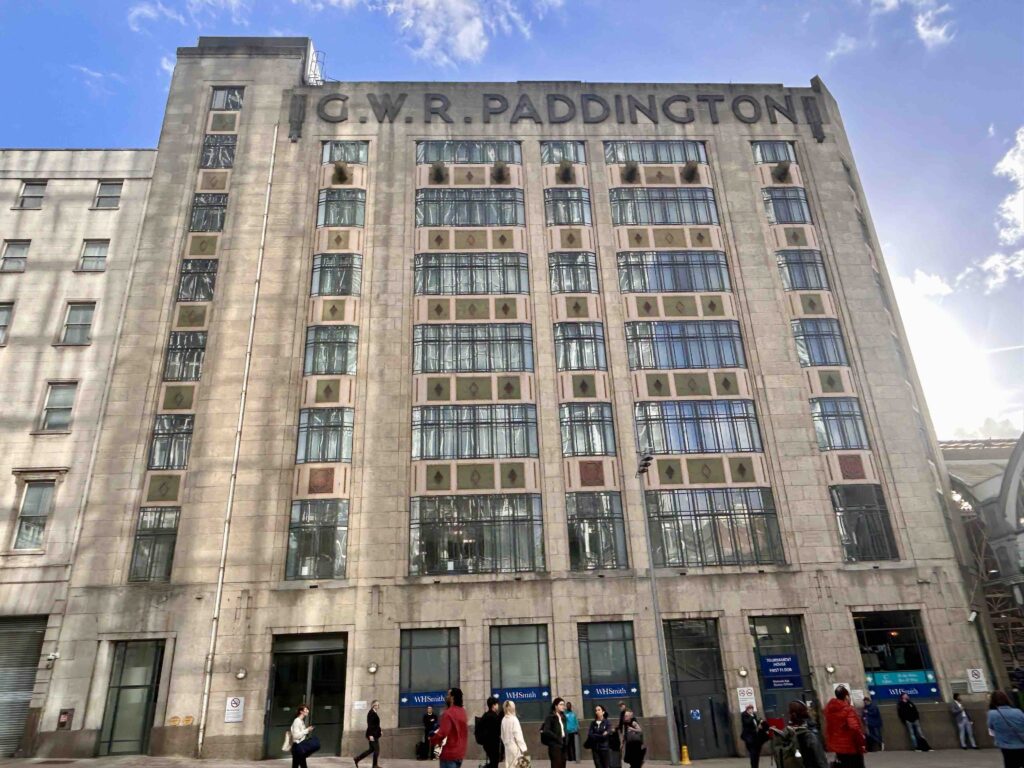
John Wyver writes: Articles and more encountered and appreciated over the past week. My header image is one of my favourite facades in London, that of the building now known as Tournament House at Paddington Station. Designed by P.E. Culverhouse of the GWR Chief Civil Engineers office and completed in 1935, it was this week revealed again as its covering of scaffolding was removed.
• Projections – David Bordwell’s Contributions to the Study of Film: a special open-access edition of the journal ‘for movies and mind’ dedicated to the late, great writer on cinema; there are exceptional riches here, although perhaps not for those who are unfamiliar with Bordwell’s writing and recent film theory.
• Sinister synergies: for Criterion’s Current, Max Read writes engagingly about the corporate thrillers of the 1990s and early 2000s that revealed the dark side of American capitalism.
• Radu Jude, the bard of Bucharest: Rebecca Mead is a peerless profile writer, as is witnessed by this latest for The New Yorker [£; limited free access] exploring the life and ideas of the eccentric Romanian filmmaker.
• Screenmaxxing: why Hollywood is supersizing the big screen experience: Jesse Hassenger for Guardian is very good on premium large-format (PLF) auditoriums and the films being made for them.
• British animation of my childhood: Matthew Ingram with a blog post guaranteed to prompt a tsunami of nostalgia (h/t Billy Smart), including this:
• New LACMA floats above Los Angeles: Peter Zumthor’s bold design for the David Geffen Galleries finally opens in the coming days, and The New York Times [gift link] responds with some excellent video (by Jake Michaels) and a Michael Kimmelman rave; somewhat less enthused is Oliver Wainwright for Guardian, Like a concrete aircraft carrier: was LA’s giant new $724m gallery really worth all the carbon emissions?
• Past, Present, Future – Orwell’s War: this exceptional podcast series hosted by David Runciman is exploring the writings of George Orwell as he tried to make sense of events from 1938 onwards; two episodes have been released to date, and they make for great listening.
• Queen Elizabeth II: Her Life in Style – an unwavering sense of self expressed through fashion: I appreciated Hannah Rumball-Croft’s thoughtful response for The Conversation to this latest Royal Collections Trust exhibition.
• I’m just a sound: Ian Penman is a wonderful essayist, especially when writing about popular music, and his latest offering about Brian Wilson and the Beach Boys for LRB [£; limited free access] does not disappoint.
• Reading (and shopping) with Angela McRobbie: a finely-tuned sympathetic response by Rose Higham-Stainton for LA Review of Books to the cultural theorist’s most recent collection of writings, Feminism, Young Women and Cultural Studies: Birmingham Essays from 1975 Onwards.
• The impossible promise: are we witnessing the return of fascism?: Daniel Trilling’s considered Long Read for Guardian feels important:
Does Britain’s far right, in its various guises, mark the return of fascism? The short answer is no – with a but. We are not seeing a rerun of the 20th century. Today’s far right has a life and momentum of its own, and must be seen as unique to our time. Recognising that is essential if we are to understand its causes, its weaknesses and the specific way it threatens our freedom – because it does pose a threat to our freedom. In its most extreme guises, it is openly violent. Even in its milder forms it seeks to roll back the progress we have made towards equality and make our societies less democratic.
• How to be cultured: well, this is pretty bonkers, but engaging too – an extraordinarily eclectic bunch of listicles from T: The New York Times Style Magazine [gift link], or as they say ‘a highly idiosyncratic compendium of what you need to know right now’; there’s so much here, and you are bound to discover some things that widen your horizons.
• And finally…: we recently lost the wonderful Mike Westbrook, whose very fine Guardian obituary by Richard Williams describes him as an ‘acclaimed musician, composer and bandleader who was one of the most significant figures in the history of British jazz’; here he is with friends playing a blues for the Henry Westons Sessions at the Cheltenham Jazz Festival in 2022:
Leave a Reply