
The Sunday dozen
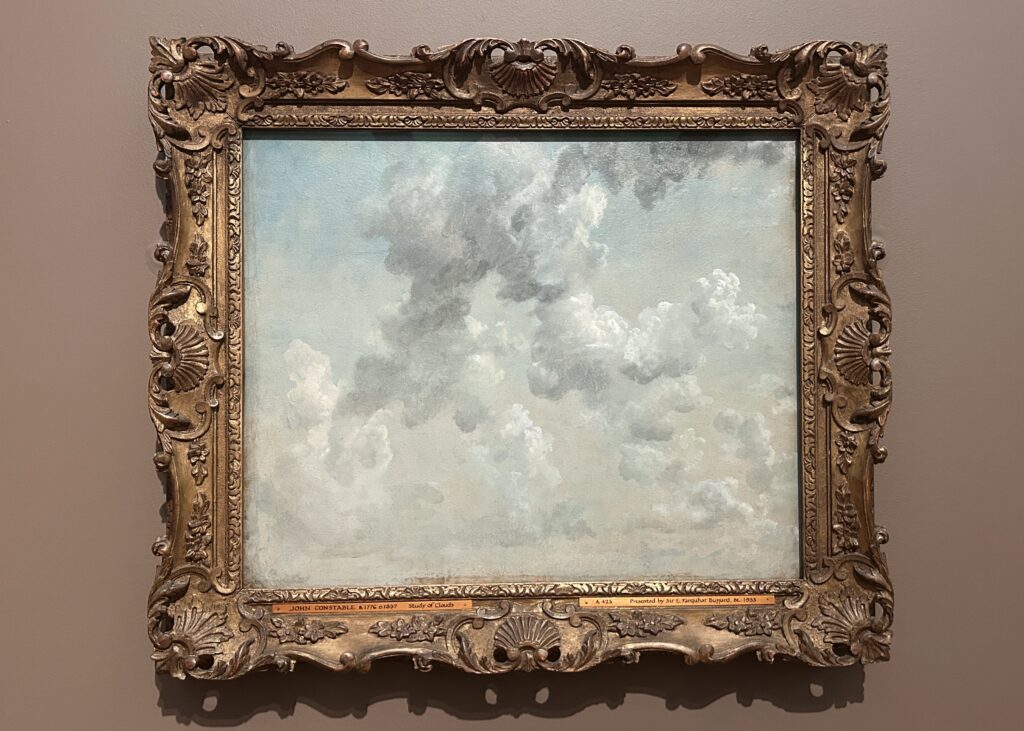
John Wyver writes: Technical troubles meant that I missed posting last weekend – apologies. But I’m back today with another group of articles that have engaged and interested me, along with — as a hommage to the changeable weather of the past few days — John Constable’s wondrous ‘Study of Clouds, 30 September 1822’, photographed at the recent Turner & Constable show at Tate Britain, but now presumably safely back with its guardians, The Ashmolean Museum, University of Oxford.
• Television returns: marking the reopening 80 years ago today of the BBC’s Television service from Alexandra Palace on 7 June 1946, Paul Hayes for the History of the BBC website reflects engagingly on the relaunch. This is a story that will also feature in my book about post-war television in Britain, but that is — well, at least four years away.
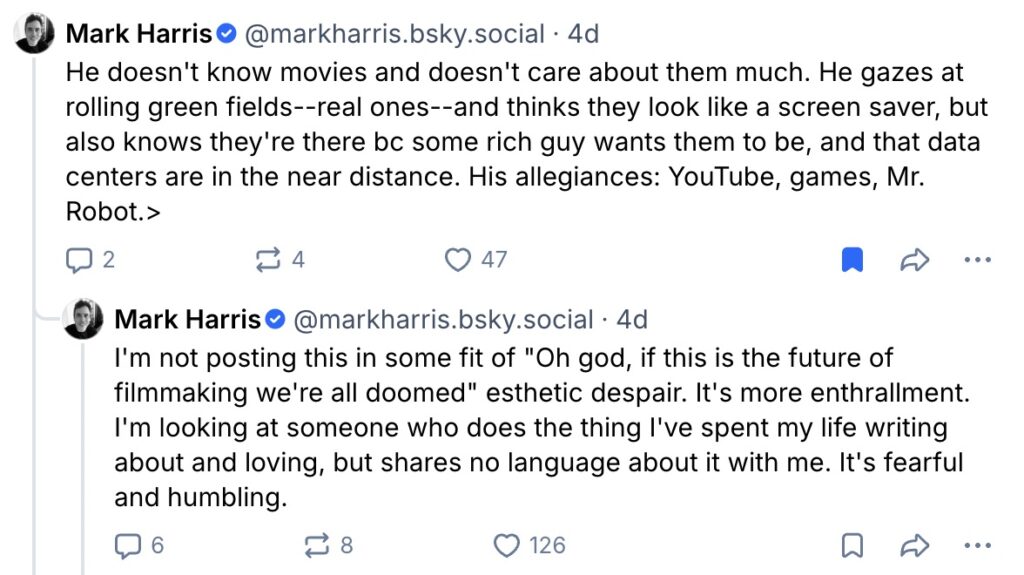
• From YouTube sensation to A24’s youngest director: a remarkable profile by Kyle Buchanan for The New York Times [gift link] of 20-year-old Kane Parsons, the filmmaker responsible for the smash-hit Backrooms; and related to which I was struck by a Bluesky thread from author Mark Harris, which includes this:
• Why Westerns still matter: I know it’s another article [and gift link] from The New York Times but I’ve been watching a whole bunch of classic Westerns recently, so I particularly appreciated Jason Bailey’s piece on a MoMA retrospective of some great contributions to the genre from Universal Pictures.
• Ozu in colour: a rich Every Frame a Painting video essay, made with TCM, by Tony Zhou and Taylor Ramos about the late films of Yasujirō Ozu:
• Hannah Höch’s fortuitous beauty: … and staying with MoMA, this is Samantha Friedman’s very fine recent essay about five photomontages made by the artist between 1921 and 1930.
• Why the American novel refused to grow up: Becca Rothfeld for The New Yorker [£; limited free access] ranges across the history of the novel in looking back to Leslie Fiedler’s ground-breaking critical work Love and Death in the American Novel, first published in 1960.
• Art for our sakes: a rather wonderful speech by Zadie Smith reproduced by The New York Review of Books [£; limited free access] in which she discusses, among other things, the writer’s responsibility to her times and The Known World by the great African American author Edward P. Jones; she concludes:
The Known World is not a novel about the invasion of Iraq. It’s a masterpiece about a corrupt system’s corrupting influence on everybody, including its primary victims. It has internal order. It’s beautiful and tragic. It is human, above all.
Reading it reminded me what humans are, what they are capable of, why they do the things they do, and why it is they leave so many things undone. It encouraged me to come here today and speak as I have. Such art is made by us and for us. It is for our sakes. Its power is not of the kind this president recognizes, but it has its own kind of force. It will outlast both him and his regime. It will outlast us all.
• ‘I can gauge John’s reaction: that’s good, stick that in’: Paul McCartney on how old bandmates – and Oasis – inspired his nostalgic new album: Laura Barton speaks with, and for the Guardian writes delightfully about, the 83-year-young musician…
• ‘I knew it was over for us’: the bands who got left behind when punk exploded: … and another recommendation for a music essay from the Guardian – Alexis Petridis’ read of the weekly music papers from 1976 which, he writes, is ‘a plunge into a past with which you feel weirdly unacquainted’ (h/t Billy Smart who wrote to me that,
it reminded my of Taylor Parkes’ useful observation that attentively critically watching old Top Of The Pops hasn’t got much to do with nostalgia as people commonly understand it, but is more like being a military historian.
• The 40 best Tony Awards performances of all time: here’s a hugely enjoyable rabbit hole for the rest of the day — a selection by Time Out USA‘s Adam Feldman of great awards show turns, including Patti LuPone in 2008:
• The ghosts of Antonio Gramsci: for The Nation [£; free access with registrsation], Aditya Bahl responds to Andy Merrifield’s Roses for Gramsci, which looks as if it is an essential read.
• The flow of time is ours to disrupt: not in any sense the easiest read, but I found this short essay productive – for iai news, philosopher Timotheus Vermeulen draws on the ideas of Walter Benjamin, along with a wide range of cultural references, to propose that instead of thinking of temporal experience as linear, orderly and forward-flowing we might consider it as ‘closer to clay on a potter’s wheel, something we can grip, turn and remould. ‘
• Squadrons of pigs: Stefan Collini’s overview for LRB [£; limited free access] of the many troubles facing Britain’s universities.
• Enshittification, despotification, and the open internet: Mike Masnick is very good for Liberalism.org on the past and a possible future for the architecture of the internet:
The real question is whether the underlying architecture creates incentives that concentrate power or that distribute it. It’s not about whether technology is inherently good or bad, liberating or oppressive. Architecture shapes incentives; incentives shape outcomes. And once you’ve built a chokepoint, the attempts to capture it will be relentless, because the payoff for whoever controls it just keeps growing.
• The end of books — what happened when a dumpster arrived behind my university’s library: a gorgeous essay by Sheila Liming for The Yale Review about the digital, Derrida (don’t be put off) and the decline of books.
• Magnifica Humanitas – doin’ the Vatican rag: who better to comment on the Pope’s recent encyclical about AI than digital guru Bill Thompson, still (thankfully) with the BBC but writing here on his personal blog?
It feels somewhat.. ironic (in the real sense of the word not the Alanis Morissette one) that the Holy Roman Catholic Church seems to be the most significant large organisation to speak out against the potential dangers both of AI and the US government’s slide into authoritarianism and repudiation of international law. And the Pope may not have many divisions but he does have over a billion believers.
• How Anthropic used AI ethics slop to play the pope and eclipse OpenAI: And if you still have the energy and interest for more reading about AI, the Holy Father, and much more, this is very good from Brain Merchant for Blood in the Machine [gift link].
• And finally…: Sadler’s Wells’ Dance Film Festival opened on Friday with a conversation with choreographer Damien Jalet and a screening of two films which feature his dances. One was the phenomenal STORM, directed by Romain Gavras and starring Swedish rapper Yung Lean.
Since STORM has racked up more than 14 million views on Youtube in the month since release, you have almost certainly seen it, although not was we were privileged to do on Friday — on a huge screen with the music played VERY loud. Jalet’s choreography features in a single, long-held shot towards the end. Here it is (with a content warning that it features some moderately violent scenes and threat):
Leave a Reply