
One more catch-up dozen
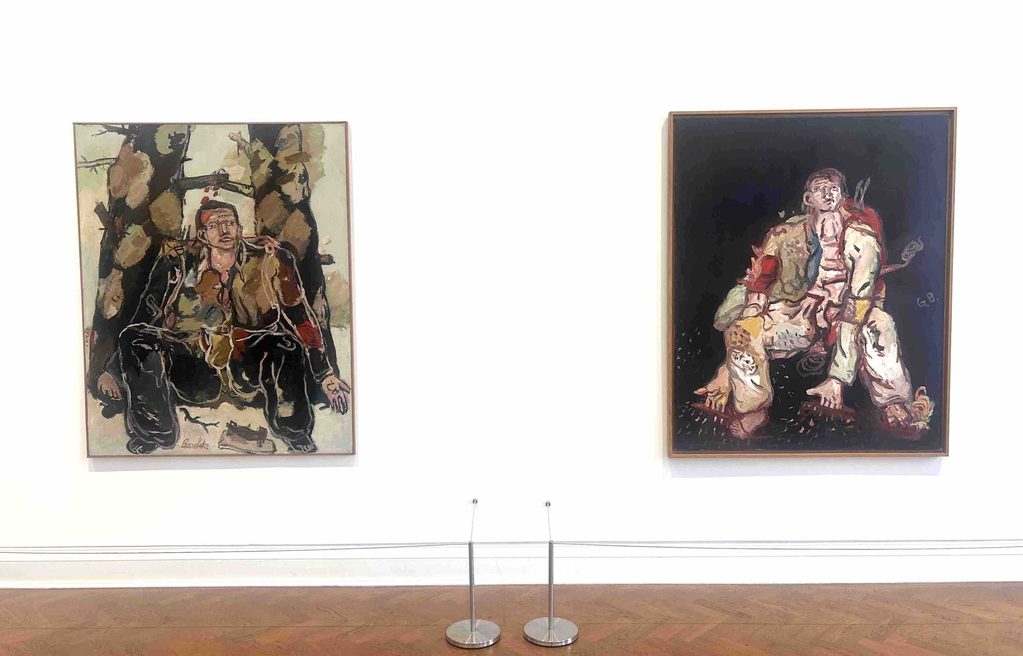
John Wyver writes: I am not doing very well with my supposedly weekly Sunday links, but here instead is a mid-week collection of articles and more that have caught my attention recently.
The image is of two paintings by George Baselitz in the wonderful exhibition ‘The Heroes 1965-66′ at Thaddeus Ropac in London: ‘Falle’ (Trap), 1966, on the left and, right, ‘Ein moderner Maler’ (A Modern Painter), 1966. The show is on until 18 December and I most definitely want to return, and perhaps even to write about these extraordinary paintings. As the gallery’s website states:
Rejecting both the prevailing optimism of the post-war era and the dominant artistic currents of the 1960s, [Baselitz] forged a singular figurative vocabulary through which to confront the realities of post-war German society and interrogate the place of the artist within it. The central motif of this series is a cast of monumental, ambiguous figures set within ravaged landscapes. They sit or stand aimlessly in no man’s land, displaced between past and present.
• The one that remembers also sings: Adrian Martin is very good on the first volume of the late Peter Wollen’s writings, Arrows of Desire: Selected Writings 1963–2002, new from Verso, which according to Martin embrace
the “modern movement” of the 1970s—the loose but (for a time) workable alliance of Marxism, semiotics, psychoanalysis, and feminism—while defining that movement in a capacious, highly historicized way, as a spiral continually returning to the breakthrough experiments of earlier 20th century developments in art and politics in various parts of the world.
• Avedon shows the scars, just not the photographer’s own: I really liked Ron Howard’s documentary which is now on Netflix, and this review by Naomi Fry for The New Yorker is a fine complement, pointing out that the film ‘largely skims over some of the knottier aspects of Avedon’s life. His tortured bisexuality is entirely evaded, and his two unhappy marriages are only briefly addressed, as is his clearly difficult temperament.’
• Watch these ballet dancers crack open a celestial realm: a beautifully rendered New York Times feature [gift link] by Gia Kourlas about the recently revived George Balanchine ballet ‘Pithoprakta’, danced by New York City Ballet.
• Inside the Archive #78: Getting to grips with copyright: a valuable resource – the talks from the BFI Copyright Conference earlier this year – ‘Bringing together archivists, rights specialists, researchers, technologists, and collection managers, the day explored the practical realities of working with copyright in screen heritage collections.’
• The 1956 Hungarian Uprising was a working-class revolt: a rich historical essay for Jacobin [£; but free registration] by Adam Fabry and Anita Zsurzsán.
• 1956 – End of Illusion: a terrific 10-part BBC Sounds series with David Runciman looking back at how Suez, Hungary and the American Presidential election all came together in November 1956.
• Why Brexit won’t go away: the latest post from Chris Grey, which is ever more essential reading given current developments in UK-Europe relations.
• ‘Nothing they said made sense’: down the rabbit hole with Britain’s sovereign citizens: a fascinating Guardian ‘Long Read’ by Mark Blacklock about a subject I knew nothing of.
• Across 8 Mile: exceptional journalism from James Meek in Detroit for the LRB [£; limited free access].
• The lucrative world of literary scams: published last month in The Dial, this is such an informative report by Snigdha Poonam about the e-mails that I and a hundred colleagues receive daily.
• Temperature zero for culture: why everything is starting to look the same: this important Substack post by Lauren Leek even got its own article in The New York Times [gift link] by Scott Reyburn, who writes that it ‘analyzed the “flattening” effect that predictive algorithms have had on music, movies, hospitality and almost every aspect of today’s consumer culture.’
• Reading after reading: an immensely rewarding cluster of essays from the scholarly Post45, introduced at this link by Ben Davies and Christina Lupton; as they write:
The authors in this cluster agree that we should not count on the reading of literary fiction in its traditional and analogue forms to endure. Yet they anticipate this displacement differently… In concert, these pieces are thoughtful without being mournful. They are not about the loss of literature, which continues to matter in all the ways one expects it must for literary critics. Rather, they register the deep history of the rhythms that analogue reading gave us; the ways of spending and freeing up time, moving through space, sequestering ourselves and being with others, reading with our hands before the promise that hands might be free of books.
• Ten years, thousands of staff and a billion dollars: the exclusive inside story of Grand Theft Auto VI: a terrific Guardian piece by Keza MacDonald.
• And finally… Dolly Parton singing ‘Light of a Clear Blue Morning’, back in 2003 but with a special resonance for the past days in the USA.
Leave a Reply