
A tale of an archival ‘Aha!’
John Wyver writes: To Falmer, near Brighton, for a visit to The Keep to dig into the Mass Observation Archive. I’m starting on the first stages of research for Switching On (title tbc), a kind of sequel to Magic Rays of Light: The Early Years of Television in Britain. The new book is intended to take the cultural history of the medium from the Second World War to the first night of ITV in September 1955.
Mass Observation carried out their own survey about television in 1949, and were also commissioned by Radio Rediffusion to ask customers about what they liked on the radio in 1949 and what they thought of television in 1955. As scholars including Helen Wood, Rachel Moseley and Tim O’Sullivan have recognised, the papers related to these projects are wonderfully revealing about contemporary attitudes to the emerging medium.
Although there are digitised riches from the MO survey in the extensive Mass Observation Online resource (accessible without a fee on terminals at The Keep and the British Library), I wanted to look at some of the documents that exist only as paper. (Note that Mass-Observation is hyphenated up to 1949, when it dropped the hyphen and was incorporated as a private company, Mass Observation (UK).)
In doing so I had one of those – relatively rare – surprising and rewarding archival ‘Aha!’ moments. Leafing through the contents of a folder otherwise dedicated to 1949, which was titled ‘Rediffusion Survey 1949: Background Material’ (reference SxMOA1/2/45/1, since you ask), I came across a batch of fascinating pages from 1938-39 that had clearly been mis-filed.
Nothing in the catalogue indicated their presence, and yet here were script drafts, studio plans and a letter about a linked pair of pre-war transmissions. Most precious of all, there was a six-page account by a M-O ‘observer’ of the Alexandra Palace (AP) studios at work. Taken together, the documents offer a vivid and in certain respects unique picture of two broadcasts from some two years in to the BBC’s high definition service.
Lambeth Walks Out and Lambeth Keeps on Walking
The first of these live broadcasts, Lambeth Walks Out, was a feature programme broadcast from AP on the evening of 26 September 1938. It recounted the history and celebrated the popularity of the dance known as ‘the Lambeth Walk’. A revised version was transmitted just over three months later, on the evening of 9 January 1939, as Lambeth Keeps On Walking. I wrote a blog post about the latter programme just over a year ago.
On both occasions the presenter was Tom Harrisson, a polymath who occasionally hosted AP broadcasts, as well as living a busy life as an explorer, an anthropologist, and a founding member of the pre-war M-O group.
My speculation is that the mis-filed papers about the broadcasts were Harrisson’s personal property, not least because the letter is addressed to him from producer Andrew Miller Jones. Somehow, they ended up in an entirely unrelated MO file, which nearly ninety years on is fortunate, since I do not think the scripts and studio plans, not to mention the ‘observer’s’ report, exist elsewhere. [* but see below in Comments]
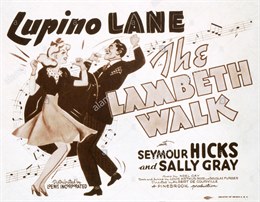
In a rich, detailed discussion of the Lambeth Walk and its media manifestations, including the 1939 feature film (above), Lawrence Napper in his book British Cinema and Middlebrow Culture in the Interwar Years, 2009, includes a proposed outline for Lambeth Walks Out that is preserved by the BBC’s Written Archives Centre. But I have not otherwise come across detailed camera scripts and studio plans for either this or the later broadcast (and of course as with all pre-war live broadcasts there is no recording).
Scheduled at 9.40pm on a Monday evening in the early autumn, Lambeth Walks Out began with an announcement over a caption card of the title:
Ladies and gentlemen, we present to you, Lambeth Walks Out. The programme will be compered by Tom Harrisson, whose Mass Observation of the British Islanders have provided us with a new kind of actuality. He will be accompanied by Noel Gay, the composer, who, with Lupino Lane, has put Lambeth on the map of the world.
The eye of television
Harrission picked up the narration, speaking over film views of Lambeth and accompanied by a barrel organ playing in the studio. He introduced the district and its people, before appearing in vision and speaking directly to viewers about how the Lambeth walk had in just six months affected the lives of millions. And he continued,
My own eyes have done their best to probe into the way in which this thing has happoned, but deeper than mine goes the eye of television. Let us follow that eye and look deeper. Let us start from long ago.
Which cued up a studio sequence of folk dancing, and then dancers doing ‘the lancers’ and, after, waltzing. These scenes were transmitted from AP’s studio A, after which the programme switched back to studio B for shots of a couple sitting smoking at a café table before rising and dancing together to ‘September in the rain’. Harrisson reflected on jazz and on social dancing becoming ‘a routine amusement’, before in vision once again he spoke these words:
The steps of the jazz dances are fairly simple, but behind them are the sentiments of the American Negro who has lost his own native community life and can never again see his own sort of village green. For twenty years now we have been providing the somewhat incongruous spectacle of the English people expressing the frustrations of industrial life through the idiom of Mississippi and the Gold Coast.
Segueing swiftly from the deep south and west Africa to the banks of the Thames, Harrisson suggested that ‘jazz was cut to fit the Cockney cloth’ and – somehow – the Lambeth Walk was born. By which point on screen a group of dancers in the studio were supposedly Cockneys enjoying a party supposedly in Lambeth. Lupino Lane (on stage that evening in Me and My Girl) was featured in a Movietone newsreel, as was Charlie Chaplin on film doing ‘the traditional cakewalk’.
As Harrisson said, a dance needed a song, and this cue brought Noel Gay into the picture for an interview. After which the programme also introduced Adele England, principal of the Locarno School of Dancing, who was said to have refined the movements into a ‘popular dance floor success’. Which she was happy to demonstrate before everyone in the studio joined in and the programme faded out to a repeat of the title caption.
Walking once again
For the revised programme in January, Harrisson made a number of modest script changes, including a reference to the events of the previous September in Munich, during which he claimed that ‘right in the height of the crisis, the Lambeth walk kept on making front-page news’. Songwriter Jimmy Kennedy also made an appearance this time, alongside Noel Gay and Adele England again.
Where the script of the second programme appears to differ most clearly from the first is in the greater detail included about the use towards the close of an Eddie Cantor recording for Decca of the Lambeth Walk, on which he spoke-sang,
What a happy old world this would be / If the leaders of nations would just agree / To make their people forget about war / And teach them the Lambeth Walk.
As, remarkably, you can hear towards the end of this recording:
Immediately after which, Harrisson signed off, just as remarkably, with
Hail and forward, democratic dances.
The M-O observer
There’s more analysis to do about these two scripts, and about the handwritten annotations by Harrisson throughout. Eventually I expect all this to become the focus of a conference paper or a journal article (and I’ve informed the archive about the mis-filing), but I want also here to highlight briefly the typewritten report by the M-O observer, identified only as ‘A.H.’, who visited AP for the transmission of Lambeth Keeps on Walking. At some point Harrisson must been provided with the copy preserved in the file.
The flatly-written account begins with journey on the BBC bus from Broadcasting House to AP. Aspiring throughout to a spare objectivity, the witness describes being met by ‘Miss Claire’, who has been delegated to show the observer the studio at work. In common with many other visitors to AP, the observer ‘gained the impression that the room was in a chaotic state’.
In conversation with Miss Claire the Observer [they capitalise their role] found that hitches frequently arose in this kind of work and that today delays had been particularly frequent. They were at that moment waiting for the engineers to finish their meal.
During transmission, the observer noticed that Noel Gay seemed more nervous than in the earlier rehearsal, and also that Jimmy Kennedy could not play the piano very well, although he did better in the broadcast than during the run-through. Staying on in the studio after the show, the observer also watched the Schubert Evening broadcast, in which ‘the fades in and out and the mixing was better done than in the Lambeth Walk programme’.
After which it was time for the observer to return to the streets of central London, but not before a general reflection that is as poetic as the neutral M-O style permitted:
Very impressed with the setting of the Palace itself. From the grounds had a fine view of a very wide area of London. Miss Claire told me that in summer on a fine day you can pick out the historic spots of the city with ease. The district itself looked interesting and very pleasant.
Every time that I read fresh Wyver ‘Me & My Girl’ scholarship it makes me wish ever more keenly that I’d seen the 1985 West End revival that ran for a whopping *eight years* at the Adelphi (especially with the original Robert Lindsay/ Emma Thompson/ Frank Thornton cast). ‘The Sun Has Got His Hat On’ and ‘Leaning On A Lamp Post’ were added to the songs. I must have walked past the theatre in the Strand hundreds of times when it was on. Did you ever see it?
I regret it now too, and I somehow doubt I’ll get another chance to see a major production. 3303 performances in that 1985-1993 run! But I was much too earnest then to go to musicals, unless it was the RSC’s Kiss Me Kate.
* Update: I’m grateful to a colleague who has researched in detail another pre-war programme presented by Tom Harrisson, who has mailed to inform me that in fact WAC holds copies of the scripts of both programmes, with some annotations. I shall pull out the relevant file when I next visit and provide a further update. I think the copy of the observer’s report that I read is unique.
Great archival find and incisive sociological article, shedding light on a post-Munich vogue for war distraction. The subject of how the ‘Lambeth Walk’ became popular, is an early documentation of how urban myth spread. Early M.O. surveys cover the idea that most people could not pinpoint the origin. A sound recording issued on record gives at least some idea of the original Lupino Lane production. The staged film sequences later shot by the BBC for demonstration are also notable and puzzling at once. Puzzling – as it seems like this one song carried most (but not all) of the popularity of the show, and captured the popular imagination. Anyone studying the era will find the popular music is not the myth of patriotic or sentimental war songs, but of catchy tunes.