
Back to the birth
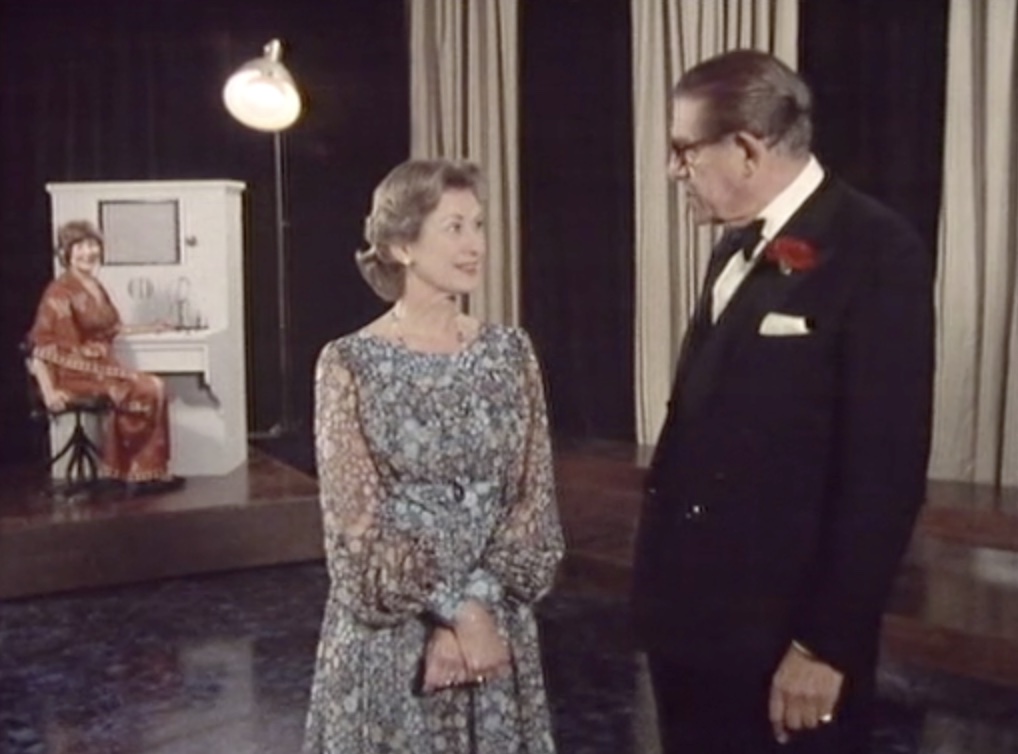
John Wyver writes: To mark Monday’s Centenary of television in Britain, BBC Four this week played two programmes from the archives, The Birth of Television from 1976 (a scene from which is above) and JLB: The Man who Saw the Future, a 2003 drama-documentary about John Logie Baird. Both are now on BBC iPlayer for a month (the programme titles are links there), and I thought it would be interesting to revisit them. Today’s post is about the 1976 film, and we’ll get to JLB in a future post.
We are now as distant temporally from the production of The Birth of Television as that process was from the January evening in 1926 when Baird gave the first public presentation of what he called ‘true television’. Fifty years is the span in each case, and that period, and fractions of it, meant that the film’s writer and producer Bruce Norman was able to interview many of the participants in the earliest events.
Indeed, the interviews in The Birth of Television are the reason it is so precious, even if in most cases the contributions are brief and anecdotal. But here in the flesh, as it were, are journalist Bill Fox, present at the January 1926 presentation and later the Baird company’s first press officer, and Baird’s first engineer Ben Clapp.
There are early performers including Gracie Fields and Arthur Askey; the announcers at Alexandra Palace, Elizabeth Cowell and Jasmine Bligh, as well as Leslie Mitchell, who presents the programme; and central technical figures, including Douglas Birkinshaw, Tony Bridgewater and cameraman John Bliss.
Perhaps most valuable, because they figure less prominently in other recountings of this story (including I have to admit, Magic Rays of Light), are the men who developed electrical television at EMI, including J.D. McGee and Bernard Greenhead. Towards the close, Margaret Albu, identified in the film as ‘Mrs John Logie Baird’, makes a telling contribution.
Many of these interviews in longer forms were drawn together in Bruce Norman’s later book Here’s Looking at You: The Story of British Television [link to an online copy at Internet Archive], published in 1984 by the BBC and the Royal Television Society, and still, despite a number of inaccuracies, a key source for the story of British television through to 1939.
The framework for the interviews is an uneasy mix of technical exposition and variety show. Ben Clapp, for example, gives a detailed demonstration of Baird’s early mechanical system, and J.D. Percy guides the viewer through the complexities of the Intermediate Film Process as installed in studio B at the start of operations at Alexandra Palace. One of the surviving studios at AP also provides the location for the linking scenes.
Juxtaposed with the technical sequences are extended performances by, among others, ‘our Gracie’, who shows what a trouper she was by performing ‘Nowt about owt’ in full, and Arthur Askey, giving us his signature ‘Bee song’. There are also three male singers impersonating the trio The Three Admirals, who performed in the earliest broadcasts from AP to Radiolympia.
Much of the rest, alongside the technical expositions, is anecdotal, pleasing in its way but lacking any more expansive context. And there are lazy errors, some of which have since become encrusted in the history, such as the description of The Man with the Flower in His Mouth, 1930, as ‘Britain’s first television play’, and the characterisation of Cecil Madden, a key if at times unreliable witness to the AP broadcasts, as ‘the first television producer’.
Regulars here will know that Magic Rays of Light identifies Box and Cox, 1928, as the first drama made for British television, and establishes both Harold Bradly and Eustace Robb as taking the producer role well before Madden. Both Bradly and Robb worked with 30-line television, consideration of which is included in The Birth of Television, but with minimal recognition of the developing complexity of its output.
Indeed, actual broadcasts have a minimal presence in the film, which in one sense, because of the absence of recordings from the pre-war years, is understandable. As Leslie Mitchell observes, ‘All we have is some old film and a few photographs – but who do survive are people.’
Yet what is in fact a really extensive photographic archive covering the pre-war years has only a minimal presence, and overall there is scarce indication of the range, the complexity and the sheer achievement of early television, whether in its 30-line form or as the high definition service from Alexandra Palace.
In this failure to engage in detail with the actual output, The Birth of Television follows Asa Briggs’ earlier chronicling of this history, at the same time as it reinforces an understanding that has largely dominated attitudes across the succeeding five decades.
The culmination of the documentary is the May 1937 outside broadcast of the Coronation procession, for which archival film exists. And inevitably the documentaries Television Comes to London, 1936 and the BBC Television Demonstration Film, 1937, are drawn from extensively. On occasion too, The Birth of Television falls back on some basic and almost inevitable under-resourced dramatised reconstruction.
The one early programme that is considered in some detail is the twice-weekly show Picture Page, with a reconstruction of Joan Miller at a mock-up of the familiar ‘switchboard’, then Miller herself talking about her experiences. Which leads into Leslie Mitchell and Dinah Sheridan, who is excellent value as a vivid interviewee, relishing a stand-up exchange about what it was like to be interviewed, all done in the style of Picture Page itself (see header image).
The Birth of Television, then, is a curious, in some ways valuable, and yet limited document that fifty years on remains of considerable interest, as long as it is approached with modest expectations and a degree of caution about a number of its assertions.
Leave a Reply