
BBC Ibsen 1: the archive
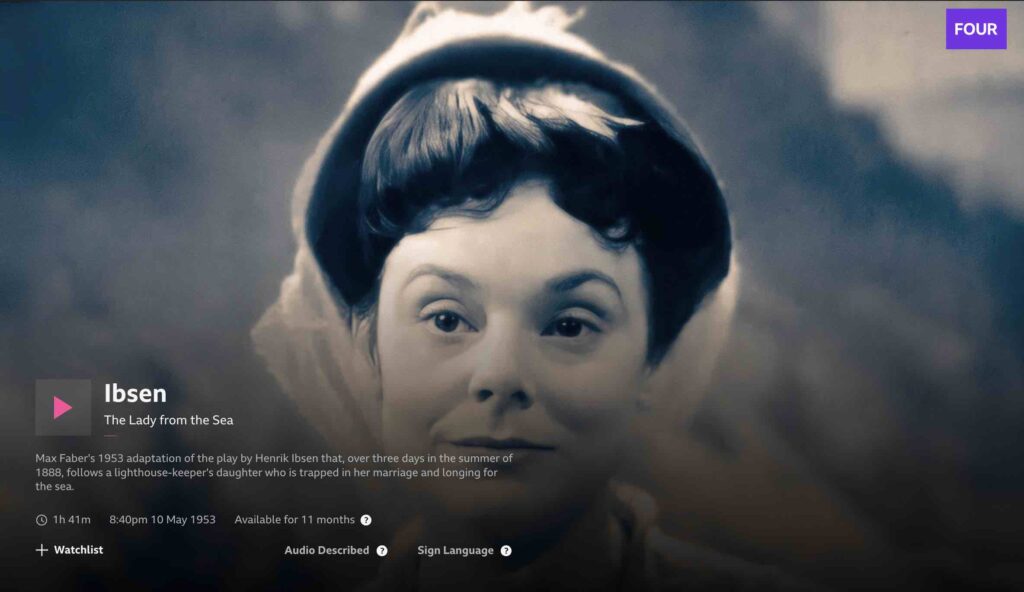
John Wyver writes: Sunday on BBC Four and BBC iPlayer saw the start of a thrilling season of classic dramas by, and documentaries about, Henrik Ibsen. The full programme, to be broadcast over the coming weeks, is now available for streaming for the next eleven months (and hopefully with an extension), and there are riches galore. The offerings come from five decades from 1953 onwards, and some are true rarities; a number of the productions have not previously been accessible since transmission; and there is at least one remarkable restoration.
Those appearing on screen include Judi Dench, Anthony Hopkins, Ingrid Bergman, Michael Gambon, Kenneth Branagh, Juliet Stevenson, Jenny Agutter, Patrick McGoohan and many more. Production talent includes Waris Hussein, Elijah Moshinsky and David Thacker. For viewers interested in television drama and theatre history, this is a peak ‘high art’ offering. So given that television these days provides few such cultural treats, why is the corporation not making more of a fuss of this?
First, let’s look a little more closely at what is included. There are thirteen full-length dramas, with a pair of productions of Hedda Gabler, The Master Builder and The Lady from the Sea, together with productions of A Doll’s House, Little Eyolf, An Enemy of the People, Ghosts, Peer Gynt, The Wild Duck and Brand.
Of the major plays that means we are lacking only Rosmerholm, a production of which was broadcast live in July 1947, but not recorded, and Pillars of Society and John Gabriel Borkman, neither of which, as far as I can see from my initial research, has been broadcast by BBC television.
A number of the recordings in the collection were released in a 2007 BBC Video/2 Entertain DVD box set, although I believe this was only available with Region 1 encoding in the USA and Canada. A 1953 The Lady from the Sea with Irene Worth, however, has not been previously released (see header image). This is one of the earliest full-length BBC television plays to have been recorded, and has been enhanced by a sensitive digital restoration.
Two other productions, both from 1972, are I think similarly available for the first time since their original transmissions. (I’m tentative about much of this, as it’s hard to track releases of this kind, and I’m all too aware that I may have these things wrong; the inevitable corrections are welcome as Comments below.) One of these is Hedda Gabler with Janet Suzman and Ian McKellen; the other is Peer Gynt with Colin Blakely, Wendy Hiller and Francesca Annis.
Equally welcome in the iPlayer collection are three complementary documentaries. One is a programme from Ronald Harwood’s 1984 series All The World’s a Stage, which situates Ibsen in the context of contemporaries including Shaw, Strindberg and Wedekind. Certainties and Doubts is Colin Nears’ 1979 study of Ibsen, and is one of his elaborate celebrations of European Romanticism, which it will be fascinating to revisit.
Perhaps rarest of all is a 1964 drama-documentary, Summer in Gossensass, written by esteemed Ibsen translator and biographer Michael Meyer and Finnish director-producer Casper Wrede, with Norwegian poet and actor Claes Gill as the playwright in his early sixties (and incidentally Rodney Bewes as ‘Young Ibsen’). This too appears to have been digitally restored for this outing.
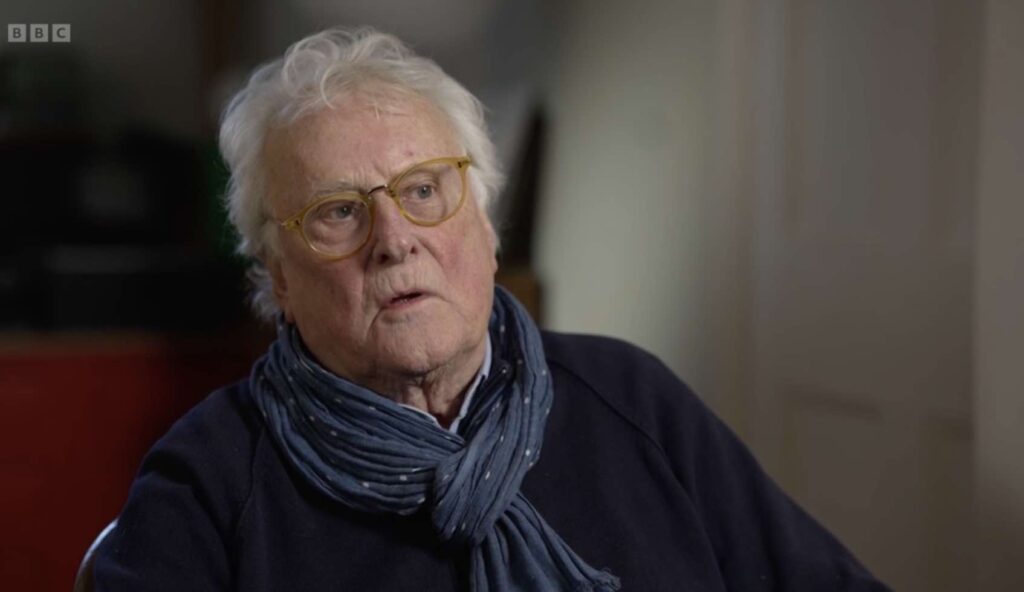
There is also a short, typically intelligent introduction to the collection by Sir Richard Eyre (above) as a Remembers… episode. Introducing a selection of extracts, he reflects on questions of translation, on the morality, patriarchy, and the social questions underpinning the plays, and on their ambiguities and paradoxes. As he says, ‘Almost every drama that you see on television nowadays owes something to Ibsen.’
What’s not here? There were seven live transmissions of Ibsen plays before the 1953 Lady from the Sea, including part of a 1937 West End production of Ghosts with Marie Ney and a 1950 Master Builder with Roger Livesey. All of these pre-date the introduction of tele-recording.
Peter Ustinov was Peer Gynt in 1954, and at least one half of this survives, and I don’t know about the status of A Doll’s House from 1958 with Mai Zetterling. I’m similarly unsure about whether or not there is a recording of the 69 Theatre Company production of When We Dead Awaken with Wendy Hiller, which was transmitted in 1970.
Nor, of course, can a project like this offer us the riches of Ibsen on ITV, which I detailed back in 2011 for a Screen Plays blog post which remains on line. These include a truly remarkable film version of The Wild Duck with Dorothy Tutin from 1957 which deserves to be far better known (and which I wrote about here), and a John Osborne version of Hedda Gabler with Diana Rigg and Alan Dobie, which was released as a Network DVD.
An additional enhancement to the iPlayer collection might also have been the availability of some of the numerous BBC radio productions of Ibsen, eight of which were included on the North American DVD box set noted above. But of course every one of these productions, whether for the screen or audio, needs to be cleared for these new forms of release, and this is a process that takes time and resources.
Given that a great deal of energy and effort has gone into making the BBC Four and online collection possible, why is the BBC not making more noise about it? I have not seen a press release, for example, nor was there any kind of launch, whereas I would have thought the restored Lady from the Sea, shown perhaps in conjunction with the BFI, could have attracted attention.
Nor, beyond the short interview with Richard Eyre, is there any kind of contextual material online, Even the credits for the productions are, as is standard for iPlayer, hidden away on separate programme pages. Why did the corporation not commission online writings about the productions, or seek to place a supportive press story or two?
Even restricted to just a year’s availability, the collection itself is a great resource for education in secondary schools and universities, and in drama schools and other learning contexts. But with additional elements and links it could have been so much richer and more useful.
If I was cynical, I might think that the BBC was embarrassed by the gap between the provision of these classic dramas in the past and the desperate paucity of such work in the schedules of recent years. The idea of BBC Two or Four presenting a major new Ibsen drama, perhaps drawn from a sparkling theatre production like the recent Orange Tree Hedda, adapted by Tanika Gupta with Pearl Chanda, is simply unthinkable.
Which is all part of the BBC television’s lack of interest in and engagement with theatre, as Lyn Gardner has highlighted in The Stage this week, and with the arts more generally. Open now is the government’s consultation on the future of the BBC, and I can only urge you to respond to this with your thoughts on this and other topics.
Meanwhile, in future posts here I propose to contribute more detailed responses to a number of the individual production, beginning with The Lady from the Sea, which I also first wrote about some fourteen years ago for the Screen Plays blog.
The 1972 Hedda Gabler was repeated as part of the fiftieth anniversary of BBC Television celebrations in 1986.
“a production of [Rosmersholm] was broadcast live in July 1947, but not recorded” – but, more to the point, a 1965 production made by BBC Scotland for the Theatre 625 BBC2 strand (starring Peggy Ashcroft as Rebecca West) does.
The other surviving productions missing from the collection are –
1954 Sunday Night Theatre: Peer Gynt (2 parts)
1962 Ghosts
1968 Hedda Gabler (Welsh language)
1993 Performance: Hedda Gabler
There were also two Open University productions of entire acts from Peer Gynt and The Wild Duck in 1977.
I’m not sure about your taxonomy of “the major plays”. Most Ibsen scholars would say that there were fifteen of them – Brand, Emperor & Galilean, Peer Gynt and the final twelve prose plays (from Pillars Of Society – When We Dead Awaken).
I knew you’d be able to help with further details, Billy – thank you! But Emperor & Galilean as one of the major plays? Really?
It’s intriguing that the 1993 Performance: Hedda Gabler is not included in the online collection. This was a television version of Deborah Warner’s stage production with Fiona Shaw. Maybe there were felt to be too many Heddas, or maybe they were unable to clear the rights.
This must be the last Ibsen shown on television, which means that it has been 32 years since there was a new television production of one of his plays.
Also not featured in the online collection is the 1964 BBC1 broadcast of Peer Gynt – The Ballet, ‘freely adapted from the drama by Henrik Ibsen’ with choreography by Vaslav Orlikowsky. According to BBC Programme Index, this London Festival Ballet Production was ‘adapted and produced for television by Charles R. Rogers’.
https://genome.ch.bbc.co.uk/6325d4c1fc9f4615959c68449962bcbf
The archival status of this is uncertain.
Emperor & Galilean is *later* than Brand and Peer Gynt. The three plays are generally considered Ibsen’s mature works in that epic mold, before he went on to write the twelve naturalist prose plays on which his fame largely rests. All three were primarily intended to be read. I have seen all three on stage and wouldn’t especially want to do so again.
And now, as of lunchtime on 29 January, there’s a press release:
https://www.bbc.com/mediacentre/2026/henrik-ibsen-plays