John Wyver writes: Some 18 months after its start, the official BBC Television service from Alexandra Palace was still struggling to attract viewers. On Thursday 2 June 1938, the Daily Telegraph’s well-informed radio correspondent L. Marsland Gander penned a detailed analysis of the challenges facing the Corporation’s new venture. As he wrote:
Judging from the criticisms that reach me, the BBC is still failing to please its television audience with any consistency. I think there may be a two-fold reason for this.
In the first place, although only two or 2 1/2 hours of transmission are given daily, the BBC is attempting to squeeze in items to appeal to all tastes. Secondly, the BBC programmes are so often built on more earnest and less popular lines than the typical cinema bill.
As an alternative to the impossible effort to please everybody, I suggest that it would be better to seek a common denominator and cater for the majority.
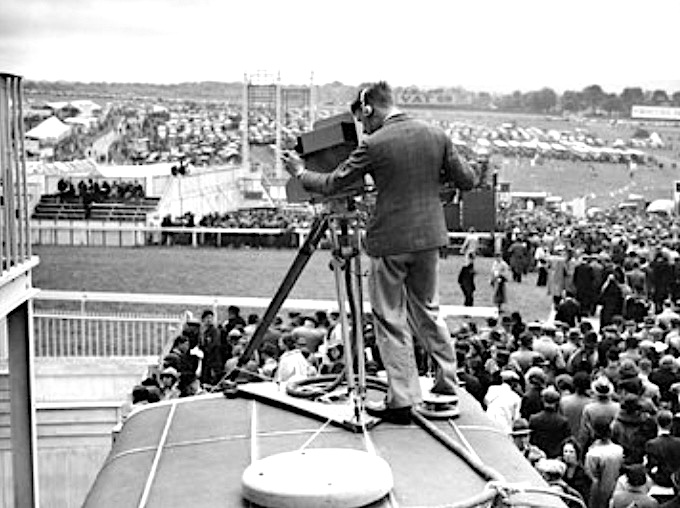
John Wyver writes: For nearly 50 minutes on the afternoon of Wednesday 1 June 1938 viewers in London were transported to Epsom for Derby Day scenes including limited shots of the race itself. But the broadcast was not seen solely on domestic receivers, since it was one of the first BBC broadcasts to be relayed to two large-screen ‘cinema projection’ systems.
‘The greatest thrill since we heard Al Jolson’s voice in the first talkie,’ was one journalist’s verdict after seeing, thanks to a Baird projector, the climax of the race from the comfort of a seat in the Tatler Theatre in London’s Charing Cross Road.
Across town, some 600 invited guests, seated in the Deco splendour of the Derry & Toms department store, also watched the unfancied Bois Roussel, making only the second start of his career, produce an astonishing burst of speed in the final furlong to win by four lengths. This rival Kensington screening employed the Scophony system, and was received similarly positively, despite one of the BBC’s three cameras having failed and a second operating well below its best.
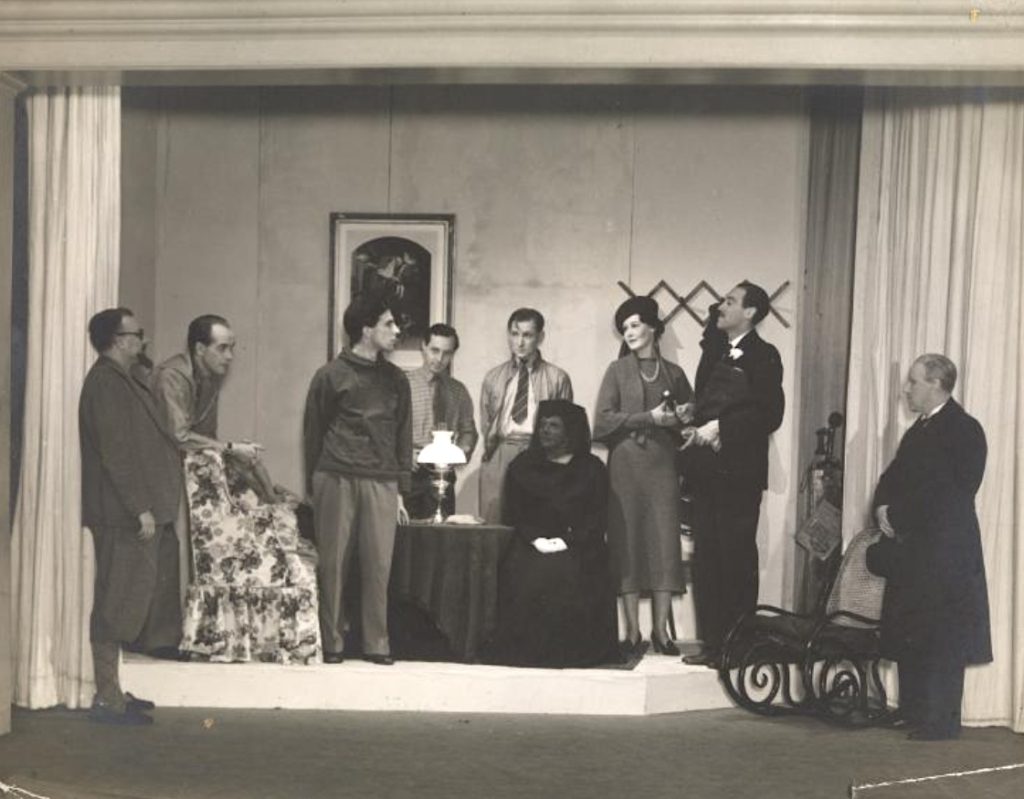
John Wyver writes: Unbilled in Radio Times, and so clearly organised at very short notice, in the afternoon of Monday 31 May 1937, AP broadcast a half-hour of scenes from Rupert Doone’s Group Theatre production at the Little Theatre of The Ascent of F6 by W.H. Auden and Christopher Isherwood.
Only a little over six months after the start of the official BBC service, producers were still scrabbling around for theatre shows that they could tempt in front of the cameras, and work from the theatrical fringe like the Little Theatre was easier to access than West End fare.
A key producer of modernist drama, the Group Theatre had been founded in 1932 by Doone and Robert Medley. In a rich Guardian article from 2023 (which includes a discussion of The Ascent of F6), Sam Kinchin-Smith characterises the enterprise as
one of the motliest and most distinctive gatherings of British and Irish genius of the first half of the 20th century, a dynamic collaboration between artists who transformed their fields and changed the course of modern literary, musical and artistic history.
And among those artists in the 1930s, in addition to Auden (who was a mainstay) and Isherwood, were writers T.S. Eliot, Christopher Fry and Louise MacNeice, composer Benjamin Britten, and designers Duncan Grant, Henry Moore, John Piper and Graham Sutherland.
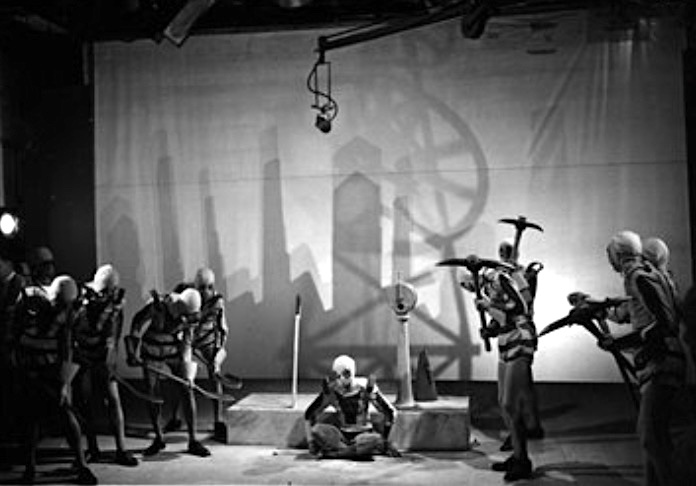
John Wyver writes: On Tuesday 30 May 1939 viewers could watch Jan Bussell’s 87-minute production of Arnold Bennett’s drama The Great Adventure in the afternoon and then, presumably in the other studio, an 82-minute adaptation of the Czech writers Karel and Josef Čapek’s satire The Insect Play in the evening.
Malcolm Baker-Smith’s settings, which clearly made imaginative use of the shadow projection system known as the ‘penumbrascope’, can be seen in these production photographs, as can Hugh Stevenson‘s striking costumes. Stevenson was better-known as a costume designer for ballet, and he worked frequently with choreographers Antony Tudor and Andrée Howard, both AP regulars, and the latter of whom provided dances for The Insect Play.
John Wyver writes: Although director of television Gerald Cock initially envisaged feature films being central to the schedule from Alexandra Palace, British and American producers and distributors refused almost without exception to supply product of any kind. Recognising television as a rival, and being especially concerned about broadcasts being screened in pubs and restaurants, the mainstream film industry refused all co-operation, and would not even permit Cock to screen trailers.
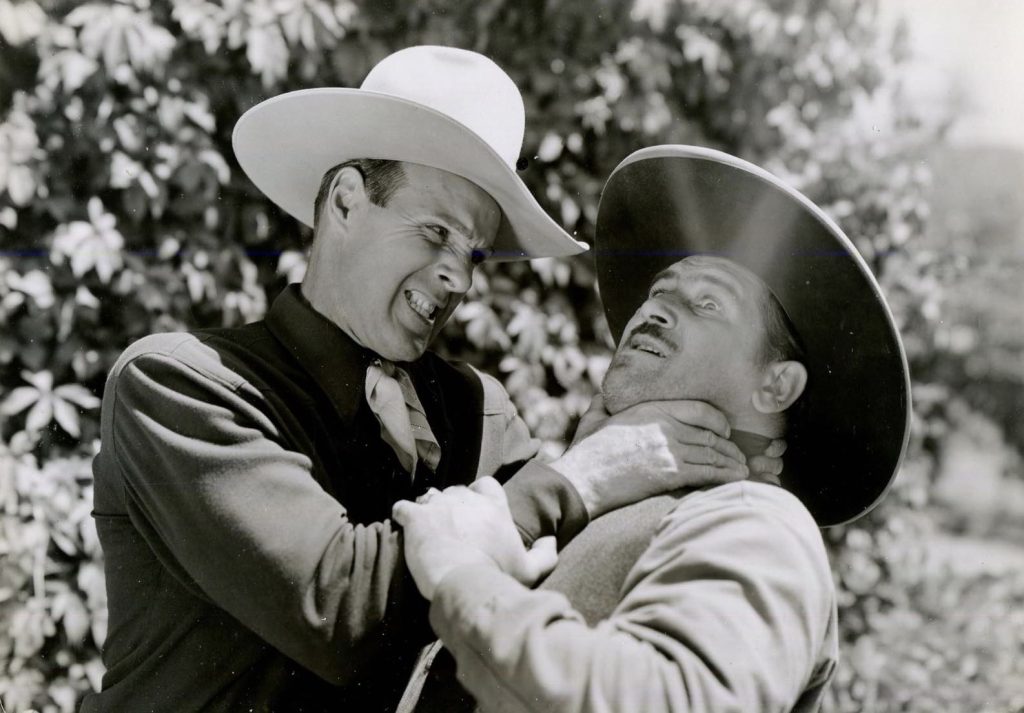
Among the handful of films shown by pre-war television were five low-budget westerns acquired from the tiny producer-distributor Exclusive Films, which also supplied shorts to AP. Two of these oaters starred Harry Carey and three featured the all-but-forgotten Kermit Maynard, including The Fighting Texan, shown on the evening of 29 May 1939. As Wikipedia details,
The story follows rancher Glenn Oliver [Maynard, natch], who has been noticing a decrease in his horse population, while a nearby ranch is getting more and more horses.
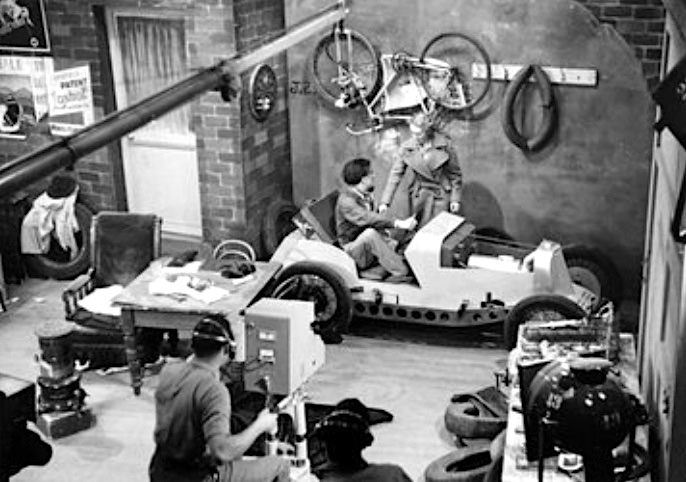
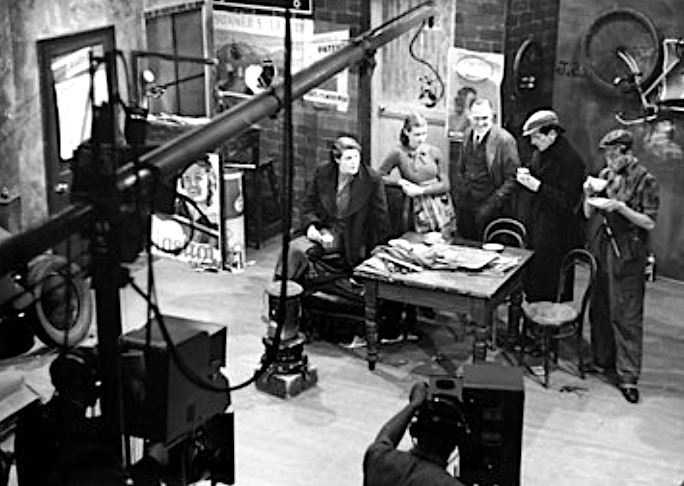
John Wyver writes: The idea of a Sunday evening play from Alexandra Palace was well-established by 28 May 1939 when the schedule was given over to Nicholas Phipps‘ crime drama First Stop North. Charles Hickman’s production, with the author in a key role, had been playing for a week at the King’s Theatre, Hammersmith, and what was clearly a relatively elaborate set, designed by Roger Furse, was de-rigged and re-assembled in less than 24 hours.
Set in a garage north of London that specialises in re-purposing stolen cars, the drama sounds as if it might have been a rare slice of pre-war televisual social realism. ‘E.H.R.’ in the Observer praised it as ‘good entertainment’. The author was celebrated for his contributions to revues, including for television, and in the late 1940s and 1950s, he scripted a run of British film comedies including Doctor in the House (1954), together with three sequels, and The Captain’s Table (1959).
The drama is notable for being one of series played by a repertory company run by Wilson Barrett and Esmond Knight, who also had a role in First Stop North. Presenting 24 plays on a weekly basis between January and July 1939, the venture appears to be been a moderate artistic success, although not an especially profitable one.
[OTD post no. 162; part of a long-running series leading up to the publication of my book Magic Rays of Light: The Early Years of Television in Britain in January 2026.]
John Wyver writes: The Saturday evening schedule on 27 May 1939 was taken over by a production of George H. Grimaldi’s drama Behind the Schemes. The scene was laid in the publicity office of Fleet Street’s (imaginary) Daily Quiver, and for the Times critic the play ‘did not have a dull moment’.
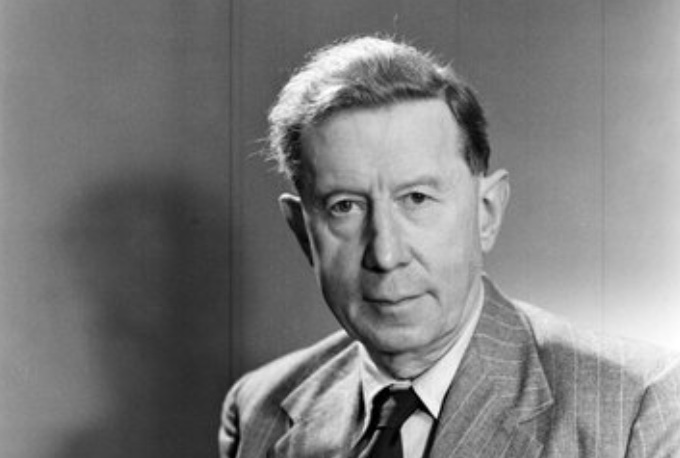
The play had been given at the Richmond Theatre in the autumn of 1938, which is presumably how it came to the attention of AP drama producer Fred O’Donovan (above, in 1951), who the Times writer was happy to credit with the transmission’s success:
Mr Fred O’Donovan thinks in terms of his cameras, which means that viewers never think of them, but only of the story, and his production had pace and clarity.
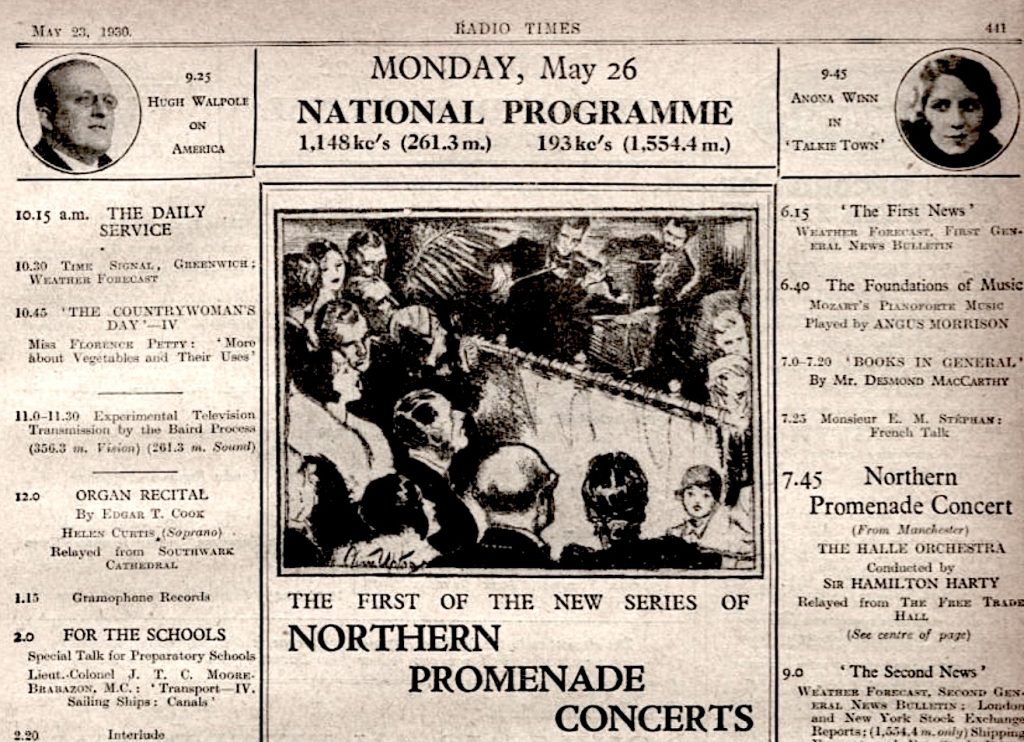
John Wyver writes: By the late spring of 1930 Baird Television Ltd had been transmitting thrice weekly half-hour variety bills for around 18 months. The 30-line images were very basic and the service’s profile can be judged from the minimal visibility in Radio Times, halfway down the left-hand column, of the broadcast on the morning of Monday 26 May: ‘Experimental Television Transmission by the Baird Process’.
Although Radio Times provides no details, the Programme-as-Broadcast record details that this show featured musical comedy artist Nancy Fraser and comedy entertainer Doris Palmer, along with Dorothy Gadsden and Richard Hughes in ‘duets’. That’s the magic word, which appears for the first time on this day in the Baird listings and suggests that the system was by this point sophisticated enough to feature two figures on screen together.
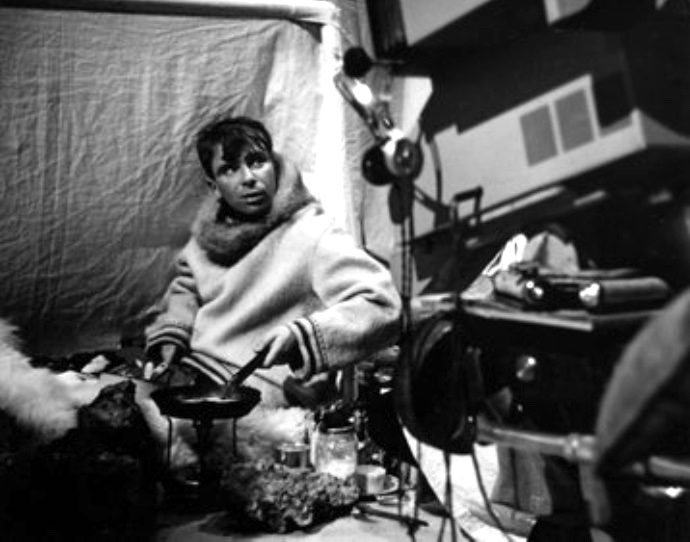
John Wyver writes: At the heart of the evening schedule on Wednesday 25 May 1938 was a 25-minute talk by Reynold Bray illustrating the conditions in which he lived for two summers in Arctic Canada. As can be seen above, a replica of 2-metre long tent was set up in the studio and Bray sat in his fur coat surrounded by his stove and the stuffed birds he was there to collect. He was assisted in this by Patrick Baird, who had accompanied him on various expeditions.
An obituary in Nature in March 1939 noted that Bray was ‘an Arctic explorer of considerable achievement and much promise.’ But it continued with an explanation of events soon after this broadcast
In 1938, Bray planned with P[atrick] Baird to continue his exploration of the western coast and the interior of Baffin Island. Ice, however, interfered with the ship’s progress and eventually the two men were landed on the south-east of Melville peninsula, whence they set off in their boat last August in an attempt to reach Igloolik Island, 300 miles to the north at the eastern entrance to Fury and Hecla Strait. Some forty miles south of the island, on September 14 last year, Bray was blown out to sea in a canvas boat and lost.
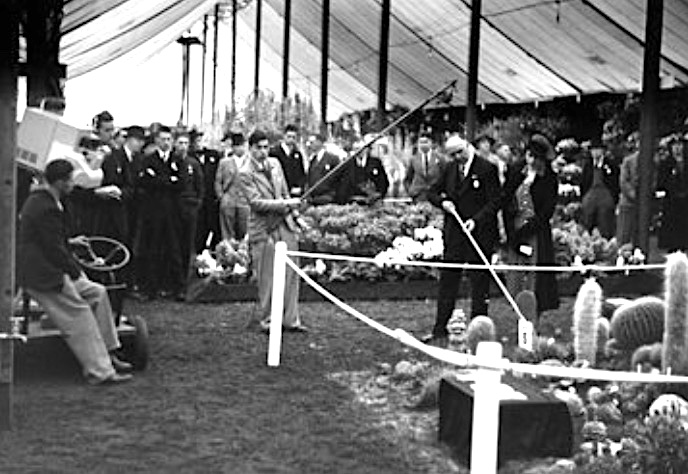
John Wyver writes: Just as for the BBC’s coverage this week, 87 years ago the corporation’s mobile unit visited Chelsea Flower Show (above) for three broadcasts, beginning with a 40-minute broadcast on Sunday 22 May with Freddie Grisewood and Elizabeth Cowell, along with television gardener Mr Middleton, looking at the construction of various gardens.
The team returned the next afternoon for a half-hour transmission, with Mr Middleton interviewing various exhibitors, and on Tuesday 24 May a 20-minute show late morning featured a discussion of flowers in the East Tent (likely the scene in the image above), as well as consideration of topiary and garden furniture.
The Times approved:
Television afforded a new delight to viewers last week, when they were taken by Mr C.H. Middleton on a personally conducted tour of the Chelsea Flower Show. Mr Middleton always gives the impression that he has come straight to the microphone with the mud still clinging to his boots, and this time we could see him in a real garden [as opposed to patch of ground taken over near the AP studio] and enjoy to the full the easy informality of his talk.
The visit to Chelsea on Monday was especially interesting, for not only did we have glimpses of busy workmen creating the gardens before our eyes, but some of the most famous exhibitors were brought before the cameras to tell us about their exhibits and to show them to us.