
Dear BBC Archives…
In a way, you’re spoiling us – and we’re grateful. ‘Us’ being the nerdy types fascinated by television’s deep archive. For so long, because of rights restrictions and a general lack of interest, television’s history, beyond select monetisable shows like Doctor Who and Dad’s Army, remained largely inaccessible. But now programmes that I had barely even heard of are popping up on BBC Four and, for shorter or longer periods, on BBC iPlayer.
There is a collection of Screen Two dramas and a ‘Classic Comedy’ grouping with treats like The Fall and Rise of Reginald Perrin from 1976. There are remarkable time capsule documentaries like Special Enquiry: A Girl Comes to London, 1956, and The Evacuees, 1979.
Mike Leigh’s great Nuts in May was recently made available in a dazzling new digital upgrade. So too was the Dennis Potter series The Singing Detective. Bravo. And revelatory new releases this past month have included the Ibsen drama The Lady from the Sea, 1953, as part of a compendious and glorious Ibsen collection, and BBC television’s first commissioned opera, Arthur Benjamin’s Mañana, 1956.
It’s genuinely wonderful to have these programmes available again, and looking as good or even better than on their first transmission. But…
I’m truly distressed at how little respect you give to these programmes. Not in technical terms, since it is clear that real care and resource has gone into making the digital prints as excellent as they can be. But rather in their online presentation, and in the lack of any attempts to showcase them, to create an audience for them, and to offer context and understanding and discussion, both online and off.
My case study here is Mañana, since it is the most recent, and because it very specifically highlights the problems. On the iPlayer web page, the viewing link is accompanied simply by the sentence, ‘Broadcast on 1 February 1956, composer Arthur Benjamin’s Mañana was the first opera commissioned by the BBC.’
Not a word else. If you hunt out the ‘Programme website’ link (bottom left, below the ‘More like this’ recommendations — including Wogan and Radio 2 Live; really?), the information there reads in full, ‘Broadcast on 1 February 1956, composer Arthur Benjamin’s Mañana was the first opera commissioned by the BBC.’
That’s it. No note about the plot or the setting. No cast list. Nothing about the production team. Not even a still or framegrab on either page. And when Mañana was shown late on Sunday, there was no introduction to the programme, and the verbal presentation link drew attention only to the transmission being exactly seventy years from the first showing.
That is really no way to treat an archive treasure like this. Especially one that is as obscure and as precious as is Mañana.
Nor is it a way to stimulate interest. Or to build an audience. Or to score any press attention. Or to attract people who might be curious enough and stimulated sufficiently to become more fully engaged with television’s archive. Or indeed simply to show respect to a significant fragment of broadcasting history, and of cultural and social history more generally.
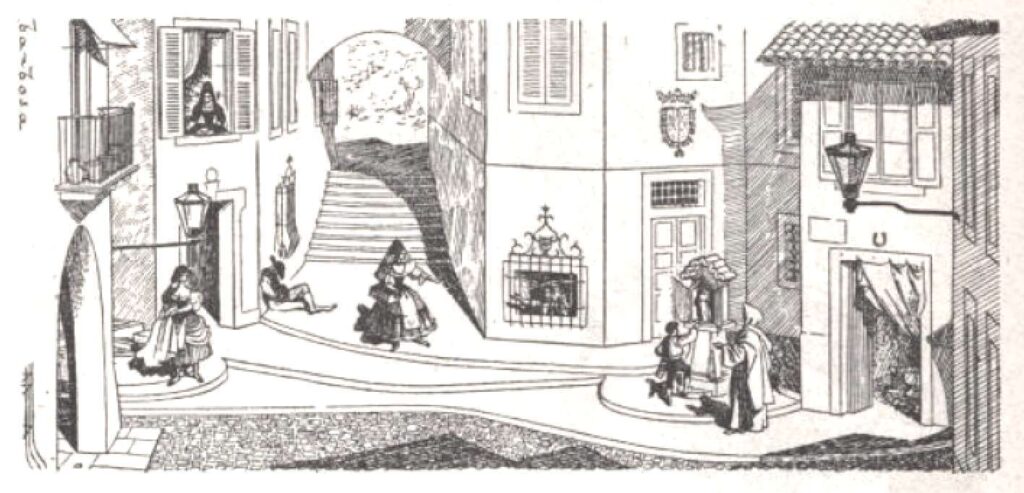
Over three blog posts this week, I have used easily accessible online elements to research and write about the backstory of the opera, the production as television, and its reception. I’ve drawn on Radio Times elements associated with the first transmission, including the drawing used as the header here, and I’ve looked up the careers of some of the production’s key figures, including composer Benjamin, librettist Caryl Brahms, and soprano Heather Harper. Creating the three posts has taken about a (most enjoyable) day of my time.
My firm belief is that information of this kind significantly enriches anyone’s appreciation and enjoyment of the opera. So why isn’t even a little of this offered online alongside the programme link? Or on another BBC web page?
More generally, why does the BBC not make more of significant presentations like this? Why is there no press release? Why did no-one try to prompt a press article, if not in the Guardian then in BBC Music Magazine or Gramophone? Why were the host of opera and modern music blogs not alerted? Why is there no related social media? (Apologies if I’ve missed any of these.)
Why was the digital restoration of the master not screened as a special event at BFI Southbank or the Royal College of Music? Why has no-one sought to put together a cinema showing and a related panel discussion with music critics and screen performance practitioners? Why does the process start and then stop with an all-but-invisible release on iPlayer?
And why do you, BBC Archives, not look at and learn from the exceptional achievements with art house cinema of physical media release experts like Criterion, Radiance and Second Run? They know that on-disc extras, like interviews, video essays and audio commentaries, as well as printed booklets, can provide exactly the kind of material to boost viewers’ enjoyment and to develop a loyal following.
One answer, almost certainly, is resource, or rather the lack thereof. Not enough time, not enough people, and almost certainly not enough executive buy-in. If that is really the case, then I can offer a possible solution. Which is simply to explore partnerships and collaborations and relationships with historians and devotees and scholars and academics and fans, and with those of us who fit several or all of these descriptions.
We would be only too happy to help – and what’s more, if need be we’ll be content to do so without being paid.
All we would ask for is an occasional cup of tea and a seat at the table. The tea would ideally be real, but the seat can be metaphorical. Simply put, we would like to be a part of the process of releases like Mañana or the Ibsen collection, to plan them with you, and to have the necessary access to produce related materials. In this way, we feel certain we could add real value.
That said, regular readers will recall that some of us are involved in an extended discussion with the BBC Written Archives Centre, in relation to which we are campaigning against the recently introduced and profoundly problematic changes to access there. And in those discussions it has been dismaying and dispiriting to have our expertise dismissed and our offers of collaboration rejected out of hand.
My hope is that eventually sense will prevail in relation to WAC. Similarly, I would like to think that more productive dialogues might contribute towards the archive presentations on BBC Four and iPlayer being more appropriately contextualised and promoted and made a fuss of and treated with respect. Because they are, indubitably, worth it.
Thanks for reading this far, and for Mañana and the Ibsen collection, and so much more.
Here’s to the better treatment of television’s past in all of our futures,
John Wyver
An excellent piece with which I wholeheartedly agree. I’ve often thought the same. But how do you get this message to the BBC?
Some programmes do get a 15-minute ‘Remembers’ introduction, which is nice, but many don’t. If there is no one living who were involved with the earliest programmes, why not get an expert to talk, if only for 5 minutes, about the programme’s background and import? They did have Richard Eyre talking about Ibsen in general terms, but programme specific introductions are better, and needn’t involve a ‘name’.
The lack of any info on the iPlayer is really disappointing. If they don’t have time to research and write something, or the budget to pay someone like you to do so, surely they could at least host the original Radio Times content as background reading. They already own the copyright to that. There are plenty of options which would cost nothing or next to nothing and to much to encourage interest and goodwill from their audience.
Completely agree with you John. It does seem awful to have these gems just thrown into the schedules without any context or reference. I suppose they assume that the audience who cares about the programmes will find them. But it is very easy to miss them.