
I ❤️ the BBC, but…
John Wyver writes: Yesterday saw the publication of two important responses to the current (that is, until 11.59pm next Tuesday) public consultation on the DCMS green paper about the BBC Royal Charter review. First off, as Roger Bolton explains eloquently here, it is super-important that everyone who cares about the Corporation should contribute a response, which can be easily done via the somewhat restrictive online form.
That said, it is also possible to send in a standalone response, which is what the BBC WAC Campaign is doing (more of which, next week) and what the BBC itself has done with A BBC for All [link to .pdf], which is summarised here. So too has the Campaign for the Arts, with a report titled A Stage for the Nation [link to .pdf]. Both documents are detailed and well worth careful attention, but here I want to focus on just one narrow area of both. What follows considers each report’s address to the decimation – that’s my word – of the arts on television over the past decade.
In many ways I think the BBC response is impressive and well-argued. There’s much here about news, creative industries and the World Service that is sensible. The consideration of questions of trust and accountability is rigorous. The discussion of funding is grown-up, even if, or perhaps because, it remains open. Much of the document underscores why the BBC is so central and crucial to our social and politicial world. Much of it is a reminder of what we love and respect and admire so much about the Corporation and what it creates.
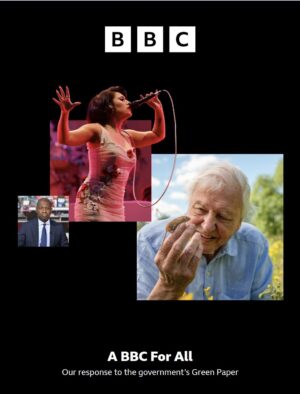
But… the document’s engagement with arts and culture is truly disappointing, being essentially confined in the 118 pages to just one paragraph on p.38 headed ‘Arts, Culture & Music’. ‘The BBC is the UK’s biggest cultural partner…,’ this begins, prompting the questions, Partner with whom, and for what?
It continues, ‘… and most ambitious creator of original arts programming.’ Here we have to recognise that in broadcast terms that there is really not much competition, despite the valuable contribution of part funding for productions by Sky Arts.
Moreover, as throughout much of the document, no distinction is made here between radio and television. Television, for which arts programming is now, let’s say, modest, is not considered separately from the riches of Radios 3 and 4, and from the various online offerings. Arguably treating the BBC’s output as a whole is entirely appropriate for today’s convergent world, but here the shortcomings of television’s engagement with the arts today is lost amongst loose language and woolly claims.
‘Audiences spent more time watching arts programming on the BBC than all other broadcasters and streamers combined…’ This at least is television-specific, but given the state of the arts across ‘other broadcasters and streamers’ is most certainly a low bar.
Nor does it take into account the ways in which the arts are presented by the moving image output of cultural institutions as in NT Live/@Home and the wide range of other ‘arts programming’ from a plethora of organisations from Tate and the ROH to Ballet Black and the Orange Tree.
‘…and each year we make available a total of 28,000 hours of arts, classical music and culture content.’ There is no breakdown of this total, which certainly embraces extensive radio broadcasting and many, many repeats; nor is there a definition of ‘culture content’.
‘Last year we partnered with 163 organisations working on arts projects and content.’ Given the breadth of the BBC’s concerns and reach that does not feel like an especially impressive figure, especially when there is no more detailed discussion of ‘partnered with’. No examples are given of these organisations or of the relationships developed.
The remaining half of the relevant paragraph is then (almost) all about audio content: BBC Introducing, BBC Proms (although we need to recognise that some concerts make it on to BBC Four), and the national orchestras.
There is no specific engagement with television arts programmes, no concern about the absence of review programmes on screen; no acknowledgement of the lack of creative and imaginative films about the arts; no notice of the dearth of intelligent and deeply informed television about the history of the arts; and no recognition of how encounters are largely missing with the boldest and most challenging creative figures of today, both in Britain and internationally. There is no awareness of how literature and theatre and opera are almost entirely missing from BBC television today, and that dance is present on Strictly and almost nowhere else.
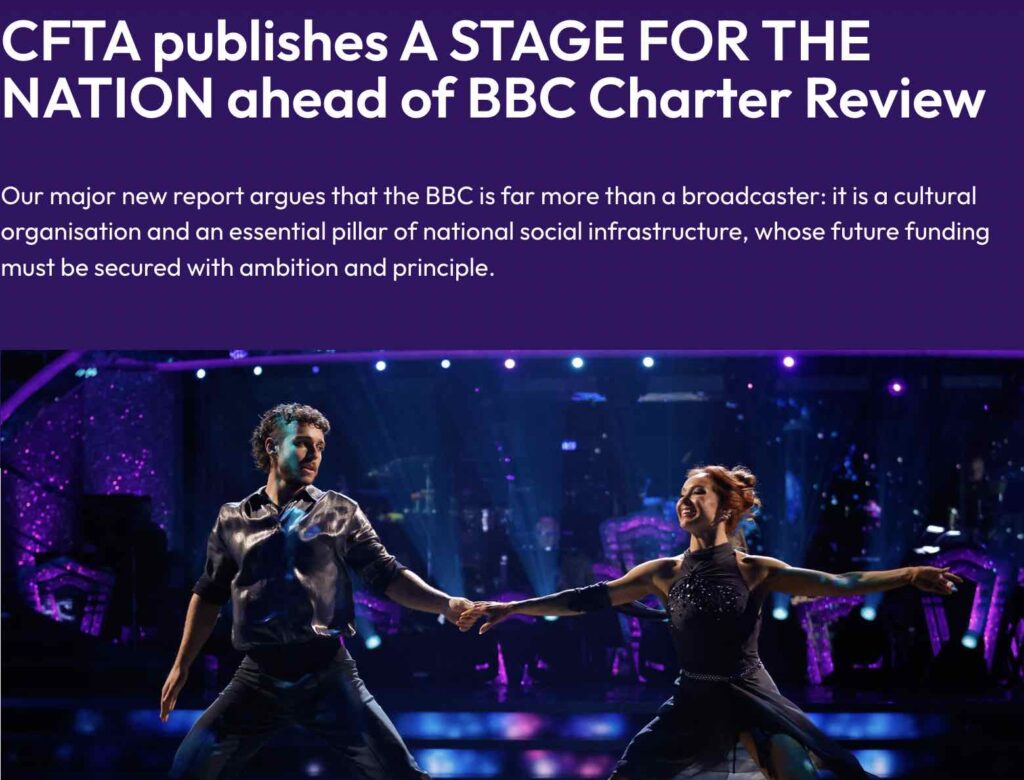
A Stage for the Nation
Surprisingly, and disappointingly, I found the Campaign for the Arts document rather less rewarding than the BBC report. I hoped for rather more from an organisation whose mission is to ‘champion, defend and expand access to the arts and culture, for and with the public.’
Perhaps I am being too critical, but the report feels somewhat complacent in its cheerleading for all that the BBC is doing as ‘the largest single investor in UK-made programmes’, and in bringing the Proms, Glastonbury and Gavin & Stacey (those are the three examples in the executive summary) to the nation. For the Campaign it seems that the BBC is doing a jolly good job, and it is vital that we support the Corporation to keep on keeping on.
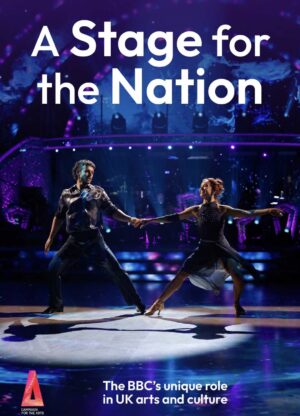
That is the tricky part of this debate. Of course it is important to support the BBC but it is also vital, including and perhaps especially during a once-in-a-decade review of its operations, to examine and question and critique the output, to identify where the organisation is falling short, and to propose how it might do better. And this A Stage for the Nation does not attempt.
There is a focus throughout the document on ‘culture’ in the sense of shared stories and social experiences, and on the ‘creative ecosystem’, but relatively little that is specifically concerned with ’the arts’ in a more specific sense, and even less with ’the arts on television’.
‘Platforming and partnering with artists, cultural organisations and creative groups’ on p. 25 rightly celebrates the BBC’s crucial collaborations during the COVID-19 lockdowns, but there is no questioning of how modest have been the follow-ons from that, at least on television. And in general, once again there is a reliance on radio for programming to celebrate, as with the spotlighting of Front Row, This Cultural Life, The Arts Hour and In Tune as examples of critical engagement with the arts.
The key section about arts television is ‘A licence to experiment’ on p. 38. This feels unimpressive in its reliance on the BBC’s distinguished past as crystallised by the BFI’s April 2022 listicle ‘100 BBC TV gamechangers’. It is all very well celebrating BBC television giving a platform for live performance by Les Ballets Nègres – but this was back in 1946! Why does the report not consider the commitment, or lack thereof, to comparable live performance today, to cutting-edge dance, to contemporary opera, to urgent theatre of the moment?
As is noted, ‘Arena is still produced by the BBC’, but it also needs to be said produced only very occasionally – with just five films since the start of 2025. Many editions are buy-ins or only part-funded, and some, such as Wall to Wall’s very fine L.S. Lowry: The Unheard Tapes, while counted as an Arena internally, are not recognised as such in promotional materials or anywhere on screen.
Also, I am not sure that we need this report to tell us that the BBC has made some really good dramas, and we especially do not need to fall back on Cathy Come Home and Pennies from Heaven to somehow legitimise I May Destroy You and Small Axe.
Yes, the BBC produced Civilisation back in 1969, as well as the follow-ups Civilisations (eight years ago) and the fairly terrible recent Civilisations: Rise and Fall. K would be spinning in his grave at such a comparison. And then, as the report continues straight after, the BBC produces great comedy, but once again we have lost a focus on television arts programming.
Perhaps I am missing the point, and perhaps, as many would argue, I am clinging to an elitist, out-of-touch idea of what arts programming on television could or should be. But it is unarguable that when compared with even a decade ago there is now a vanishingly small number of arts programmes made by BBC television, and there has been strikingly little debate about why and how we have reached this point.
Funding for the BBC has been desperately constrained over the past decade, which has meant that hard decisions have had to be made about what to support and what to cut. But the ‘creative ecosystem’ has had next-to-no engagement with those choices in relation to arts television. Nor, as far as I can see, were arts organisations themselves involved in the writing of A BBC for All and A Stage for the Nation; at least as far as I have seen, none are specifically credited.
Even now, with this crucial consultation coming to a close, I wonder how many arts organisations have made their views known through the portal or separately. Whether you are a painter, potter or candle-stick maker, or indeed the Royal Shakespeare Company, you have until 11.59pm on Tuesday 10 March so to do.
Leave a Reply