
Magic Rays at BFI: High Treason
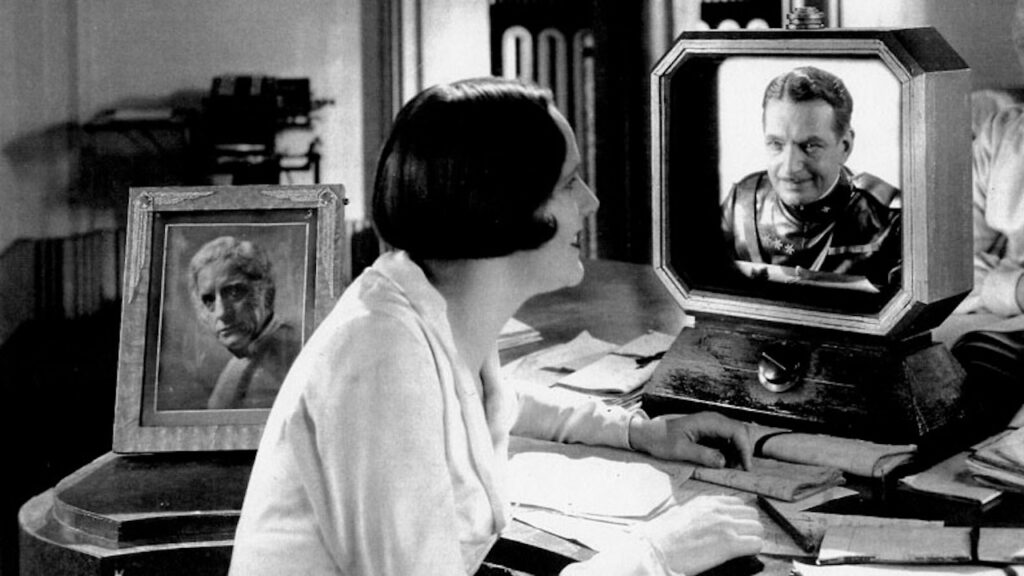
John Wyver writes: The successful series of screenings at BFI Southbank continues on Sunday, 18 January, with the first of three programmes of British feature films that offer imagined versions of television at its start. First up is the silent version of High Treason (above), a science fiction drama directed by Maurice Elvey, which will be presented with piano accompaniment by John Sweeney. A few tickets are still available. Reproduced here is the programme note that I have compiled for the event.
The Baird Television Development Company began experimental 30-line television transmissions in November 1928. These semi-regular late-night presentations of mostly variety and music hall artists, complemented by occasional talks and even a the first television drama, Box and Cox, in December, prompted a wave of press interest in the new medium. And this in turn, despite few people having actually seen television in action, led to imagined uses of the medium appearing in various forms in a clutch of British feature films made at the end of the decade.
The unformed nature of television’s identity and unstable ideas about its uses are strikingly displayed in High Treason, a Gaumont-British production directed by Maurice Elvey, which was released in a silent version and one with sound, which released weeks later and was made with Gaumont’s proprietary British Acoustic sound system.
Imagined forms of television appear throughout High Treason, a fantasy set some three decades in the future. The film employs models and effects to depict a conflict between Europe and the Atlantic States. Public and private screens show broadcast scenes from a ‘Daily Television News’ show and the ‘Government Broadcasting Station’. But television also features as visual telephones for intimate chats between lovers and as a system for real-time surveillance. This is television in what the scholar David Trotter has identified as the ‘interval of uncertainty, when the new medium had arrived but nobody yet knew what it meant’.
John Wyver, from Magic Rays of Light: The Early Years of Television in Britain, available in the BFI Southbank bookshop
High Treason had begun life as a play with a sensational streak. Noel Pemberton Billing’s oddball creation was a first and last detour into theatre for this flamboyant right-wing eccentric, principally known at the time as a bellicose MP, forceful champion of air power, and winner of a spectacular libel case bought by the ‘Salomé’ dancer Maud Allan in 1918.
A tub-thumping anti-war drama burdened with characters debating in long paragraphs, plus a heavily melodramatic finale, the play lasted two weeks in the West End in November 1928, earning such criticisms as ‘rubbishy fustian’ and ‘remarkably crude’.
But its possibilities for film treatment were considerable, especially once the play’s subject matter – a conflict between peace crusaders, led by a bishop, and a British Prime Minister bent on war – had been located in a future world already glimpsed in the visual design of Fritz Lang’s German epic Metropolis. ‘No self-respecting film man,’ Elvey’s producer and scriptwriter L’Estange Fawcett had previously written, ‘can afford to neglect the scenic lessons taught by such a picture as Metropolis.’
… The film’s London city-scape, conceived by Gaumont’s chief designer Andrew Mazzei and created largely through Philippo Guidobaldi’s models [featured] the banks of the Thames crowded with chunky tiered buildings and skyscrapers far taller than Big Ben, and planes of all shapes and sizes crisscrossing the busy sky. Interior scenes, restricted in the theatre to the Prime Minister’s Downing Street study, a newspaper proprietor’s home, and an Old Bailey courtroom, now included settings ranging from the sleek Art Deco geometrics and a spidery touch of Art Nouveau to a faux-medieval Arts and Crafts ceiling.
Gadgets ranged from multiple sliding doors and ‘televisors’ (the era’s video telephones) to a shower cubicle with a drying facility and wardrobe attached, and a ‘Phantom Orchestra’ od stand-alone instruments largely operated by a man twiddling knobs – an entertainment that could have suggested the synthetic music machines so scathingly described by Aldous Huxley in his novel Brave New World (1932).
Geoff Brown, from Silent to Sound: British Cinema in Transition (John Libbey Publishing, 2024)
[The film’s] opening sequences show a London filled with skyscrapers, with a developed Thames crossed by new bridges and filled with water traffic; and though no-one has a flying car, the air is filled with small personal aircraft, including helicopters and dirigibles. It must be said, however, that the model-work through which all this is accomplished is more imaginative than convincing.
But perhaps of more interest to the modern viewer is High Treason’s fairly accurate prediction of the intrusion of technology into everyday life. Gadgets are everywhere in this film—particularly communication gadgets. Television was in development while this film was in production… and High Treason has the technology taken for granted…
A touch more worryingly, there is a ubiquitous government broadcasting system with video-screens all over the place; while in Dr Seymour’s office in the Peace League headquarters there is an electronic news ticker. Meanwhile, Michael and Evelyn communicate via what is, to all intents and purposes, Skype; we note with amusement that this film predicts the dodgy internet connection, too. (Albeit that telecommunication is still facilitated, or not, through operators at an exchange.)
and you call yourself a scientist!?, online blog post, October 2020
Leave a Reply