
Magic Rays at BFI: Radio Parade of 1935
John Wyver writes: Our series of screenings at BFI Southbank linked to the publication of Magic Rays of Light: The Early Years of Television continues on Sunday, 25 January, with the second of three programmes of British feature films that offer imagined versions of television at its start. The silent version of High Treason, presented with piano accompaniment by John Sweeney, played to a sold-out NFT2 last weekend.
On Sunday afternoon there is a rare large-screen outing for the 1934 Will Hay comedy Radio Parade of 1935. This is a fascinating satire on the BBC, with Hay as an only lightly-disguised Lord Reith, and with a vision of television that is entirely distinct from domestic broadcasting. Tickets are still available. Reproduced here is the programme note I compiled for the event, in the form of a substantial extract from an excellent John Ellis essay about the film.
John Ellis:
Radio Parade of 1935 concerns the problems of a radio broadcasting organisation, the National Broadcasting Group or NBG, in the grips of an overly bureaucratic management led by the indolent tyrant William Garlon (Will Hay). Its output consists of arcane lectures, aetiolated classical music and dull, middle-of-the-road dance music.
The ambitious complaints manager, Jimmy Clare (Clifford Mollison), manages to persuade garland into an experiment involving the public televising of variety acts, and almost falls foul of a boycott by the sinister head of the Theatre Trust, Carl Graham (the egregious Alfred Drayton).
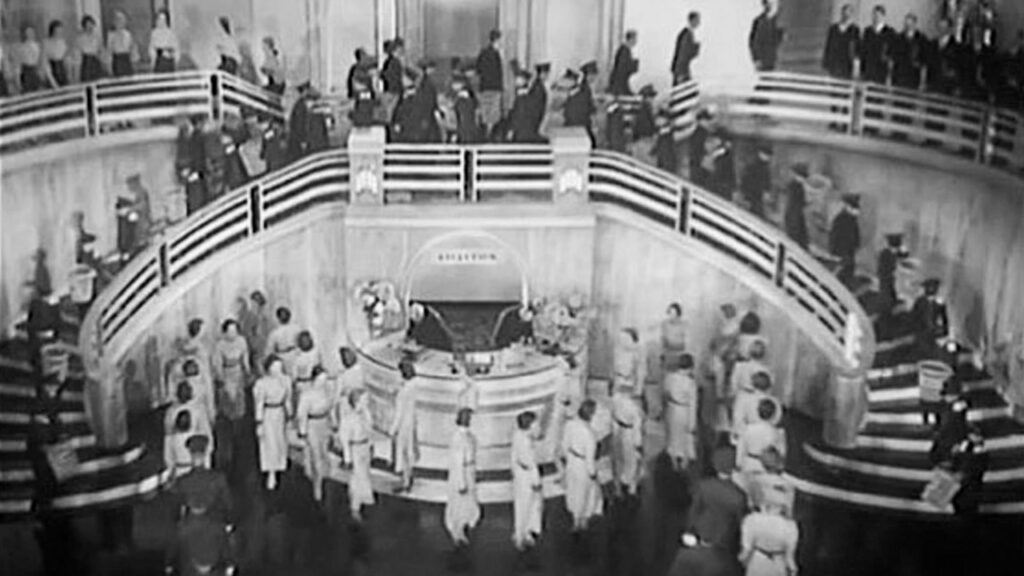
Clare manages to fill his broadcast with the unrecognised talent found in the NBG’s art deco headquarters which uncannily resemble the BBC’s new Broadcasting House, and television is well and truly launched by transmitting to crowds in London’s public spaces. The spectacular entertainments begin with Alberta Hunt’s soulful ‘Black Shadows’, then burst into colour with an elaborate music and dance piece, ‘There’s No Excusin’ Susan’.
Radio Parade of 1935 is an extraordinary satire of the BBC, which strongly suggests that the BBC was not a popular institution at the time. The film assumes that its audience will respond favourably to the image of a top-heavy bureaucracy staffed by such assistants to the Director-General as ‘Sir Egbert Featherstone Haugh-Haugh’ and ‘Lt.-Commander Vere de Vere de Vere’ with bellies and whiskers to match; a commissionaire who spends most of the film keeping the anonymous inventor of television from entering the building; a complaints department that files everything and acknowledges nothing; and a Director General who never listens to the station but spends time admiring pictures of himself.
This was the year in which audiences for commercial broadcasting from the Europe-based English language Radio Normandie and Radio Luxembourg began to outstrip those for BBC Radio.
Satire was a dangerous weapon in the attempt to weld together an audience, yet Radio Parade of 1935 manages to carry it off. In some ways, the film is even more ambitious in its contemporary references. It is a film à clef, with names echoing those of real life characters: Reith (‘wreath’) becomes Garlon (‘garland’), for instance. The transposition from ‘BBC’ to ‘NBG’ plays on the popular use of ‘NBG’ to mean ‘No Bloody Good’. […]
Radio Parade of 1935 may be a topical satire of the BBC, but it still depends on the BBC for its very existence.. The opening credits list many of its artists under the generic heading of In Town Tonight which as virtually every audience member would have known was the title of the BBC’s most topical entertainment-based show.
First broadcast on 18 November 1933, it ‘established itself as a popular favourite, bringing to the microphone at the same time each week a great medley of characters who either lived in or were visiting London. A sense of spontaneity was achieved.’
It was the invention of the then Head of Variety, Eric Maschwitz, who is also credited by Asa Briggs with the discovery of some of the acts appearing in Radio Parade of 1935, including the suggestive gibberish of Clapham and Dwyer; the aggressive and surreal Ronald Frankau, a forerunner of Spike Milligan; the impressionist Beryl Orde; and the obtuse ‘piano tuner’ Claude Dampier. […]
The film connects in another way with its audience through its anticipation of television, which eventually began regular transmissions in 1936. Indeed, it could almost be construed as a lobby for television or a particular kind, one that could use cinemas themselves as television venues (the film was produced by British International Pictures) which was part of the group that owned the ABC chain of cinemas).
Publicity surrounding the coming of television – radio with pictures – had been a part of public imagination since Baird had displayed his early experiments in Selfridges’ Oxford Street store in London in 1925. […] The Selsdon Committee of Enquiry into television broadcasting was set up on 16 May 1934 and at one of the preparatory meetings between the Post Office and the BBC on 5 April, many matters were discussed including ‘the possible use of television to serve a chain of cinemas’.
This potential of the technology, only fitfully exploited in subsequent years, is the form energetically proposed by Radio Parade of 1935, which imagines television as an essentially communal viewing activity somewhere between the cinema and the public concert.
The television broadcast is the spectacle that completes the film. The final number is an experiment in Dufaycolour, a British process that accentuated greens, oranges and yellows at the expense of red saturation. ‘There’s No Excusin’ Susan’ tops the opening dance spectacular ‘Good Morning’ in its use of the massed geometric approach of Busby Berkeley.
These two spectacles probably helped the film on its American release (entitled Big Broadcast of 1935) but even they display a peculiarly British reticence. In the midst of the opening number, showing the disciplined staff of the NBG arriving for work, two lugubrious weather forecasters intrude with a verbal routine based on familiar complaints about the British weather. Even at its most international, the film remains defiantly local.
Excerpted from ‘British Cinema as Performance Art’, in British Cinema, Past and Present, edited by Justine Ashby and Andrew Higson (Routledge, 2000).
This afternoon’s screening on the NFT2 screen from a Studio Canal Blu-ray confirmed quite what an oddball but truly interesting film this is. Part conventional romcom, part genuinely funny (if you respond to old school English humour), and part distressingly racist, this has genuinely impressive opening and closing dance numbers.
Will Hay is a delight, and I was entirely won ov er by Helen Chandler as Joan. I also thought that Clifford Mollison’s Jimmy could have been modelled on Alexandra Palace producer Cecil Madden.
I had failed to recall the running gag of a bumbling eccentric inventor trying to get a meeting at NBG and being blocked by the commissionaire. The character is ‘A. Bird’ (and that’s Algenon), played by Hugh E. Wright, and is transparently a John Logie Baird figure, even down to the trace of a Scottish accent.
When Bird does resourcefully manage to get into the offices, he encounters Jimmy and Joan, and takes them across town to an attic workshop (maybe Frith Street, maybe Long Acre, in Baird terms) to demonstrate his invention. We glimpse only a wall of technology through a doorway.
Once television is embraced by NBG, as a way of circumventing the ban by the Theatre Trust, Bird is able quite remarkably to equip multiple vans with outdoor scrfeen and deploy them across London, all within a day. The actual technology is left vague, although we see two of the outdoor screens being folded out, and then an abstract pattern of moving lines superimposed on them.
Intercut with these scenes, in an entirely unconvincing manner, are newsreel shots of crowds and arc lamps, which we are meant to understand are the audiences welcoming this public form of television.
Meanwhile, Jimmy and Joan have been gathering alternative acts, picking them up at NPG from the charladies, effects men and others, exactly as ‘In Town Tonight’ radio guests, and later those on television for ‘Picture Page’, were supposedly recruited.
‘No excusin’ Susan’ as the climactic number is achieved in full colour, with vivid yellows and greens, and is rather impressive – Claude Friese-Greene oversaw the Dufaycolor sequences. Before this, Alberta Hunt’s ‘Black Shadows’, also presented in colour but with veils and a lower-key palette, has a visually astonishing setting of multiple ‘native’ drums on the tops of which figures in leopard skins dance.
Throughout the costumes (no separate designer credited, as far as I could see) and the Deco settings, by Clarence Elder and David Rawnsley, are consistently attactive. And how interesting that Rawnsley would post-war initiate the production technologies known as ‘Independent Frame’ at Pinewood.
This suite of techniques was intended to rationalise studio production work and contribute efficiencies, in part drew on television technques and kit. But it was never truly embraced by the industry, and Rawnsley ended a distinguished career as a film production designer having co-founded the Chelsea pottery and then living on Capri with his fourth wife, Phyllis May. He’s such an intriguing figure about whom I want to know more.
For more about Independent Frame, start here:
https://www.redsharknews.com/virtual-production-was-happening-at-pinewood-75-years-ago