
Magic Rays at BFI Southbank 1.
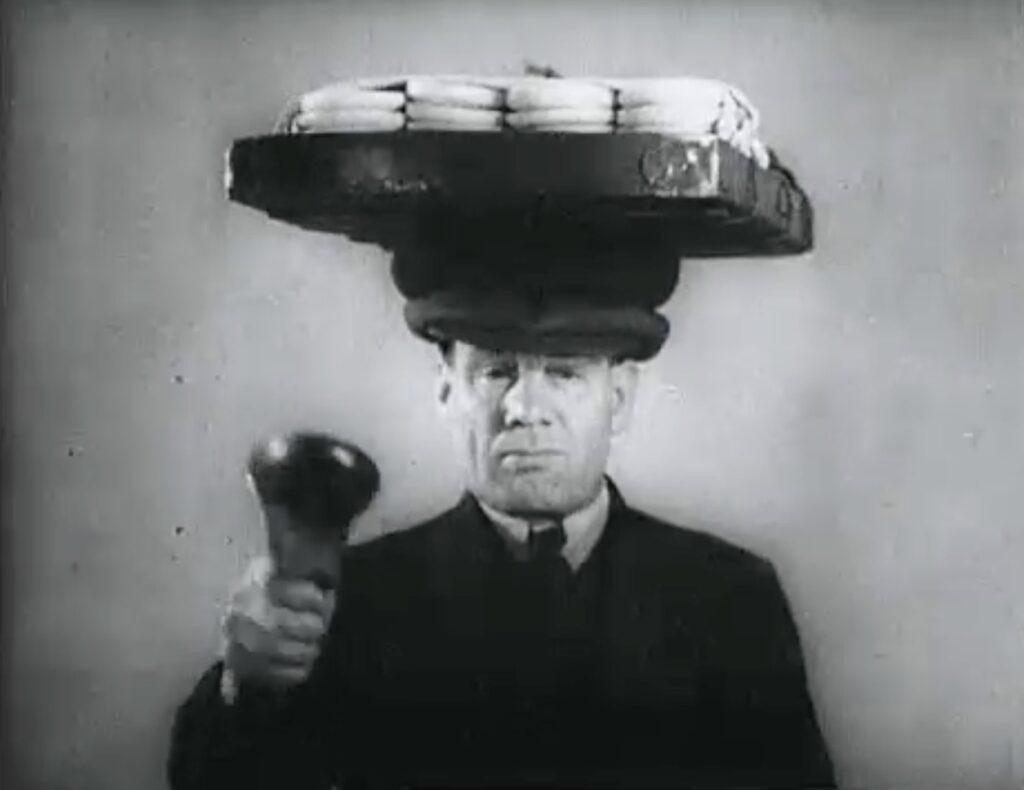
John Wyver writes: The Magic Rays of Light season at BFI Southbank kicks off tomorrow night, Thursday 8, with a programme of four documentaries made for the early television service. On what is also publication day for the book (and when I might finally see a copy), I am introducing the programme and have written the accompanying notes, which I thought, despite it making for a long post, it might be interesting to reproduce here.
If you fancy coming there are still tickets, and you’ll see the muffin man above from Picture Page as well as much, much more, but at the time of writing the website is showing only 9 seats available.
Programme Notes for Television Arrives!, NFT2, Thursday 8 January
We have only a very few minutes of recordings of live broadcasts from the BBC Television Station at Alexandra Palace (AP), which was on the air between 2 November 1936 and 1 September 1939. Scattered mostly as glimpses in newsreels and in one case of amateur footage shot of the screen, these also include a unique but very low-quality film (discovered by the late Andrew Emmerson and Maurice Schecter) made by RCA engineers in New York in 1938.
What has survived, however, are a small number of film documentaries made by the television service for screening as part of the service, and tonight’s programme features the four key examples of these.
Television Comes to London, 1936
During a month of test broadcasts ahead of the opening of the service from Alexandra Palace, producer Dallas Bower, collaborating remotely with director of television Gerald Cock, who was laid up ill at home, filmed activities at AP for the documentary Television Comes to London, first shown on opening night.
After sans-serif titles signalling the film’s modernist aspirations, the documentary begins with narrator Leslie Mitchell detailing the choice of AP as the site for the London television station. No mention is made of the earlier years of the 30-line service, and there is only a brief mention of Baird as ‘the pioneer of British television’. The early part of the documentary focuses on the physical processes and manual labour, hymned in heroic terms, needed to transform the south-east wing of AP.
The final sequence moves from Elizabeth Cowell being made up by Mary Allan, through shots of the control room, switches, generators and valve filaments, and finally to the service going on air. Elements of this memorable sequence have been reproduced countless times in features and documentaries to illustrate the ‘birth’ of television, invariably also effacing the 30-line years.
The triumphalist narration was scripted by Cecil Lewis, a distinguished First World War pilot and author of the recently published memoir Sagittarius Rising. The film’s style was down to Bower, who appears to have set out to channel the work of Soviet film-makers like Sergei Eisenstein and Alexander Dovshenko. Perhaps the clearest lineage for Television Comes to London, however, is that of the industrial documentary, a form refined from the beginning of the 1930s in films made under John Grierson at the Empire Marketing Board and the GPO Film Unit.
Apparently after an extensive search for contemporary music for the soundtrack, Bower elected to use Dvořák’s heroic New World Symphony. As played by Hyam Greenbaum’s Television Orchestra, prominently featured on screen, this provides an insistent accompaniment through almost all of the film. Its pomp and grandeur contributes significantly to the film’s striving towards a sense of the technological sublime, with scientific advance inspiring feelings of wonder and awe.
The intensity of this drive, however, is pleasingly punctured by Adele Dixon, adorned in a feather-trimmed, high-contrast gown, singing James Dyrenforth’s words celebrating that ‘a mighty maze of mystic magic rays, is all about us in the blue’. An older form intrudes again into this futuristic vision as, once Dixon has finished singing, theatrical tabs close in front of her.
The Coronation Broadcast, 1937
On or about 12 May 1937 British television changed. That was certainly the view of those producing the service from AP, and the assessment was shared by many of the estimated 60,000 who, from Ipswich to Brighton, were watching. From 15.04 to 15.59 on that Wednesday afternoon a live outside broadcast from Hyde Park Corner featured scenes of the waiting crowds and then of the passing Coronation procession on its return journey to Buckingham Palace.
Although it does not enjoy the centrality in popular memory of Elizabeth II’s Coronation 16 years later, the pomp and ceremony that marked George VI’s accession was profoundly significant at the time. And the new medium made its modest contribution as, for the first time (leaving aside earlier test transmissions), viewers could see live pictures from a remote location of a defining occasion of international significance.
Recognising the importance of the transmission, the Television Service made this short commemorative film which captured the installation of the television cameras, the crowds on the day, the marching bands and a fleeting glimpse of the monarchs’ coach passing rapidly by.
BBC Television Demonstration Film, 1937
Sales of television receivers in the spring of 1937 remained glacially slow, and set manufacturers and retailers began to demand an extension of broadcast hours. A key concern, at a time when there was no continuous testcard, was the provision of morning broadcasts for showrooms to demonstrate the improvements in image quality and programme output. Studio resources were stretched to breaking point, and a still uncooperative film industry was unwilling to provide material for additional broadcasts.
As a consequence, in the early spring of 1937 Gerald Cock asked Dallas Bower to produce what was prosaically titled BBC Television Demonstration Film. Judging from his recollections in an unpublished memoir, the experienced filmmaker relished the task. Not that the demonstration film, which was made on 35mm at the Stoll film studios in Cricklewood, offered many opportunities for visual flourishes, since it comprised short sequences of artists and presenters shot, so as to approximate the ‘look’ of television at the time, with figures shown in bright, even light against a plain cyclorama or within basic sets.
More than eighty years on,in its simplicity, immediacy and range BBC Television Demonstration Film offers by far the best visual sense of early AP broadcasts. But like viewers at the time we need to heed Leslie Mitchell’s warning, delivered straight to camera at the opening: ‘We are particularly anxious that those of you who should be watching this demonstration should not receive the impression that television programmes are simply televised film transmissions.’ Instantaneous shot changes, effortless on film, could not yet be achieved by television, and when seen in a decent print today the image definition is far superior to the 405-line standard of the time.
Television is Here Again, 1946
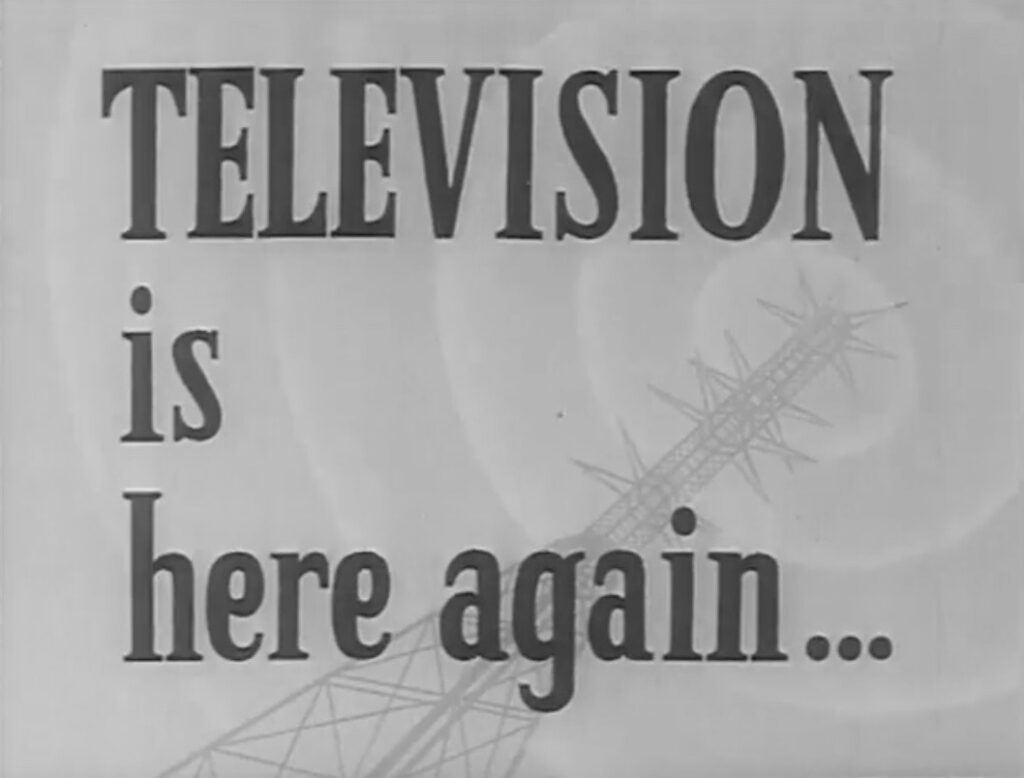
When the Television Service returned after its wartime closure, AP produced this documentary to showcase the pre-war broadcasts and to speculate about the medium’s future. With regular updates the documentary then replaced the BBC Television Demonstration Film with daily morning showings for salesrooms.
The programme tonight includes two substantial extracts which look back to the earlier output, with recreations of a variety show and a (frankly risible) attempt at a ‘hard-boiled’ crime drama. Also featured is vibrant film footage shot at the Victoria Palace alongside the outside broadcast cameras during one of two live presentations of the hit musical Me and My Girl with Lupino Lane and Teddie St Denis.
Programme notes excerpted from Magic Rays of Light: The Early Years of Television in Britain by John Wyver, available in the BFI Southbank bookshop and from the Bloomsbury website.
I see that BBC4 are supplementing the Magic Rays Of Light season, by screening archive repeats of ‘JLB: The Man Who Saw The Future’ and ‘The Birth Of Television’ at 9.00 and 10.00 on the evening of Tuesday the 20th.
Ah, good spot – I knew they were going to do some archive screenings, and they said they are also holding some things – presumably including Television Comes to London – for the 90th anniversary of the start of AP.