
Mañana, the reception
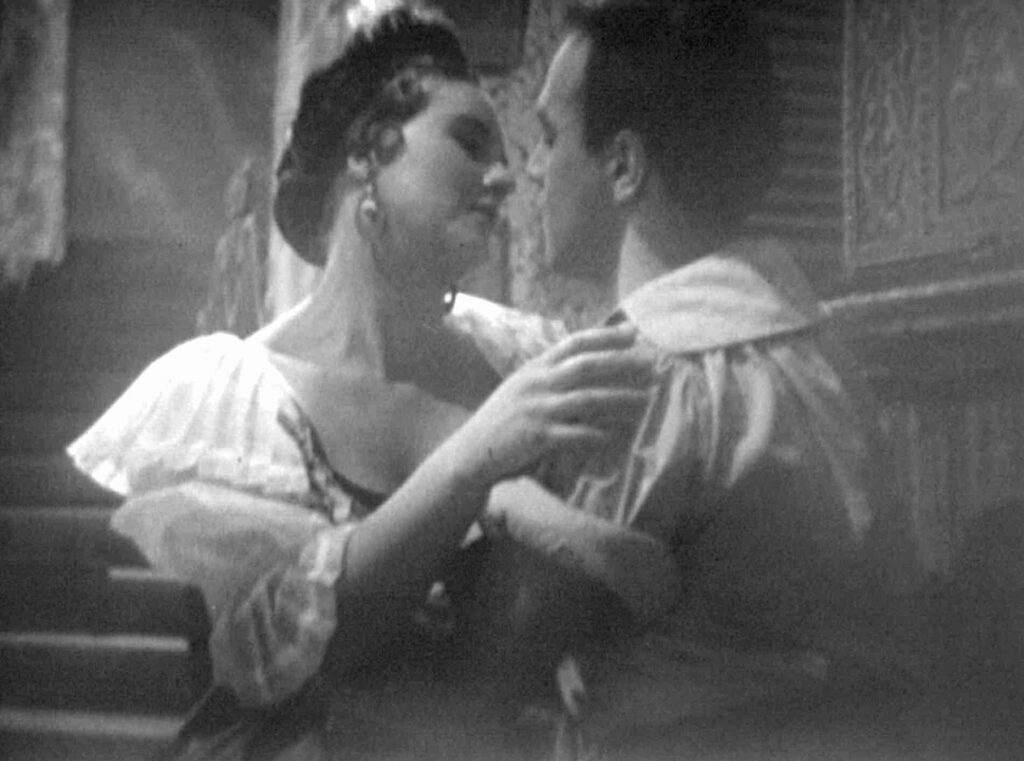
John Wyver writes: With the 1956 BBC production of Arthur Benjamin’s commissioned opera Mañana currently and pleasingly on BBCiPlayer, I have written blog posts about the backstory to the project and about the production as television. This third post explores the contemporary critical response.
The reviews were, well, mixed. The anonymous critic for The Times was broadly positive:
Th[e] slight but charming idea, so rich in opportunities which it offers to an artist in words, has also allowed Benjamin to paint the scene in Spanish-tinged music, likewise to sketch attractive musical studies of individual villagers… [but] his music, for all its felicitous invention and variety of solo, ensemble, and chorus, seemed to lack the sharply defined emotional overtones we expect from him.
Dramatically the opera had a fine climax when the villagers, preparing for the end of the world, greet instead a sunny new day, but the story takes too long to gather impetus.
The scenery was delightful and the production flowed smoothly. Musically the performance went splendidly, alike in the principal roles (though these are less in the nature of ‘star’ parts than in most operas), the contribution of the Glyndebourne Festival Chorus and the Royal Philharmonic Orchestra under Mr Edward Renton.
A considered response, although one that has next-to-nothing to say about Mañana as television. Remarkably, another opera critic, ‘C.M.’, writing for The Manchester Guardian, admitted to being ‘one… who was watching a television set for the first time’! Moreover, they were considerably less enamoured:
The story may make entertaining reading but it made a very thin plot and took so long to warm up that nobody who switched off after 20 minutes in despair of seeing anything happen could really be branded a philistine…
But in television opera, as in any other kind, it is in the last resort the music that matters, and if the work fails to move or ewntertain it is the composer who must take the blame… The composer could perhaps have pulled it together and risen above the shortcomings of the drama.
But instead he set it to 75 minutes of meandering, undistinguished competent music, better in taste and skill than the libretto deserved but nothing like as good as he can do… An hour and a quarter of tasteful leisurely music, even with one or two very agreeable songs, as there were here, mostly agreeably, if unexcitingly sung, is not likely to command the patience of viewers with a panel game to watch.
Peter Black, one of the very finest of early television critics, was ambivalent but ultimately unenthusiastic for the Daily Mail:
It struck me that TV had repeated its old error of putting the cart (camera terchniques) before the horse (the story)… It paid off handsomely in terms of pictures. No TV opera has more cleverly arranged the flow of one scene into another, or designed camera shots with a more instant appeal to the eye. The last 15 minutes were the best TV opera I ever saw.
I cannot speak with authority about the music. I think it unlikely that any of it will be heard in Housewives’ Choice.
Moreover,
No discernible attempt was made to make this story credible or even plausible. The Wise Man (Frederick Sharp) failed to impose any kind of character. He was obviously only a good singer dressed up. And this weakness went right through the cast…
I beg those concerned not to dismiss this criticism as hopelessly superficial. When the story fails everything fails with it. This is true even with the consolations of VistaVision. For television it is one of the Three Unbreakable Principles.
(Peter Black failed, at least here, to detail the other Two.)
Each of the above reviews appeared the morning after transmission, so must have been composed while watching either in the office or at home (no video or online previews then), and then immediately phoned through to a copy-taker so as to meet a late edition. Which was a tough discipline.
One other interesting response had the luxury of being published ten days later. For The Observer, the eminent and famously sharp-tongued music critic Peter Heyworth developed an interesting argument. Acknowledging the broadcast as ‘a praiseworthy attempt to meet new conditions by evolving a new form,’ he regretted that it was ‘painful to describe Mañana as a failure.
The critic recognised the challenge that Benjamin had been set:
Haunted no doubt by the visual difficulties inherent in long static periods in which nothing but music develops, he seems to have seen hias problem essentially as one of matching music to constant changes of scene… And this was reflected in a score which although agreeably tuneful and delightfully orchestrated, remained in the manner of film music somehow unsubstantial and unmemorable.
For Heyworth, however, there was a yet more fundamental problem with the form, since
We were deprived of the atmosphere of opera: we heard no orchestra tune up, we never saw that emblem of magic, the proscenium arch, and there was no applause… Now there can be no question that [producer] Mr Foa was entirely right to do this, for he was expressly not televising a theatrical performance, but trying to translate opera directly into terms of television.
Nonetheless, but so doing he suspended our acceptance of operatic conventions; and once deprived of this support, the success of Mañana depended on his ability to induce us to accept it in terms of a quite different set of conventions – those of TV.
The creative team, this critic was convinced (perhaps reflecting his strong commitment to the musical avant-garde of his day), should have been far more radical, and he trusted that this broadcast would be only the first of a series of experiments. As for Mañana,
What we saw… probably had as little to with TV opera of the future as the first, faltering steps of the movies had to do with contemporary cinema.
A footnote: Thanks to the Jennifer Vyvyan website, dedicated to the much-loved singer, I reproduce here a list of other operas commissioned for television by the BBC in the later 1950s and early 1960s; as the author there notes this was ‘a sequence of commissions that all failed to land a place in repertoire’.
- Malcolm Arnold’s The Open Window – 1956
- Joan Trimble’s Blind Raftery – 1957
- Richard Arnell’s The Petrified Princess – 1959
- Arthur Bliss’s Tobias and the Angel – 1960
- Phyllis Tate’s Dark Pilgrimage – 1962
Leave a Reply