
OTD in early British television: 3 May 1937
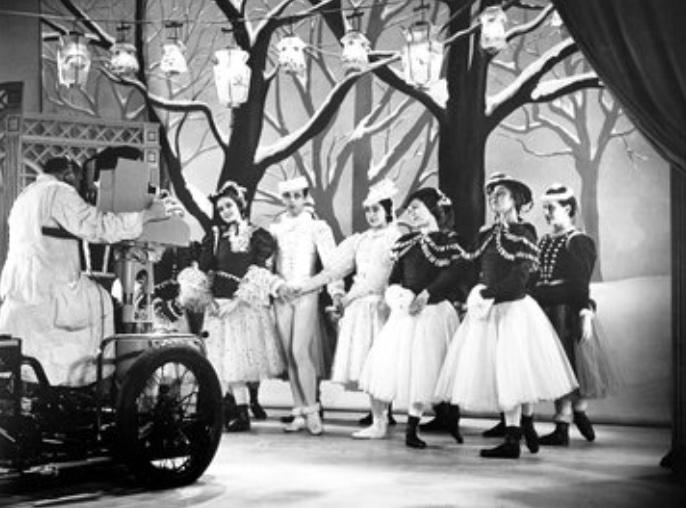
John Wyver writes: More or less six months to the day after the start of the ‘high definition’ television service from Alexandra Palace, on Monday 3 May 1937, members of the Vic-Wells ballet company travelled to the studio to perform, at 3.47pm and 9.47pm, Frederick Ashton‘s one-act ballet Les Patineurs (above).
The company had premiered what would become one of Ashton’s most popular ballets only in February at Sadler’s Wells. A cast of 15 dance a series of divertissements set at a Victorian skating party, conjured up by William Chappell‘s costumes and scenery. The idea had come from the Vic-Wells music director Constant Lambert, who created the score from fragments of two operas by Meyerbeer.
Ninette de Valois was originally intended to be the choreographer, but Frederick Ashton heard Lambert playing the score on a piano and asked if he could take it on. He knew little about ice skating, but one of his dancers, Elizabeth Miller, did, and she demonstrated some movements and tricks for him. Transforming them into balletic vocabulary, he set out to create a ballet that would reveal the virtuosity of the burgeoning English ballet and win the public’s approval.
The dancers performing at AP were more or less those who premiered the ballet ten weeks before: Margot Fonteyn and Robert Helpmann as the leads, accompanied by a line-up of future stars including Mary Honer, Elizabeth Miller, June Brae, Pamela May, as well as Harold Turner and Michael Somes.
A special white-rubber floor was laid in Studio A, and Hyam Greenbaum conducted the BBC Television Orchestra. Production was overseen by D.H. Munro in one of his first studio presentations; he would go on to produce many of television’s major pre-war ballet transmissions.
By this point Jeanette Rutherston was filing regular expert reviews of television ballet for the monthly Dancing Times. Of this first studio presentation of Les Patineurs (which would be given again in December 1938), she wrote:
[T]he best possible use was made of the space at the disposal of the dancers, but even so at times they seemed cramped and Haroid Turner in particular appeared to be worried by this and did not dance as well as usual.
Margot Fonteyn’s and Robert Helpmann’s white costumes were rather lost against the snowy background in spite of a change of lighting as soon as this was noticed by the technicians: nevertheless the transmission was a delight to watch.
Leave a Reply