
OTD in early British television: 5 November 1936
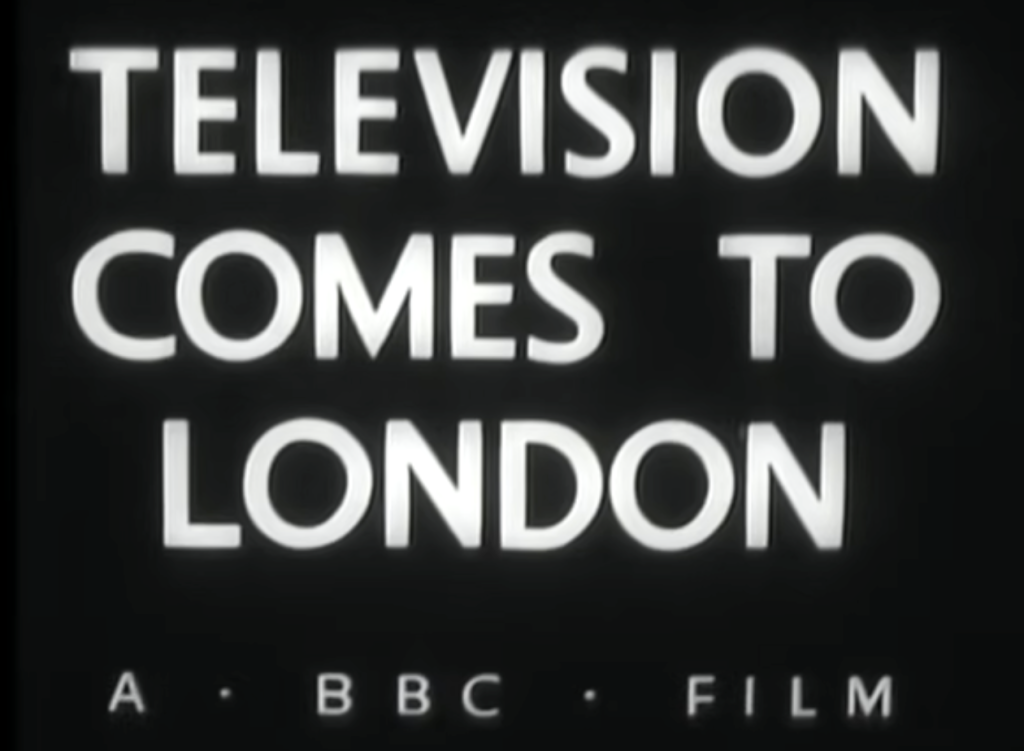
John Wyver writes: The high definition television service from Alexandra Palace was just three days old on Bonfire Night 1936. That afternoon, after a performance under the name of the Mercury Ballet of Marie Rambert’s dance company, the film documentary made to mark the opening of the AP television station was broadcast for the second time.
The 18-minute Television Comes to London had been broadcast at the start of the week, and it was to become such a fixture in the early schedules that viewers and commentators complained about its ubiquity. It is nonetheless a fascinating document, a not-too-great but still welcome prijnt of which can be accessed here.
During the month of test broadcasts preceding AP’s opening, producer Dallas Bower, collaborating remotely with director of television Gerald Cock, who was laid up ill at home, filmed activities for the documentary. Shooting had in fact begun a year before, led by film cameraman Leslie Barbrook, who like so many of the key figures in this story had served in the First World War. Appointed in part on the strength of having made the documentary Shqypnia – Land of the Mountain Eagle in Albania, Major Barbrook co-ordinated all the celluloid-related activities of the station.
After sans-serif titles signalling the film’s modernist aspirations, the documentary begins with narrator LeslIe Mitchell detailing the choice of AP as the site for the London Television Station. No mention is made of the five-plus years of the 30-line service, and and there is only a single shot and brief mention of Baird as ‘the pioneer of British television’. In fact Russian-American inventor Vladimir Zworykin is granted marginally more screen time, described as ‘the originator of the television camera’ and seen with Gerald Cock during a site visit.
The early part of the documentary focuses on the physical processes and manual labour, hymned in heroic terms, needed to transform the south-east wing of Alexandra Palace. The materiality of this work is underlined as if in some way to compensate for the immateriality of television itself.
The most impressive sequence is the Soviet-style montage featuring the construction of the mast, combining vertiginous images, crane shots and patterns of girders and workmen silhouetted against the sky. The mast becomes a synecdoche for the AP operation as a whole and, even more generally, for television.
The final sequence moves from Elizabeth Cowell being made up by Mary Allan, through shots of the control room, switches, generators and valve filaments, and finally to the service going on air. As Adele Dixon sings ‘Television’ further insistent shots of technology are cut in, as well as a glimpse of an upscale couple watching on a screen in a darkened room.
Elements of this memorable sequence have been reproduced countless times in features and documentaries to illustrate the ‘birth’ of television, invariably also effacing the 30-line years.
The triumphalist narration was scripted by Cecil Lewis, a distinguished First World War pilot and author of the recently published memoir Sagittarius Rising. In a richly varied life Lewis had in 1922 been deputy director of programmes for the British Broadcasting Company when the staff totalled just four. After resigning in 1926 he became a confidant of Bernard Shaw, directed feature films, and then returned to the BBC to join the television service.
The film’s style was down to Bower, who appears to have set out to channel the work of Soviet filmmakers like Sergei Eisenstein and Alexander Dovshenko. Perhaps the clearest lineage for Television Comes to London, however, is that of the industrial documentary, a form refined from the beginning of the 1930s in films made under John Grierson at the Empire Marketing Board (EMB) and GPO Film Unit.
Like Robert Flaherty’s Industrial Britain (1931) and Droitwich (1935) directed by Harry Watt, Television Comes to London is fascinated with labour, process and technology, and aspires to the innovative use of sound that distinguished films by Alberto Cavalcanti and Basil Wright.
Apparently after an extensive search for contemporary music for the soundtrack, Bower elected to use Dvorak’s heroic ‘New World’ Symphony, As played by Hyam Greenbaum’s Television Orchestra, prominently featured on screen, this provides an insistent accompaniment through almost all of the film. Its pomp and grandeur contributes significantly to the film’s striving towards a sense of the technological sublime, with scientific advance inspiring feelings of wonder and awe.
The intensity of this drive, however, is pleasingly punctured by Adele Dixon, adorned in a feather-trimmed, high contrast gown, singing James Dyrenforth’s words celebrating that ‘a mighty maze of mystic magic rays, is all about us in the blue’. An older form intrudes again into this futuristic vision as, once Ms Dixon has finished singing, theatrical tabs close in front of her.
[OTD post no. 279; part of a long-running series leading up to the publication on 8 January 2026 of my book Magic Rays of Light: The Early Years of Television in Britain, which can now be pre-ordered from Bloomsbury here.]
Leave a Reply