
OTD in early British television: 6 November 1936
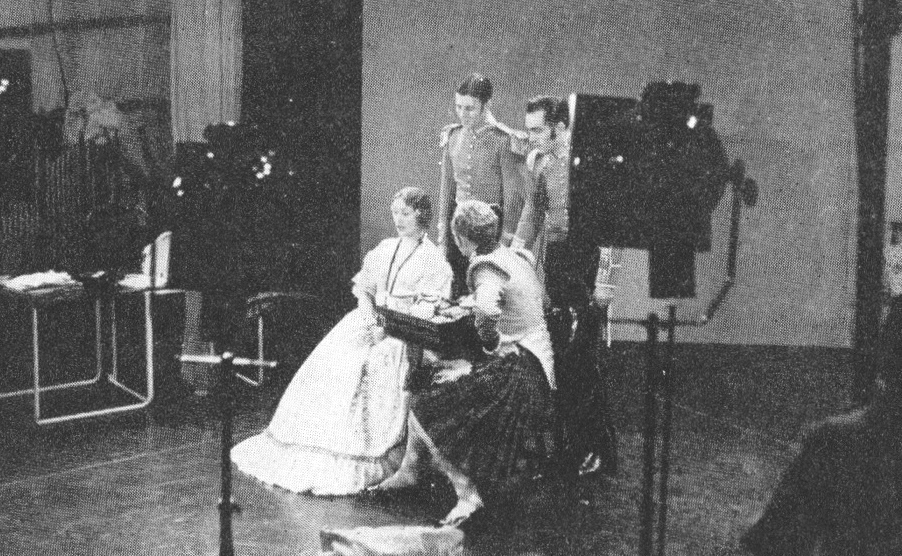
John Wyver writes: After yesterday’s post about Television Comes to London, let’s stay in the first week of the official high definition television from Alexandra Palace, and turn our attention to the afternoon of Friday 6 November 1936. This was when the cast and producer of Marigold travelled to AP to present scenes from their West End production before the somewhat intractable Baird transmission set-up in and alongside Studio B.
Drama had been far from director of television Gerald Cock’s primary concern, but he acknowledged that, ‘[e]xcerpts from plays during their normal runs, televised from the studio or direct from the stage, with perhaps a complete play at the end of its run, would have attractive possibilities as part of a review of the nation’s entertainment activities.’
Programme director and theatre aficionado Cecil Madden was of an altogether different mind. ‘Planning the television schedule,’ he recalled, ‘there was never any doubt in my mind that the emphasis should be on drama.’ As a stage dramatist, he also saw the author as the new medium’s key creative force: ‘The writer would be the trend setter; the taste maker.’ He committed the new service to ‘a play a day’, although he never quite achieved that ambition, and in the early months AP failed to deliver even a play each week.
Over a decade before, the very first radio broadcasts from the British Broadcasting Company included excerpts from West End productions, but theatre managers, concerned about competition from the new medium, prohibited this after April 1923.
Given television’s tiny staff and minimal resources, Madden followed that earlier model, making a pragmatic decision to develop Cock’s idea of working with existing productions from the stage. ‘At the outset the London theatre was ready to play,’ Madden later wrote, and transfers were initially billed as From the London Theatre, which was an established radio series.
In late September 1936, anxious to fix on a play for the opening week to announce in Radio Times, Madden noticed an imminent revival of the Scottish comedy Marigold. Set in 1842, this concerns a young girl who runs away from home to see Queen Victoria in Edinburgh.
The script fulfilled Madden’s belief that for his opening selection he needed ‘something that is comparatively innocuous and which does not present too many technical problems’. For a £50 fee, a deal was done with Herbert Cambrose Ltd., the company presenting the play at the Royalty.
Once the toss had determined that, after opening night, the Baird set-up (as opposed to the Marconi-EMI electronic cameras in Studio A) would be used for the first week, producer George More O’Ferrall had to match scenes from the play with its technical capacities.
The transmission began from the spotlight studio, with a beam of light rapidly scanning whoever was there standing in otherwise pitch darkness. In fron of a poster for about two minutes theatre producer Lance Lister introduced the scenes to come. In a black-out the poster was removed to a plain white background for a three-minute dialogue, before the poster was reinstated in a second black-out, and the shot held until the intermedia film (IF) camera next door in Studio B could be brought into operation.
The IF camera recorded images on 17.5mm film, processed and developed them rapidly, and then ran them, still wet, through a telecine machine. This was a process that took approximately 55 seconds, and so the audio had to be delayed to synchronise with the pictures. It was an immensely cumbersome process, and a dangerous one too given the proximity of the chemicals with high voltage electricity. There were also frequent breakdowns, as there was once in this showing of Marigold.
The drama was played befofre the IF camera (and supposedly in Edinburgh Castle) for some seventeen minutes, with six actors along with Pipe-Major Iain Macdonald-Murray. Presumably the different lenses on the static IF camera were used to vary the shot.
The presentation then switched back to the spotlight studio for a third scene with four of the cast. Despite the short breakdown, the afternoon transmission went sufficiently well for Madden to thank Lister warmly, and at the end of the month the show returned to AP for two further transmissions.
The constraints of the Baird system, however, meant that up until Christmas Marigold was the sole drama attempted from Studio B, and even after new electron cameras from the Baird team became operational, only four dramas, each with a minimal cast, were played with this set-up.
Nearly a decade and a half ago, I wrote about Marigold for the Screen Plays blog, which is still online; while parts of the earlier post are repeated above, it does also have a couple of paragraphs about later events concerning the production.
[OTD post no. 280; part of a long-running series leading up to the publication on 8 January 2026 of my book Magic Rays of Light: The Early Years of Television in Britain, which can now be pre-ordered from Bloomsbury here.]
Leave a Reply