
The Cultures of Early Television
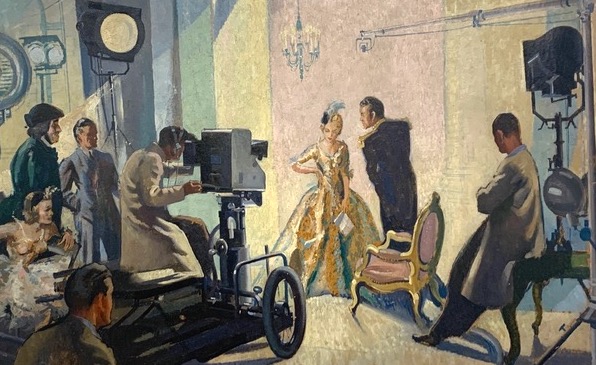
John Wyver writes: I’m delighted to unveil the schedule for the The Cultures of Early Television, a University of Westminster conference that I am convening on 2 and 3 July at Portland Hall in London.
Organised with the support of The British Academy, this two-day gathering focuses on television before the Second World War in Britain, continental Europe, the United States and the Soviet Union. With presentations, panels and screenings of rare archival material, the event marks the centenary of the first British public presentation of what John Logie Baird called “true television”, which took place in London in early 1926.
The conference brings together scholars and archivists from Britain, Europe and North America to explore imaginings and understandings of early television, and its productions and people, rather than its technologies, which has been the dominant construction of this history to date.
One central focus will be early television’s intermedial entanglements with the radio, cinema, theatre, dance and visual arts of the first half of the twentieth century. Parallel to this will be a concern to develop a transnational dialogue for a field that has largely developed along national lines.
The conference should be of interest not only to media historians, but also to those concerned with mid-century culture more broadly, to social historians, and to those with a general interest in the development of television.
Registration is free, and there are still some places available; go to the Eventbrite page to sign-up as an ‘external guest’.
Thursday 2 July
- 9.00 Registration; coffee and tea
- 9.30 Welcome
- Catherine Dormor, Pro-Vice Chancellor, Head of College of Creative Arts and Technologies, University of Westminster
- 9.35 Introduction
- John Wyver
- 9.45 Opening Keynote
- André Lange, editor, Histoire de la television website: ‘The promised ubiquity – revisiting the formative years of television, 1877-1926’
- 10.45 Coffee and tea
- 11.00 Panel: Beginnings
- Doron Galili, Stockholm: ‘Pulp vision: popular genre fiction and televisual fantasies’
- Donald McLean: ‘Looking back at Looking In: the evidence that increased awareness of BBC productions in the low-definition era’
- John Wyver, Westminster: ’30-line broadcasts in Britain, 1928-1935: a television of attractions?’
- 12.30 Welcome
- Peter Bonfield, Vice-Chancellor, University of Westminster
- 12.40 Screening: BBC Television Demonstration Film, with introduction by Lisa Kerrigan, BFI
- 1.30 Lunch (not provided)
- 2.15 Panel: People of pre-war British television
- Jamie Medhurst, Aberystwyth: ‘Eustace Robb, a pioneering producer’
- Kate Murphy, Bournemouth: ‘Business as usual? Women’s work in pre-war BBC Television’
- 3.15 Coffee and tea
- 3.30 Panel: Early televisions in the United States
- William Boddy, Baruch College: ‘Interrogating the interregnum: Media historiography and 1930s American television’
- Paul Marshall: ‘The television of Ulises Armand Sanabria’
- Mark J. Williams, Dartmouth College: ‘Los Angeles: The “local” exception to early television historiography’
- Ron Simon, The Paley Center for Media, via video link: ‘The 1939 launch of American television’
- 5.15 Drinks reception
Friday 3 July
- 9.00 Coffee and tea
- 9.30 Traces of early British television
- Simon Vaughan, APTS: ‘BBC Television in the 1930s: a visual history through the lens of Desmond Campbell’
- Dick Fiddy, BFI: ‘Traces of television’s early comedians’
- Stephen Bourne: ‘A sort of magic – Black contributors and creators on pre-war BBC Television’
- 11.00 Coffee and tea
- 11.15 Panel: Early televisions in Europe and the Soviet Union
- Danielle Simon, Middlebury: ‘Early television and Fascist spectacle at the 1939 Villaggio Balneare ’
- Oliver Botar, Manitoba: ‘Moholy-Nagy: The Telehor (Television) as the transmitter of abstract “Light Plays”’
- Jeffrey Cohen: ‘Television before the network: performance and spectacle in early Soviet broadcasting, 1931–1941’
- Angelina Lucento, Duke University: ‘Realism in real time: early Soviet monumental painting as proto-television’
- 1.15 Lunch (not provided)
- 1.45 Screening: Compilation of reports of pre-war television in Europe and USA
- 2.45 Panel: The intermediality of early British television
- Luke McKernan: ‘BBC television news and the newsreels in the 1930s’
- Ian Christie: ‘Dallas Bower – a visionary at Alexandra Palace’
- 3.45 Coffee and tea
- 4.00 Closing keynote
- Anne-Katrin Weber, Lausanne: ‘Surveillance and targeting by CCTV – a transnational perspective on interwar television’s useful forms’
- 5.00-5.30 Plenary discussion
Leave a Reply