
The Sunday dozen
John Wyver writes: Another collection of articles and a video that have engaged me this week, embracing politics and the visual arts, melodrama, children’s television, PTA and Pynchon, neolithic monuments and a modernist lido, building Jerusalem in post-war Britain, the future of photography, close reading, and the hideousness of the Epstein elite.
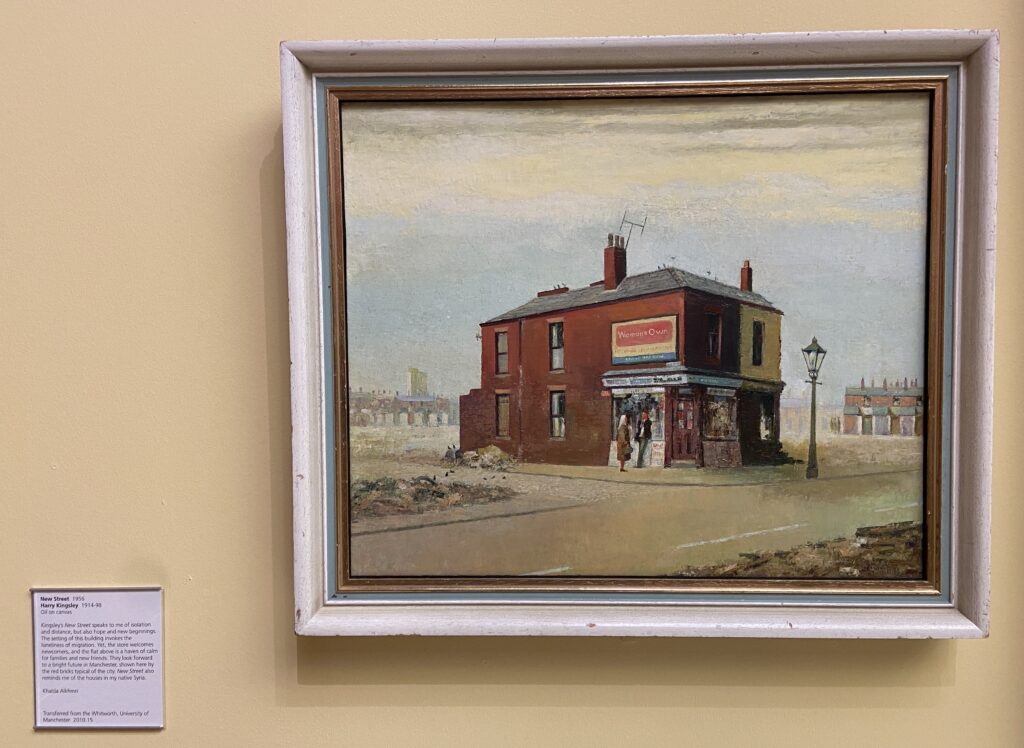
Several of the links were suggested by friends and colleagues, for which thanks. I wasn’t sure what image to use this week, so I’ve simply chosen a favourite painting that I encountered in the Manchester Art Gallery earlier in the year: ‘New Street’, 1956, by Harry Kingsley. I am particularly fond of the television aerial.
• Surrealism against fascism: first up, a remarkable and essential essay by Naomi Klein for Equator about Gaza, fascism, Walter Benjamin, Surrealism, André Breton, Zohran Mamdani and much more:
We’re beginning to glimpse what fascism looks like amid the wreckage of history, with all its ironies and absurdities. But an urgent question remains unanswered: what, in that same wreckage, might antifascism look like? We cannot look to the past for easy answers, since the past has changed us in such fundamental ways. But we can look for clues – including to an antifascist movement of artists and philosophers in which Benjamin himself reserved a special kind of hope.
• Tightrope of hope: … and then the new LRB [£; limited free access] also has a rich essay about Surrealism and resistance to fascism, in this case by Hal Foster, who reviews with his characteristic thoughtfulness Surrealism and Anti-fascism: Anthology edited by Karin Althaus, Adrian Djukić, Ara H. Merjian, Matthias Mühling and Stephanie Weber.
• Around the world in melodrama: 9 countries, 45 essential films: terrific whistle-stop tour by multiple authors of melodrama from nine film industries, including an immaculate British choice by Melanie Williams: Maria Marten, or The Murder in the Red Barn (1935); Brief Encounter (1945); The Wicked Lady (1945); The Remains of the Day (1993); Aftersun (2022).
• In sunny Southland: Paul Thomas Anderson and Thomas Pynchon’s California: I’m still happy to read more about these two key contemporary figures, and Leonardo Goi for Mubi Notebook is worth your attention.
• No film left unscanned: vital thoughts about digital scanning from the archivist, filmmaker, historian and more, Rick Prelinger:
While film preservation should enable universal access to the sum of cinematic creativity, much film is enclosed by copyright or business restrictions. Most films held in archives are still not visible and even fewer are available for reuse. By scanning films that are out of copyright or have no surviving rightsholder, we can open up an immense reservoir of images, sounds and ideas for the makers of the present and the future.
• Whirligig: in the week of its 75th anniversary, Paul Hayes, writing for the History of the BBC website, pays appropriate tribute to the pioneering Saturday teatime series – and what’s more he has a delightful video too:
• How Stranger Things defined the era of the algorithm: a provocative part-visual essay by James Poniewozik, immaculately presented by The New York Times [gift link]:
Stranger Things succeeds in part because of how well it evokes pop culture that audiences already love. It is, in other words, a human-made equivalent of the algorithm, the software engine that has come to define the experience and the aesthetic of streaming.
• The future of photography – a roundtable: a rich and challenging Artforum discussion [£; limited free access] moderated by Pablo Larios, with Ketuta Alexi-Meskhishvili, Thomas Demand, Florian Ebner, Roxana Marcoci, Christian Scheidemann, and Jeff Wall.
• In northern Scotland, the neolithic age never ended: an absolutely gorgeous essay by Alex Ross for The New Yorker [£, limited free access] about the ancient monuments and landscape of the Orkney Islands; great images by Jim Richardson too.
• Tinside Lido, Plymouth (1935): a lovely, positive blog post from Westcountry Modernism (I can’t spot an author’s name) about a beautiful 1930s seaside lido and its rescue and restoration over the past decade.
• Flipping Britain’s post-war script: for The New York Review [£; limited free access], the industrious Ferdinand Mount, whose writings also appear regularly in The TLS and LRB, reviews Kit Kowol’s Blue Jerusalem: British Conservatism, Winston Churchill, and the Second World War which tasks itself
to dig up and, where necessary, demolish the foundations of the conventional narrative of 1945 in Britain and to offer a rival version in which the ‘New Jerusalem’ is painted not Labour red but Tory blue.
• The claims of close reading: Johanna Winant for Boston50Review on a still-radical form of criticism, and on poetry and power.
• How the elite behave when no one Is watching: inside the Epstein emails: even if you feel you have read more than enough on this subject, this exceptional analysis of language and power for The New York Times [gift link] by Anand Giridharadas is well worth your time.
• And finally…: have I shared this before? Almost certainly. But in the wake of Thanksgiving here’s ‘the greatest song ever written about America’, composed of course by Woody Guthrie, and sung by the Boss at the Memorial Coliseum in Los Angeles, 30 September 1985 (which is now forty years ago).
Leave a Reply