
The Sunday dozen
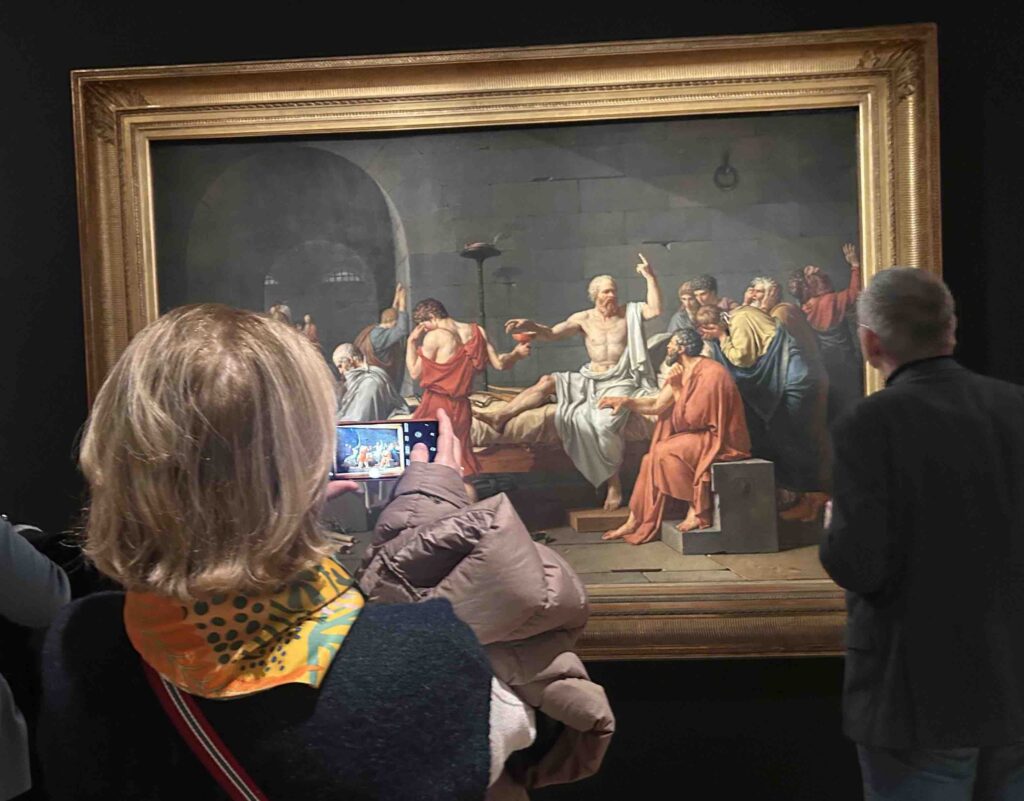
John Wyver writes: Television, photography, modern dance and the legacies of empire are among the topics of articles that engaged me this week. As for the image, it is another from my day trip to Paris on Friday, about which I posted here. I am currently much engaged by watching (and photographing) people photographing paintings in art galleries, and I want to write about this at some point. For the moment, however, enjoy this encounter with Jacques-Louis David’s The Death of Socrates, 1787.
• Public service media – funding and governance options: an important new report, co-edited by Professor Georgina Born and Professor Justin Lewis FBA, and published by The British Academy, free to download, with a range of comparative international case studies, and consideration of possible ways forward in the BBC Charter debate.
• I Know Where I’m Going!: In the wind: a new essay for Criterion’s Current by Imogen Sara Smith about the Powell-Pressburger classic romance.
• Exploring The Wednesday Play‘s legacy at 60 – 03:09 Stand Up, Nigel Barton (BBC1, 8 December 1965): a fine essay by Tom May, with a contribution by John Cook, about Dennis Potter’s semi-autobiographical drama, with production information, historical context and detailed analysis.
• The mischievous ex-bankers behind Industry: Rebecca Mead, as enjoyable and insightful as ever, profiles Konrad Kay and Mickey Down for The New Yorker [£; limited free access].
• The 100 best episodes of the century: one of those completely-bonkers-but-crazily-brilliant lists, in this case from The Ringer: all of American (mostly) television (not just prestige drama and ‘buzzy’ comedies), strictly one episode per show, anything since 2000 (and this is an update from 2018); capsule comments, plus supplementary discussions; lots here I didn’t know, but the top ten is pretty solid.
• Split: a short Shadowplay entry by David Cairns about a subject close to my heart, the use of splitscreen in recent documentaries, including Rebecca Miller’s Mr Scorsese and Errol Morris’ Chaos: The Manson Murders.
• Turner and Constable as they’ve never been seen before: exemplary art criticism from Laura Cumming at the Observer [£; limited free access] responding to Tate Britain’s new exhibition.
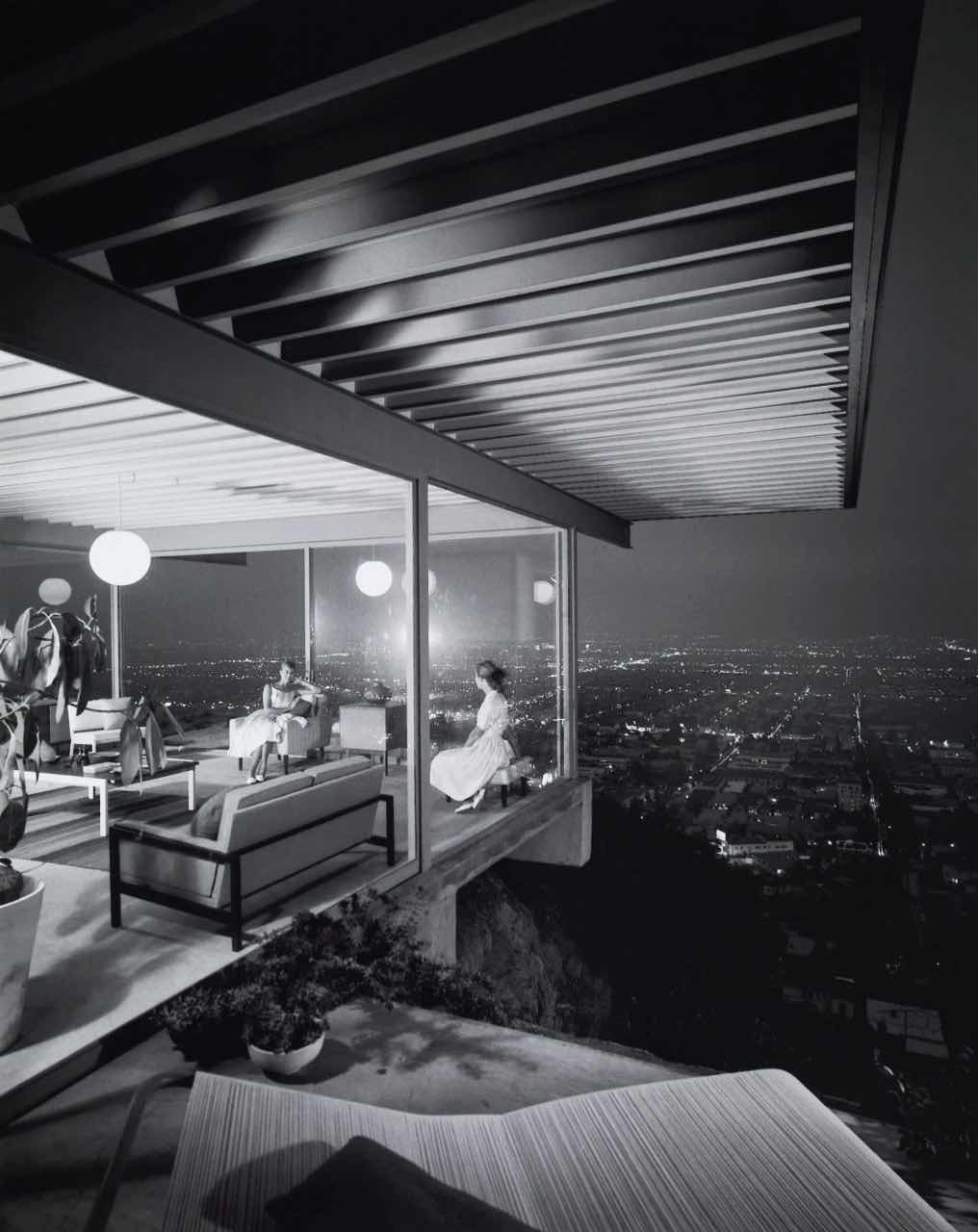
• What the Stahl House says about L.A.: such good architectural criticism by Christopher Hawthorne for the Punch List Architectural Newsletter, focussed on perhaps the most famous architectural photograph of the 20th century (above, Julius Shulman photography archive, Getty Research Institute. © J. Paul Getty Trust):
[W]hat I’ve always found most captivating about the photograph is the way it makes legible—makes glamorous, even—a certain paradox about Los Angeles architecture. Like so many of the city’s landmarks, including the Hollywood Bowl and the Griffith Observatory, the Stahl House earns its quintessential Los Angeles-ness precisely by its distance, and even its estrangement, from the city around it.
• Beginning to see the light: I’m a big fan of Stephen Shore’s photography, and this is a fine review of a show of his early work by Rowland Bagnall for The LA Review of Books.
• I am Martin Parr: BBC iPlayer has this engaging documentary about the photographer – and lovely bloke – Martin Parr who died a week ago. (I still don’t understand why, when there’s room for a four-paragraph description of the documentary, iPlayer cannot find space fort even the most basic credits.)
• Fall for modern dance with this masterpiece [gift link]: a wonderfully imaginative piece of brilliantly illustrated criticism, with video and audio, from Gia Kourlas and theThe New York Times exploring choreographer Paul Taylor’s glorious Esplanade, first danced fifty years ago.
• The empty lab, in science and in fiction: John MacNeill Miller on the problems with lab lit, the ‘small but growing genre of fiction in which central scientific characters, activities and themes are portrayed in a realistic manner’:
For all its efforts to humanize scientists, lab lit is reticent to address the work they actually do in their labs. As a result, the genre proves surprisingly conducive to anti-scientific paranoia. In an era when science is consistently under fire from do-your-own-research dilettantes and dyed-in-the-wool conspiracy theorists, lab lit does as much to stoke anti-science conspiracy theories as it does to allay them.
• Antislavery and the original ‘Scramble for Africa’, 1807-1879: this is a a long and fairly specialist read, but a very worthwhile one, being Alan Lester’s keynote lecture for this weekend’s ‘140 Years Beyond the Berlin Conference’ at the Africa Centre and SOAS.
• The plunderers’ dilemma: Susan Tallman for The New York Review [£; limited free access]:
[I]nstitutions that once proudly announced themselves as repositories of the colonized have been rebranded as “world museums.” Yet many still struggle to articulate a mission that doesn’t smack of fusty scholarship, cultural condescension, and worldviews best not mentioned.
• Cycling for the AI generation: Cillian Kelly on his substack The Backpedal is very good on AI with respect to writing about cycling, and indeed about all else.
• Are you enjoying our linguine?: a touch self-indulgent perhaps, but this is glorious writing by Francesco Pacifico for The Dial.
• And finally… how much are we looking forward to this? The official trailer for the Kino Lorber Blu-ray release of Queen Kelly, directed by Erich von Stroheim, and now finally restored.
Leave a Reply