
The Sunday dozen
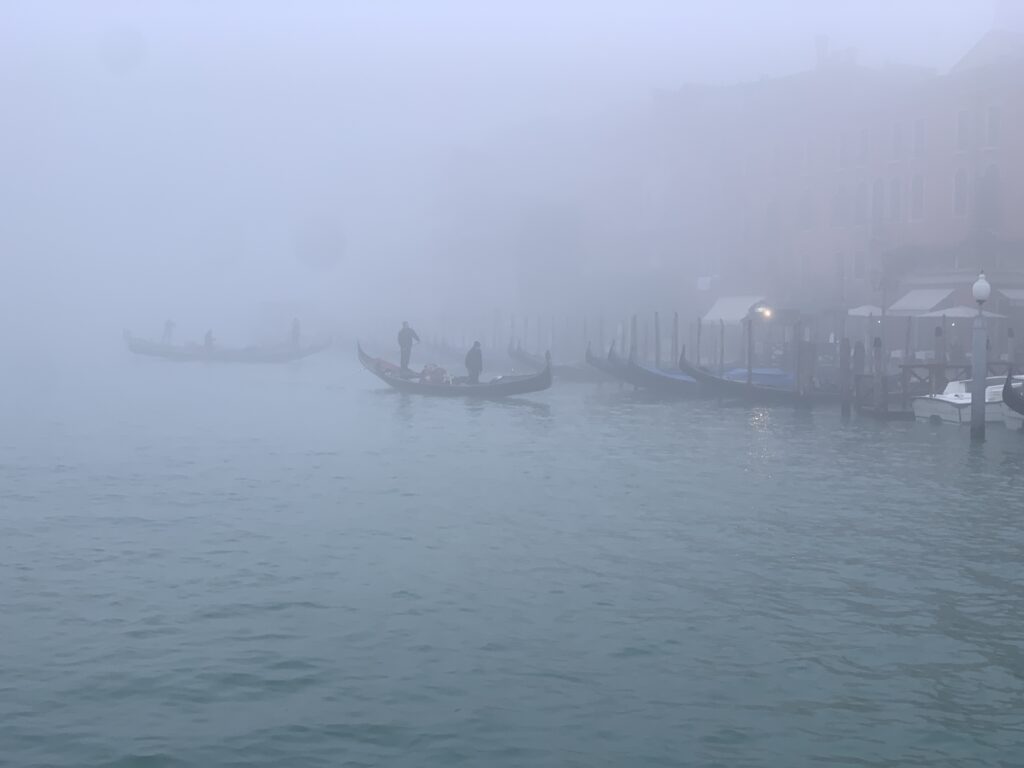
John Wyver writes: Stuff from the past week that has engaged and informed me, with a bias this time towards the USA (but not all of it bad). There is television and film, a trial from the 1920s, a Soviet architect and French feminism. Anne Applebaum’s essay below about two of my favourite things, Henry James and Venice, is my excuse for posting a photo I took in the city early in 2024. It’s also a reminder to me to return, and soon.
• Fixing the BBC: thoughtful contributions gathered by Prospect from Liliane Landor, John Tusa, Razia Iqbal, Sophia Smith Galer, Armando Iannucci, Mark Damazer and Lewis Goodall.
• 1975 Christmas Radio TV Times time travel edition: brilliant from Hannah Cooper at Visual Mutterings – a downloadable .pdf with details of a wide selection of Christmas offerings from television fifty years back, and by clicking on a programme’s entry you get taken to a stream of it.
• Reading with Jean-Luc Godard: Jonathan Rosenbaum this week posted to his personal website his thoughtfully sceptical review, written for Mubi in January 2024, of this exceptional collection from Montreal-based independent publisher caboose books; it happens that I’ve been really appreciating the volume in the past few weeks, in part to complement the screenings in Michael Witt’s rewarding ICA season Jean-Luc Godard: Unmade and Abandoned, the January edition of which has just gone on sale.
• Jean-Luc Godard as architect: … and apropos of nothing, here’s an engaging 2016 BFI-sponsored video essay by Richard Martin and Jon Spira about space in Godard’s 1960s films:
• ‘The ancient and long-forgotten language of cinematography’: a very fine essay for The New York Review [£; limited free access] by Gabriel Winslow-Yost about the death of cinema and Bi Gan’s film Resurrection:
Resurrection feels so much more joyful than any other elegy for cinema I’ve seen. With film dead, maybe we simply have less to worry about: there’s nothing we need to do to keep it alive, no reason not to take whatever parts seem useful and use them however we want.
• What Dickens knew about Christmas decorations: Helen Barrett’s delightful essay from her Sounds and Visions blog is the second holiday-themed entry this week.
• A revelation tore apart her fairy-tale marriage, and shocked the nation: a remarkable tale of class, sex and race from the early 1920s, by Laura Wexler for The New York Times [gift link].
• Stalin’s architect: the remarkable life of Boris Iofan: Deyan Sudjic with a wonderful excerpt from hios book Stalin’s Architect: Power and Survival in Moscow, including a discussion of Yuri Trifonov’s 1976 novella The House on the Embankment which is set in Iofan’s most significant building.
• Henry James’s Venice is still here: truly lovely from Anne Applebaum for The Atlantic [gift link]:
Before it’s too late—before Venice sinks into the lagoon, before James’s oblique writing falls out of fashion again, and, frankly, before I am so consumed by the current global political crisis that I can’t appreciate Venice anymore—I set out to find the secret city that he loved, and that I love too.
• Two pins and a lollipop: Bee Wilson for the LRB [£; limited free access] is great on Judy Garland, which is especially apposite for me since after at least a decade our family has forsaken our usual Christmas movie of It’s a Wonderful Life and we are going instead on Monday to Meet Me in St Louis (which may or may not deliver).
• ‘This land is your land’: I know I’ve posted it before, but there are times, including after this past week, when we all just need reminding of the good times – here’s Pete Seeger, Bruce and friends singing Woody Guthrie’s anthem at the ‘We Are One’ Presidential Inaugural Concert, January 19, 2009:
• Origin Story – The New Left: a very fine two-parter podcast from Ian Dunt and Dorian Lynskey, although these are mostly Lynskey’s; the pair’s deeply informed but lightly informal treatment works exceptionally well here.
• Hélène Cixous, The Art of Criticism No. 7: for The Paris Review, Alice McCrum interviews the great ‘critic, philosopher, theorist, novelist, memoirist, feminist’:
Cixous and I first spoke this past spring, in a phone call to arrange our in-person sessions. She was stern, though impish. When I asked whether she’d prefer to conduct our conversations in English or French, she asked, “Do you speak cat?” (We spoke a combination of the two, with Cixous occasionally addressing Haya, who often lay on the table between us.)
• Susie Wiles, JD Vance, and the ‘junkyard dogs’: The White House Chief of Staff on Trump’s second term (Part 1 of 2): Chris Whipple’s absolutely extraordinary reporting for Vanity Fair [£; limited free access] key Tr*mp administration figures…
• The Vanity Fair photographer who disrupted Trumpworld’s polished image: … and an interview by Shane O’Neill for The Washington Post [£; limited free access] with photographer Christopher Anderson about the unforgiving portraits that he took to complement the article.
• I’m Kenyan. I don’t write like ChatGPT. ChatGPT writes like me: an important contribution from Marcus Olang to the AI debates:
I am a writer. A writer who also happens to be Kenyan. And I have come to this thesis statement: I don’t write like ChatGPT. ChatGPT, in its strange, disembodied, globally-sourced way, writes like me. Or, more accurately, it writes like the millions of us who were pushed through a very particular educational and societal pipeline, a pipeline deliberately designed to sandpaper away ambiguity, and forge our thoughts into a very specific, very formal, and very impressive shape.
• And finally…: we lost the great Joe Ely this past week; this is Matt Eskey’s gorgeous video to Eley in 2024 performing ‘Odds of the blues’, with the bonus of the Boss:
Leave a Reply