
The Sunday dozen
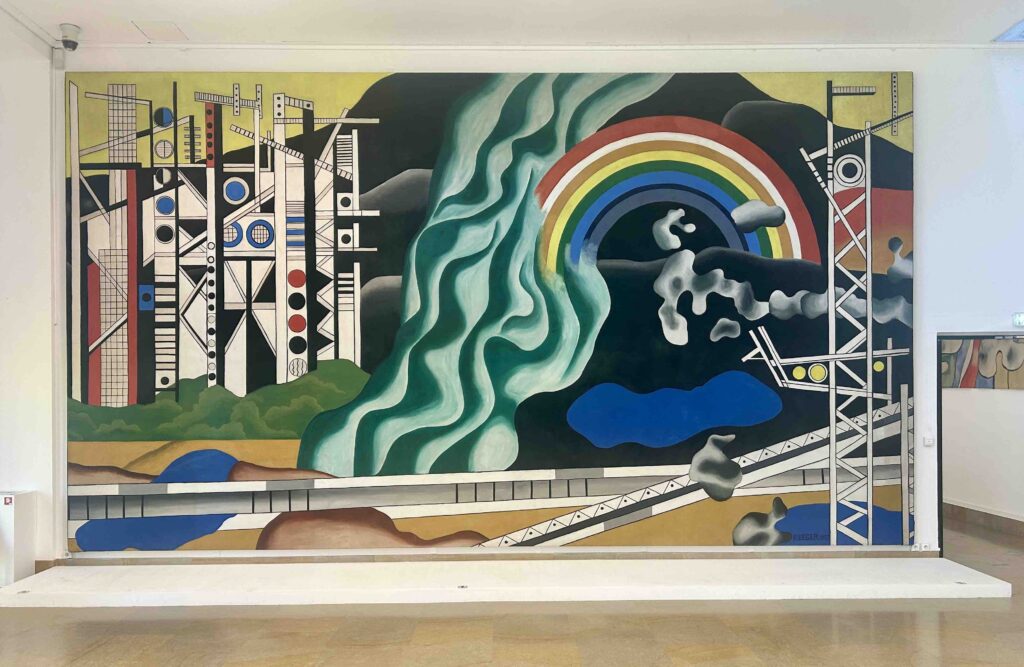
John Wyver writes: too much politics today perhaps, but it’s been that kind of a week; otherwise there are a couple of great film links and a terrific AI essay, along with other articles well worth your time. This week’s image is Fernard Léger’s great 1937 mural Le Transport des Forces, which I admired greatly at the Fernand Léger National Museum at Biot this past summer.
• Film Studios in Britain, France, Germany and Italy – Architecture, Innovation, Labour, Politics, 1930-60s: in addition to my Magic Rays of Light, on Thursday Bloomsbury published this substantial and exceptional volume edited by Sarah Street and six other scholars; thrillingly – thanks to funding from the European Research Council – it’s entirely free to download.
• Talking about Wajda…: Michael Brooke’s Substack postings about central and eastern European cinema are already proving to be essential, so do subscribe; this one is especially good, about his experience in creating commentary tracks for Andrzej Wajda’s The War Trilogy; note also that BFI Southbank has a major Wajda retrospective next month.
• Death to the celebrity documentary: John Bleasdale for The New World on AKA Charlie Sheen, Being Eddie and more:
What did I learn? Nothing. These are anti-documentaries in that, after watching them, you know less than you did when you began. They serve as image curation and have as much bite as the fluffer on the set of a porn film.
• V&A East: the spirit of the 19th-century cultural campus of ‘Albertopolis’ lives on: for The Conversation, Bill Sherman, now running the Warburg but formerly the V&A’s director of research and collections, looks backwards and forwards as he anticipates the opening of V&A East.
• Trump’s assault on the Smithsonian: ‘The goal is to reframe the entire culture of the US’: Charlotte Higgins excellent on a central strand of the war on culture in the United States; see also from The New York Times [gift links], The Smithsonian faces new pressure to submit to Trump’s will and Smithsonian removes label noting Trump impeachments.
• Richard Serra / Steve Reich: this is some kind of wonderful, thanks to Gagosian Quarterly – a 10-minute video(sadly not embeddable) with musical ensemble Sō Percussion performing Steve Reich’s Music for Pieces of Wood inside the exhibition Richard Serra: Running Arcs (For John Cage), 1992, at Gagosian, New York.
• The most successful information technology in history is the one we barely notice: at BigThink, Joel Miller, author of The Idea Machine, reflects on the extraordinary success of the book.
• The robot and the philosopher: writing for The New Yorker [£; limited free access] photographer Dan Turello is at a conference about AI in Florida when he asks himself a question: ‘What if I were to photograph Sophia—a humanoid robot developed by Hanson Robotics—and then, in a separate session, the philosopher David Chalmers, a prominent theorist of consciousness, and reflect on the experience?’ His thoughts make for a great read.
• Dogwhistles, discrimination, humour and the law: regulating implicit messaging: from the Open Library of Humanities Journal, a lengthy, academic essay that makes many important points in its exploration of ‘how implicit, discriminatory messages bypass sanctions in the United Kingdom and beyond, despite their potential for significant societal harm.’
• Enemies within and without: your periodic reminder to read Chris Grey’s essential Brexit & Brexitism posts, of which this is the latest:
As 2026 starts, the isolation and division which characterises post-Brexit Britain is clearer than ever and, although some criticisms of it are unfair, the government’s weakness and unpopularity make it inadequate to the task of dealing with the scale of the dangers the country faces.
• On Venezuela: historian Tony Wood for the LRB [£; limited free access] with a particularly rich analysis of the past week’s events…
• Trump, Venezuela and the doctrine that wouldn’t die: … while Greg Grandin for the Financial Times [gift share] provides the Monroe Doctrine context…
• Life under a clicktatorship: … and Dan Moynihan sets events in the context of the US administration’s addiction to social media:
The Trump administration is made up of a cabinet of posters. For many, that’s how they won Trump’s attention. The head of the FBI, for example, is a podcaster—that’s his main qualifier for the job. They view the world through a social media lens in a way that is plausibly corrupting their judgment and undermining their performance.
• And finally…: Jeremy Millar wrote online that this was ‘the one damn song that can make me break down and cry’, I know what he means; marking the tenth anniversary of David Bowie’s death, this is from The Dick Cavett Show in 1974:
Leave a Reply