
The Sunday dozen
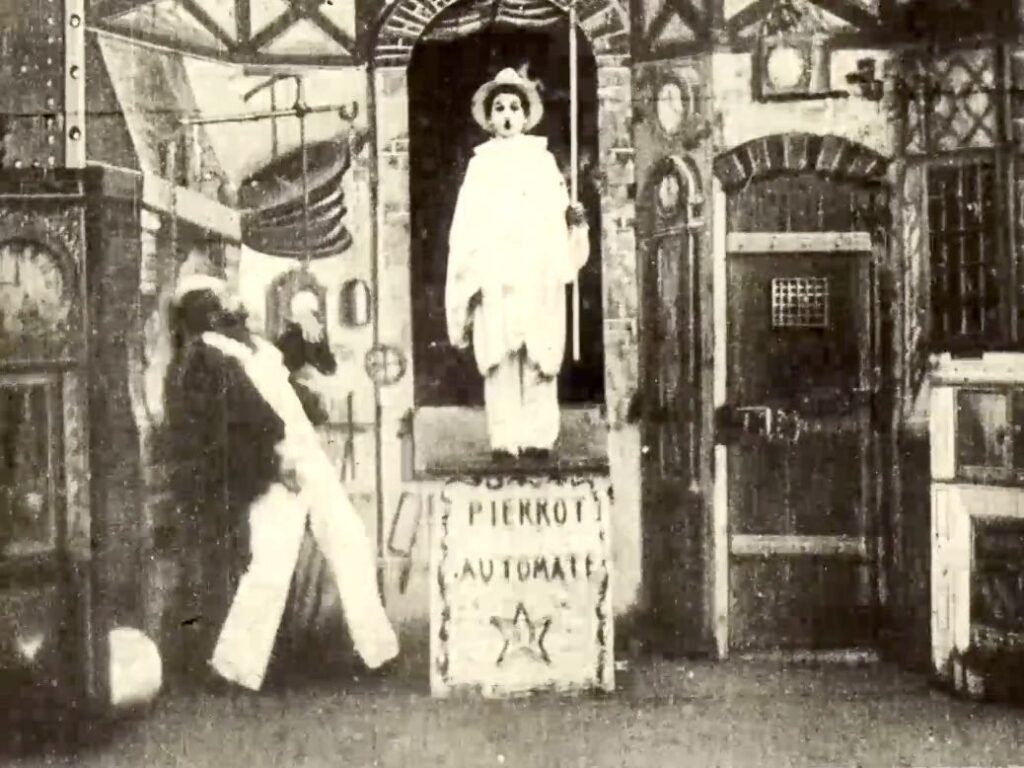
John Wyver writes: welcome to links to some of what I found vital and valuable in my week’s reading and viewing, starting with a fine discovery at the Library of Congress which is illustrated above.
• Lost 19th century film by Méliès discovered at the Library: a cheering blog post by Neely Tucker from the Library of Congress about the discovery and restoration of a previously unknown George Méliès film, Gugusse et l’Automate (Gugusse and the Automaton), which you can view via the links, and a framegrab of which is this week’s header image:
The 45-second film, made around 1897, was the first appearance on film of what might be called a robot, which had endeared it to generations of science fiction fans, even if they knew it only by reputation. It had not been seen by anyone in likely more than a century.
• Unraveling 60 years of donor paperwork at the UCLA Film & Television Archive: another positive tale from a moving image archive, in this case about the immense work necessary to tidy up all the 4,000 sets of donor agreements; the post includes a link to the Archival Collections Assessment Project (ACAP) Rights Toolkit, with suggested model agreements.
• The British New Wave outlier that tested Laurence Olivier: another enjoyable blog post by the BFI’s Jo Botting about an obscure but clearly richly interesting British film, in this case Term of Trial, 1962, directed by Peter Glenville.
• Elvis in IMAX: how newly found footage became an immersive documentary: I’m really looking forward to seeing Baz Luhrmann’s collage concert film EPiC: Elvis Presley in Concert this coming week at BFI Imax; this New York Times article [gift link] by Jason Bailey is useful background, as is Jim Farber’s Guardian piece, Baz Luhrmann: ‘There’s the image of Elvis and then there’s the man’; and here’s the ridiculously enjoyable 100-second trailer:
• Two more links to further viewpoints about the films of the late ghreat Fred Wiseman:
- Frederick Wiseman always made his point: Vikram Murphy for The Atlantic [gift link]: By focusing on how organizations operate, he captured their central character, and gave voice to the people caught up in their intricate systems.
- Frederick Wiseman: Joyce Lineham at Roving Woman posted this truly lovely recollection of the part she played in securing access for the filmmaker to shoot City Hall.
• Cutscenes | against the cutscene: for MUBI Notebook, Matt Turner is terrific on the history and meaning of the mini movies embedded in video games.
• : a fascinating short essay by Oliver Wake about the unlikely comings together of two of the most significant imaginative worlds of British television.
• British Blonde – Women, Desire and the Image in Post-War Britain: speaking about her recent wonderful book, my friend Lynda Nead is so articulate and thoughtful in this recent New Books Network podcast.
• Flash and thunder: a learned and enjoyable demolition by Michael Dobson for LRB [£; limited free access] of Stephen Greenblatt’s new book about Christopher Marlowe, Dark Renaissance.
• Want to understand Honoré de Balzac? Try Dungeons & Dragons instead of literary theory: I really enjoyed Harsh Trivedi for The Conversation on tpology, Georg Lukács and using the role-playing game as a lens for approaching Balzac’s great cycle of novels The Human Comedy.
• Reading at random with Virginia Woolf: a dense, delightful reflection, to be read slowly and carefully, by Frances Lindemann for The Paris Review on the fragmentary draft’s of Woolf’s final and unfinished work.
• Building the electrostate: for The New York Review of Books [£; limited free access], Sandeep Vaheesan is so good on the history of public power in the United States.
• It really can happen here: Juliette Bretan for LA Review of Books on transnational links between fa-right and fascist groups in the 1930s and today.
• On joy and resistance: the message of this short piece by Dan Sinker about Alysa Liu and Bad Bunny remains as essential as ever:
Because in spite of the administration’s crackdowns, in spite of the masked bastards, in spite of everything, people are still speaking up, people are still making art, people are still teaching real history, people are still fighting back against the abduction of their neighbors. People still know what it means to feel joy. People still know what it means to be free.
• And finally…: Richard Williams’ essential blog thebluemoment.com this week warmly recommended Maria Schneider’s new composition ‘American Crow’, performed by the Maria Schneider Orchestra, which is featured below, and which comes with this echo of Dan Sinker’s thoughts:
We’re living through a crisis of listening, shaped by increasingly curated perspectives that widen the space between us. Jazz teaches us something different — that listening, responding, and collaborating are at the center of its beauty. I believe those same qualities lie at the heart of a healthy democracy. In that spirit, as we mark the 250th year of America’s democracy, these are the values I wanted to share through music.
Leave a Reply