
The Sunday dozen
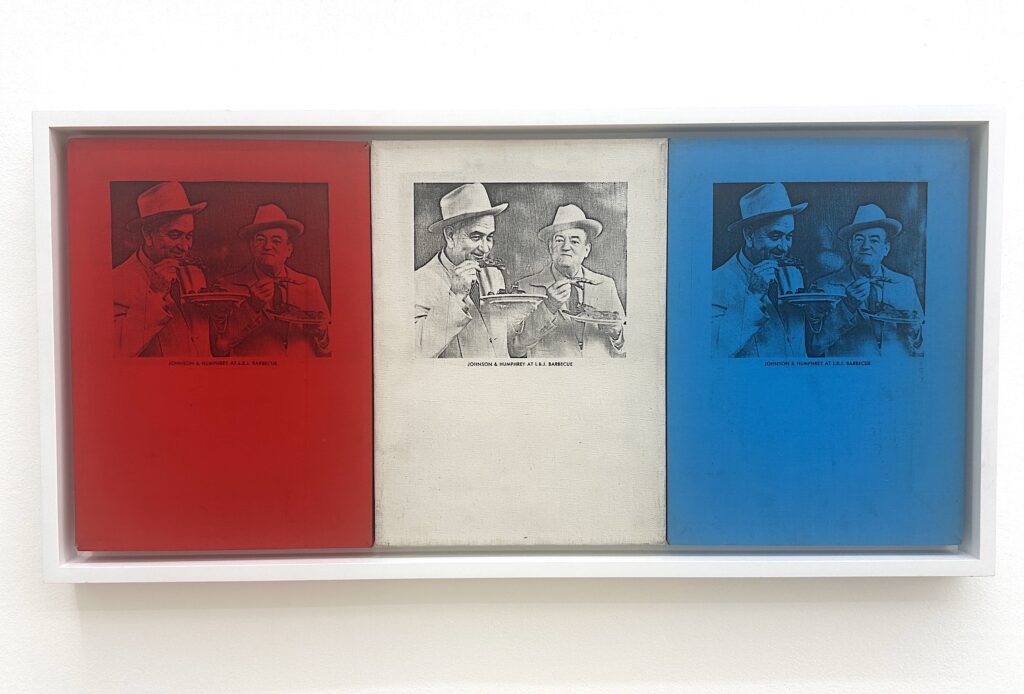
John Wyver writes: Happy Birthday, America! I think. At least that’s the title of a delightful small exhibition at London’s Mayor Gallery, which includes the artwork in the header above. It’s Billy Apple’s ‘The Presidential Suite: Johnson & Humphrey at L.B.J. Barbecue, 1964’, Xerography and paint on linen.
Otherwise, here’s another selection of stuff that has engaged and interested me over the past week. No Knicks, although I’m thrilled for them, for their fans and for New York, and no World Cup (maybe next week), but rich pickings nonetheless.
• An extended apprenticeship: a lovely piece of writing by Farran Smith Nehme about the director John Sturges at Columbia between 1946 and 1949, originally published in the Locarno Film Festival’s 2024 book The Lady With the Torch: Columbia Pictures 1929 – 1959, and just reprinted online.
• What are Frederick Church’s stunning landscapes trying to tell us: a fine essay about the 19th century landscape painter by Susan Tallman for The Atlantic [gift link].
• A dose of Duchamp: Hal Foster is among my favourites of the regulars for LRB, and this [£; limited free access] is his fine review of the Marcel Duchamp retrospective currently at MoMA.
• Search Isotype designs…: one of the finest and most pleasing online visual rabbit holes that I’ve found — a glorious design archive of Isotype Institute charts by RJ Andrews.
• The long road to Margaret Thatcher’s Britain: Rebecca Mead for The New Yorker [£; limited free access] on Paul Graham’s book “A1: The Great North Road,”, originally published in 1983 and reissued this month by Mack; article includes a clutch of powerful images by Graham.
• Greater London’s overlooked Art Deco railway stations: I loved this illustrated trip round some terrific architecture by Daniel Morris for London Connections.
• Composer of the week – Miles Davis 100: I’m late to this group of five fine engagements with Miles by Kate Molleson and critic Nate Chinen for Radio 3 — biography, analysis and lots of simply great music, including:
• 20 ways Taylor Swift remade pop culture in her image: I knew remarkably little about Taylor Swift but after hugely enjoying this strikingly imaginative Guardian presentation by Shaad D’Souza, Owen Myers and Laura Snapes I am much better informed, and grateful for it; the form suggests some eager students this side of the pond of the digital The New York Times (which is a good thing).
• Florentina Holzinger’s 9-hour spectacle pushes the limits of Body Art: having seen a performance by Florentina Holzinger and her company in Paris last year, I am fascinated by her work. This is a terrific report from Vienna by Valeriya Safronova for The New York Times [gift link] about a one-time performance involving a cast and crew of 58.
• Rash reading, slow watching with Virginia Woolf and Chantal Akerman: Ria Banerjee for Public Books:
To learn to read via Woolf and Akerman is, crucially, about the proper exercise of our rights as citizens and cultural co-creators. Reading is a form of political thinking, argued Woolf in her 1926 essay “How Should One Read a Book?” For her, reading was an exercise of civil liberties, and she answers the question in her title by centering “that independence which is the most important quality that a reader can possess.”
Already a regular reviewer for the TLS and author of many books by the time she asked, not quite innocently, how one ought to read, Woolf rejects the commonplace hierarchy between writer and reader. If we expected Woolf to be an author who would want her reader to pay close attention, nose to page, then she surprises us with her actual recommendation: “Is there not an open window on the right hand of the bookcase? How delightful to stop reading and look out!”
• Nina Simone knew just what the trouble was. (It’s still the trouble.): an exceptional analysis by Wesley Morris for The New York Times [gift link] of the great singer’s ‘Mississippi Goddam’.
• The IRA men behind the Manchester bomb: Unravelling a 30-year mystery: such an interesting investigative essay by Toby Harnden and Jack Dulhanty for The Mill.
• The world has moved on: a wonderful essay about nostalgia and much more by Cory Doctorow for his Pluralistic spinning off from the Dark Tower novels.
• The poverty of digital life: this too is very good from Angel Marino about the state of the online world.
• Jagged Intelligence — The dangerous unknowns at the heart of LLMs: a particularly thoughtful contribution to the AI debate by Melanie Mitchell for The Yale Review.
• Pokémon Go scans quietly trained the navigation tech now headed into military drones: I saw someone online describe this story, by Haye Kesteloo for DrexEl, as ‘insane’, which it is, although perhaps not more than anything everywhere all of the time.
• And finally…: Sheryl Crow and the Boss performing Dylan’s ‘I Shall be Released’ on 5 June at one of the opening concerts for the Bruce Springsteen Center for American Music.
Leave a Reply