
Tony Blair faces the camera
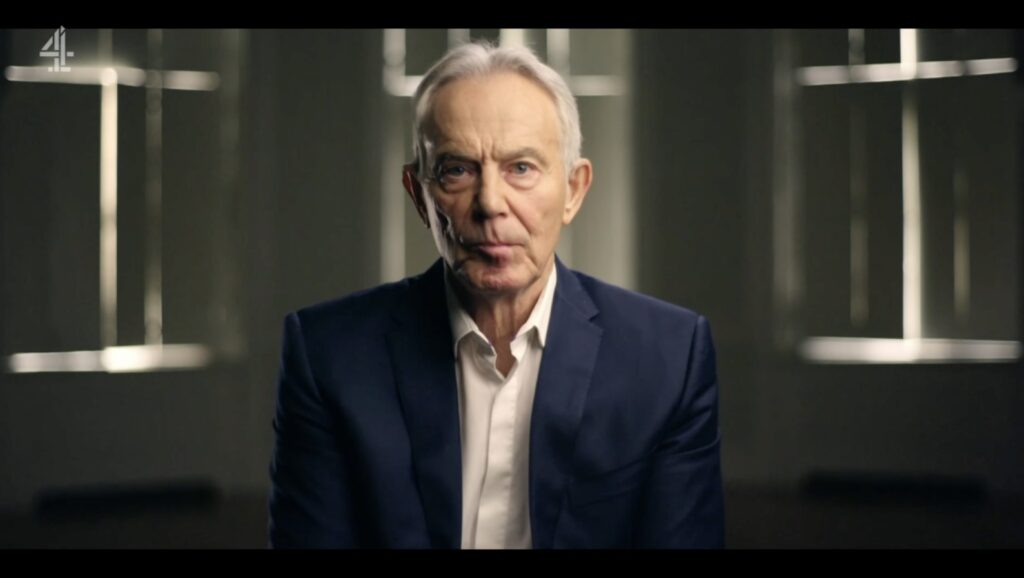
John Wyver writes: I have hugely enjoyed Channel 4’s The Tony Blair Story (broadcast last week and available on catch-up), for which the series director and narrator is Michael Waldman (who I should own is a friend). Perhaps there are no great revelations, and perhaps as Jack Seale wrote for the Guardian, ‘It’s sadly lacking in the granular detail that would really put his actions under the microscope.’
As a sweeping overview, however, the trilogy is compelling, with exceptional interviews, from the Blair family as well as Alastair Campbell, Anji Hunter, Robert Harris and many others (although no Gordon Brown). The use of an astonishing range of archival images is finely orchestrated, the score is rich, and overall it’s a highly distinctive, artful and finely delivered package.
I want to reflect briefly on just one aspect: the central interview with Blair, a screengrab from which is above. He is centrally framed, set against an abstracted background, and for most of the time he speaks directly into the camera. In each of these respects, the set-up is is notably different from all of the other interviews in the films. These are placed in home or work real world contexts, and arranged as television’s usual three-quarter profile shots, speaking to an interviewer placed off to the left or right of frame.
The direct-to-camera address is usually reserved for presenters, newsreaders and those giving party political broadcasts, and it is almost a cliché of media studies that it conveys authority and authenticity. But is that the effect here, I wonder, or is this an image of a figure in the dock responding to the accusations of a prosecutor?
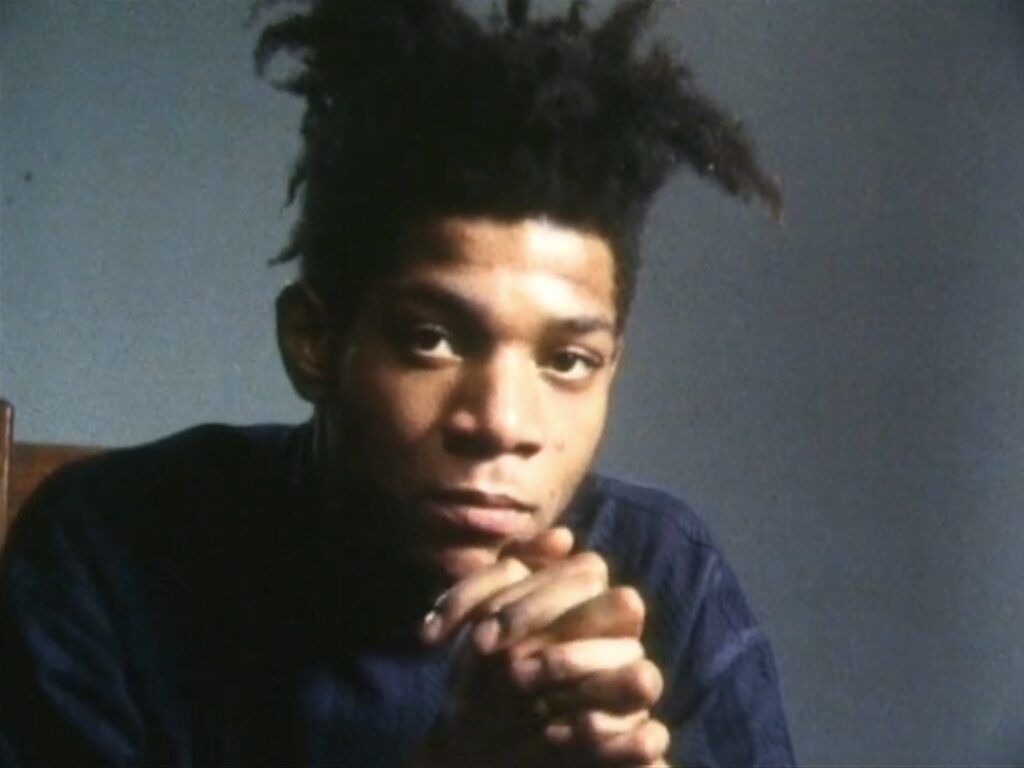
The effect is achieved, I believe, by the interviewee looking into a half-silvered mirror placed at a 45-degree angle in front of the camera lens. On the mirror the subject sees the face of the interviewer who sits to one side, in effect positioned at a 90-degree angle. The interviewee has the sense of speaking directly to the questioner, whereas they are in fact looking straight into the camera.
(Part of the set-up can be glimpsed in the ‘B’ camera shots taken from one side of the arrangement, where what I presume are Michael Waldman’s knees and his notepad are visible.)
My colleagues Geoff Dunlop, Sandy Nairne and I used a similar arrangement lomg ago in 1985-86 for the interviews in our six-part Channel 4 series State of the Art. Our director of photography Jeremy Stavenhagen built a mirrored box which we schlepped in its own flight case around Europe, the United States and Australia. Here it is in use in the interview we shot with Jean-Michel Basquiat in New York in 1986, in a sequence that can be seen here.
The documentary filmmaker Errol Morris claimed the invention of a version of this gadget that he dubbed the Interrotron (and which he apparently intended to patent). Much more about its use can be found here. Morris spoke about it in an interview from which these quotes are taken:
I put my face on the Teleprompter or, strictly speaking, my live video image. For the first time, I could be talking to someone, and they could be talking to me and at the same time looking directly into the lens of the camera. Now, there was no looking off slightly to the side. No more faux first person. This was the true first person.
I worried at first. Would it frighten people? Would they run out of the studio screaming? Who could say? I used it for the first time in Fast, cheap and out of control [released in 1997]. And it worked like a charm. People loved the Interrotron.
The modernist grey-and-silver grid behind Blair is also striking. Windows, perhaps, into the wide world beyond? Yet what might be apertures are black and blank, isolating the figure and, perhaps, cutting him off from reality. But perhaps they are bars of a prison cell? Or, given Blair’s religous faith, should we read the pattern as suggestive of three, just slightly-out-of-focus, crosses at Golgotha, and if so, how does that colour our understanding of the figure before them?
There is one other highly distinctive technique used in the interview with Tony Blair, as well as in some of the others in the programme, notably that with Cherie. The camera stays on the person after they have finished speaking, not cutting away for one, two, sometimes three beats. Emotions can be seen to flicker across the face — of satisfaction perhaps, or relief, or maybe a momentary flash of did-I-get-away-with-that?
This style of interviewing was sometimes used by the wonderful filmmaker Jana Boková, and especially in her Quinn Running, 1980, her extraordinary Omnibus profile of actor Anthony Quinn (which frustratingly is not online). She was sparing in this resting of the camera on a just-having-spoken face, but for the viewer it opened up her subject, who had done a thousand interviews before, in new and complex ways.
As I would argue, does the remarkable central interview in The Tony Blair Story.
Further to the above, Sandy Nairne, who after State of the Art went on to be director of the National Portrait Gallery, has pointed out that Alastair Adams was commissioned by the gallery to paint Tony Blair and chose a close-up direct address composition; the striking painting can be seen here: https://www.npg.org.uk/collections/search/portrait/mw210898/Tony-Blair
I’m now curious whether the makers of the Channel 4 series were, in some part, inspired by this painting to frame the interview in the way that they did.