
Tales from the forest
John Wyver writes: In 2007 the great Polish director Andrzej Wajda, then in his early eighties, released Katyń, a historical drama about the massacre across thrtee months in 1940 of at least 14,000 Polish officers and intelligentsia. This lavish, grim, powerful film was screened on Tuesday as part of the BFI Southbank season Andrzej Wajda: Portraits of History and Humanity that is just drawing to a close.
Nearly forty years earlier the Hungarian documentary filmmaker Robert Vas also made a film, ‘…the issue should be avoided’, about the Katyn Forest massacre. This ‘documentary investigation’, produced for BBC television, is an exceptional example of Vas’ rigorous approach to history on film, and is one of the productions to be considered in the symposium Robert Vas in Context on Friday 27 March. Tickets for the event, which are free, on Friday 27 March at Birkbeck, University of London, can be booked here.
Wajda’s feature, which he discusses here in a 2008 Guardian interview, is a sweeping tale centred on a cavalry captain, who is murdered, and his wife, who refuses to believe he is dead. The massacre itself is staged in the film’s concluding graphic sequence following a chronicle that begins in September 1939 with refugees in Poland fleeing the invading armies of both the Germans and the Soviets.
The film details the context leading up to the massacre, which took the life of Wajda’s own father, and shows how it was intended by Stalin to destroy the majority of those who might give form to a post-war Polish state. But the drama is as concerned with events in Poland after the war when Stalin’s ruling regime decreed that the massacre had been carried out by occupying Germans. Challenging this claim could have dire consequences throughout the period of Communist rule up to 1989.
As Wajda said,
I was only able to make Katyń after the fall of the Polish People’s Republic. After 44 years of lies, when there was only one Soviet truth: that the Katyn massacre was committed by the Germans.
Robert Vas’ austere and no less powerful documentary largely eschews reconstruction, although it makes extensive use of photographs and the German newsreel footage shot when the mass grave was discovered in 1943. The thankfully low-resolution images, which also feature in Wajda’s film, are graphic and shocking, and are brought forward here as essential evidence in Vas’ investigation.
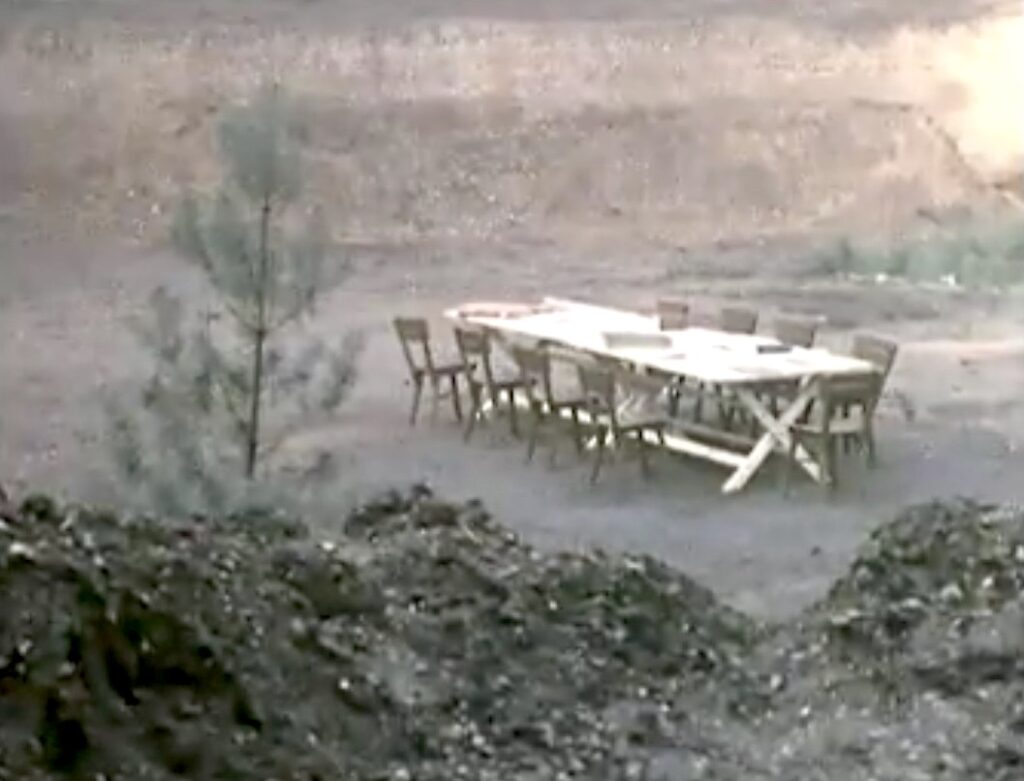
Imaginatively staged as a kind of makeshift tribunal in a clearing in Epping Forest (in the header image), ‘… the issue must be avoided’ (the phrase is Winston Churchill’s) has a group of male actors recounting events and putting forward the competing arguments that the Germans carried out the massacre versus, as was much latter acknowledged by Russian authorities, that it was the work of Stalin’s secret police, the NKVD.
(The Wikipedia entry on the Katyn Massacre has exceptional detail about the events and later investigations.)
Vas also features interviews with three of the Poles who were among the 440 men held in the camps with those who subsequently died, but who somehow, perhaps because they were pro-Soviet symnpathisers, were spared.
Representative statements by the Poles, the Soviets, the Germans, and also the Allies, are put forward in what the film claims to be a dispassionate attempt to weigh the evidence between the competing narratives. As the Guardian’s critic at the time Peter Fiddick wrote: ‘Very cool. Very Brechtian and alienated. No verdict.’
For the Sunday Telegraph, Philip Purser admired Vas’ approach which he described as ‘artificial and ceremonious and eventually illogical and yet conveyed a sense of awful isolation’. But he was disturbed by what he saw as the film’s fence-sitting:
What left me ultimately unsatisfied, even mutinous, was a certain mealy-mouthed reluctance to apportion responsibility, The evidence pointed overwhelmingly to the guilt of the Russians…
Seen today it appears entirely clear that Vas indicts the Soviets, while at the same time exposing, as the use of the Churchill quote suggests, the complicity of the Allies in the convenient avoidance of the issue both during the war and at the Nuremberg trials afterwards.
And with references spoken by Michael Briant, who is the moral centre of the fillm, to the My Lai massacre and to the Sharpeville massacre, Vas points up the continuing horrors of war crimes, and especially the lies that the powerful tell about them. As I viewed … the issue must be avoided’ this particular week, its investigation carried an especially powerful charge.
Leave a Reply