
The Eye of the (African) Artist
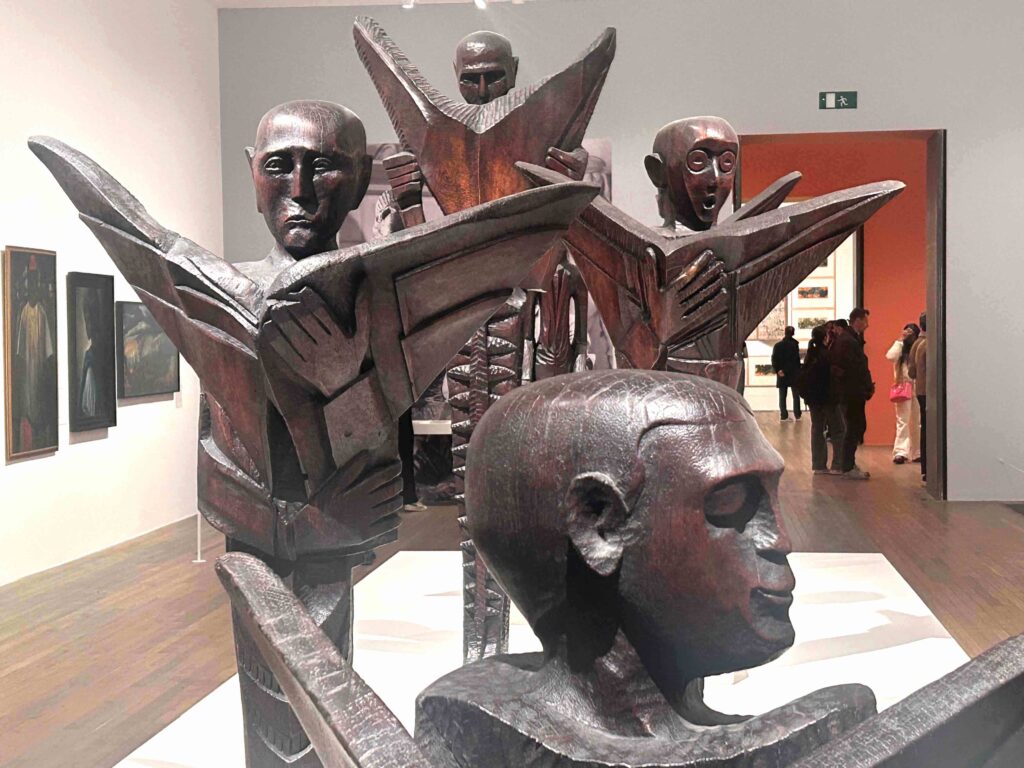
John Wyver writes: To Tate Modern for the richly interesting Nigerian Modernism exhibition (until 10 May) which is packed with the work of artists of whom I knew nothing. The second room is devoted to the art of Ben Enwonwu (1917-1994), with numerous paintings, and with its central island dominated by seven immensely striking wooden sculptures (detail above) commissioned by the Daily Mirror in 1960.
Hailing him as ‘arguably the most influential African artist of the 20th century,’ Wikipedia notes that ‘his pioneering career opened the way for the postcolonial proliferation and increased visibility of modern African art.’ For a more detailed discussion of his work, life and ideas, see Tate’s online essay by Bea Gassmann de Sousa, ‘Decolonising Nigerian Modernism: Ben Enwonwu’s “Identity in Politics”‘.
Intriguingly, Enwonwu was the focus for an edition of the first post-war television series about the visual arts. The Eye of the Artist, overseen by the pioneering talks producer Mary Adams. The occasional broadcasts began on 7 October 1947, a little over a year after the television service resumed after the conflict, and the programme featuring Enwonwu was shown on 3 February 1948, with the Radio Times billing below.
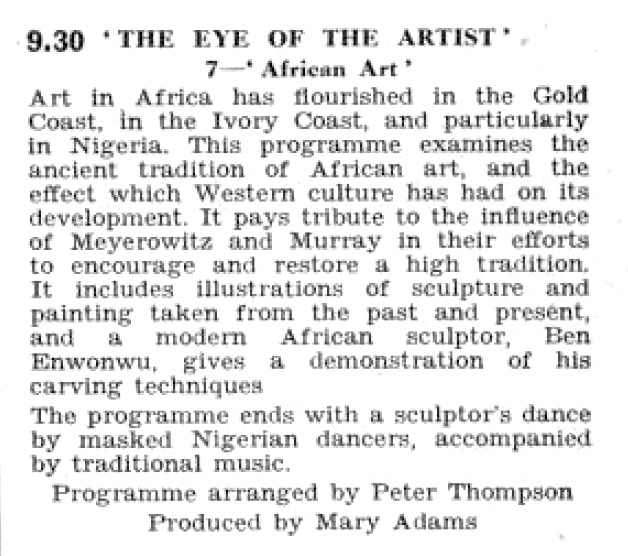
Not that you would know it from this billing, but both H.V. Meyerowitz and Kenneth Murray were key figures in the development of art education and the preservation of African art traditions during the colonial period in West Africa (1930s-1940s).
Meyerowitz was a Russian Jewish sculptor, artist and British colonial adminstrator who became the Head of the Art Department at Achimota College in the Gold Coast (now Ghana). Murray was similarly a British colonial administrator, who worked as a teacher and curator, and who is recognised as having founded the ethnographic museum service in Nigeria.
The Eye of the Artist series featured bought-in films about Matisse, Maillol and Rodin, as well as discussions of how paintings in the National Gallery collection were cleaned and plans for redesigning Westminster Precinct. But it had a wide-ranging agenda, with one programme featuring four Chinese artists (billed as Mr. A. C. Chang, Miss C. Y. Chang , Mr. C. W. Fei and Mr. S. H. Chen) working together in the studio on a single picture, and another complementing a Royal Academy exhibition about art from India with this line-up, again as described by Radio Times:
The programme introduces works of particular interest and shows the relationship between sculpture, the dance and music… Those taking part include Mr. Ram Gopal, India’s leading dancer, and members of his company. Musical arrangements are by Mrs. Dipali Nag. Dance Forms described by Mr. Michael Rouse and Sculptures introduced by Mr. K. de B. Codrington, Keeper of the Indian Section of the Victoria and Albert Museum.
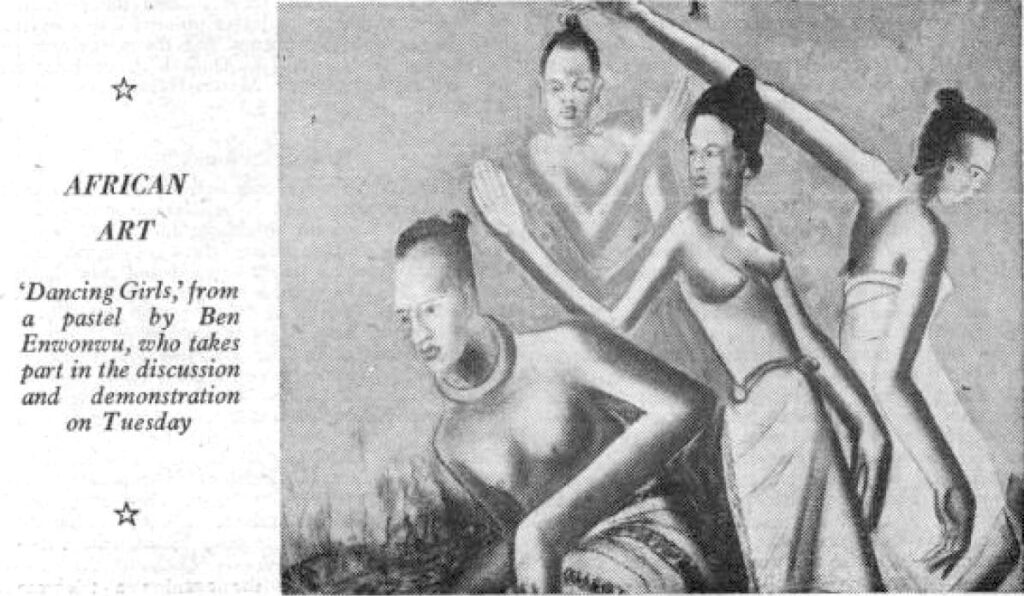
No recordings are known to exist of any of the original programmes, but for the edition in which Ben Enwonwu appeared, Radio Times also featured a detail from his ‘Dancing Girls’, a 1947 pastel and gouache on paper that now is in the UK Government Art Collection (the web page has a colour reproduction) and which currently hangs in Tate Modern.
Leave a Reply