
British television in the end times of silent cinema, 1928-30
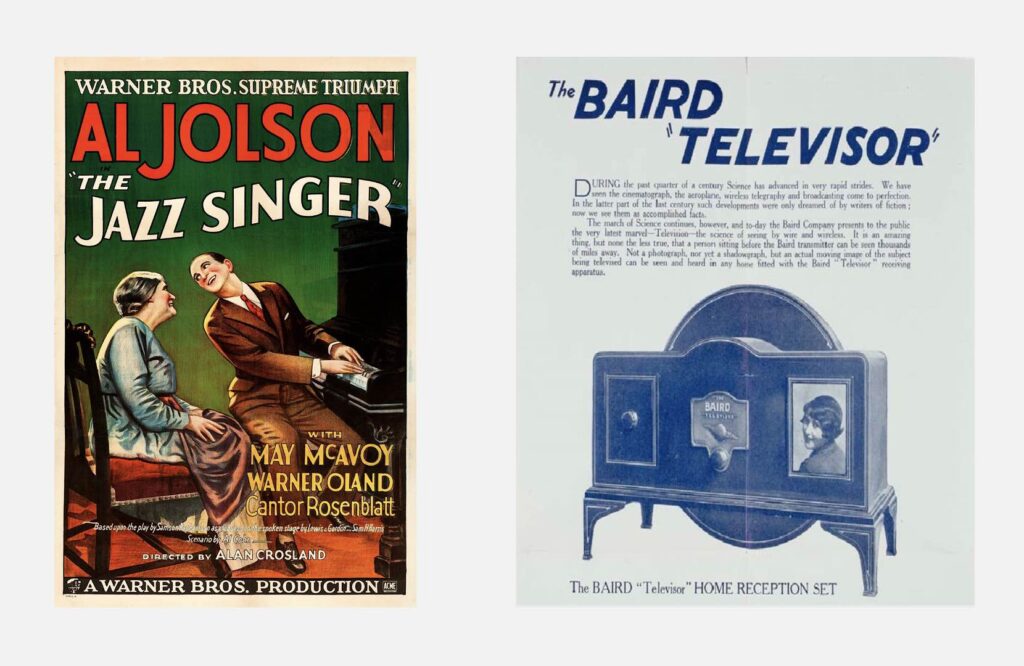
John Wyver writes: On Friday I was delighted to contibute a paper to the British Silent Film Festival Symposium 2026, immaculately organised by Lawrence Napper and held at the Cinema Museum. My presentation at the end of the day explored the connections between early television and the last days of silent cinema in Britain, in the years 1928 to 1930.
As well as highlighting certain links between film and television at this time, and speculating about how multi-camera techniques used on a small number of the first sound films might have influenced studio techniques at Alexandra Palace after 1936, I also tried to make a more general argument about the necessity for exploring cinema and television’s histories as intimately entangled, at this historical moment but also from the late 19th century to today.
The remainder of this post is a lightly edited version of the presentation, albeit without the citations that a more formal publication path would require. I would especially welcome responses and discussion in the Comments at the end.
* * * * *
Many thanks for the invitation to make this presentation, and to occupy the day’s endtimes slot for some reflections on the endtimes of British silent cinema. I am happy too that with these remarks I can claim a first in the history of this august silent cinema symposium: a presentation that is primarily about television.
I take my cue from the simultaneous premiere of The Jazz Singer in London on 27 September 1928 with the launch that very week at the popular trade show Radiolympia of the Baird Television Development Company’s ‘Televisor’ receiver (see the header image).
My argument is that over the following two years television’s development was intimately intertwined with the end times of silent cinema in Britain. And moreover that entanglement had begun almost a decade before and has continued more or less ever since. In essence, this presentation is a plea for us to consider the histories of film and television, which to date have been kept largely separate, together, as an entangled history.
So my paper, which draws on the research for my recently published Magic Rays of Light: The Early Years of Television in Britain explores the parallels and links up to the end of 1930 between film and television, including
- John Logie Baird’s early vision of film distribution to cinemas by television;
- transmission of film by the Baird company;
- comparisons by commentators of the low resolution 30-line images with the first films,
- television on a variety bill at the London Coliseum,
- and the beginnings of ‘cinema television’, which would become a significant development in the immediate pre-war years.
Finally, jumping over the 1930 dateline, I want to speculate about the possible influence of multi-camera filming undertaken on a small number of the very first sound films on the studio techniques of high definition television at Alexandra Palace from 1936 – the basic pattern of which has been refined and developed more or less ever since.
Television as the new cinema
So let me start by jumping back to before that 1928 Radiolympia, and indeed before the centenary that we celebrated earlier this year of John Logie Baird’s first demonstration of what he called ‘true television’ on 26 January 1926. Four years before, the hard-up, somewhat sickly would-be entrepreneur Baird, then living in Hastings, appears to have had his interest piqued in the idea of television by an article in Wireless World and Radio Review. One strand of its speculations about the uses of television, along with visual telephony, was that
the distribution of cinematograph films will be superseded by the direct transmission from a central cinema.
As this indicates, from the very earliest days, television was conceived as a component of cinema, at least as much as it imagined as a domestic medium. Five years later the Baird Television Development Company was incorporated with its prospectus envisaging as one of its revenue streams,
Fees paid by theatres, cinemas, and other places of public entertainment for special or inclusive transmission of scenes, films, and so on.
The closed-circuit presentations at Radiolympia in 1928, the ones that coincided with the unveiling of The Jazz Singer, were of low-definition 30-line, vertical format pictures of the kind that, albeit with significant refinements, comprise television broadcasts for the next seven years. Even so, the trade show demonstrations introduced the ideas of a television presenter and a structured schedule, and fascinated viewers there and subsequently at demonstrations at Selfridges.
Just after Radiolympia, in November 1928 the Baird company began experimental 30-line television transmissions, reaching perhaps an audience of some thirty hobbyists who, ahead of Televisors making it to market, had built their own receivers.
Initially these broadcasts, several times a week in late-night slots, were fixed shots of head and shoulders only, presenting singers and comics, although before the end of the year, there were images of an exhibition boxing bout, a cyclist riding round a ring, and even the first television drama in Britain, John Maddison Morton’s three-character sketch Box and Cox.
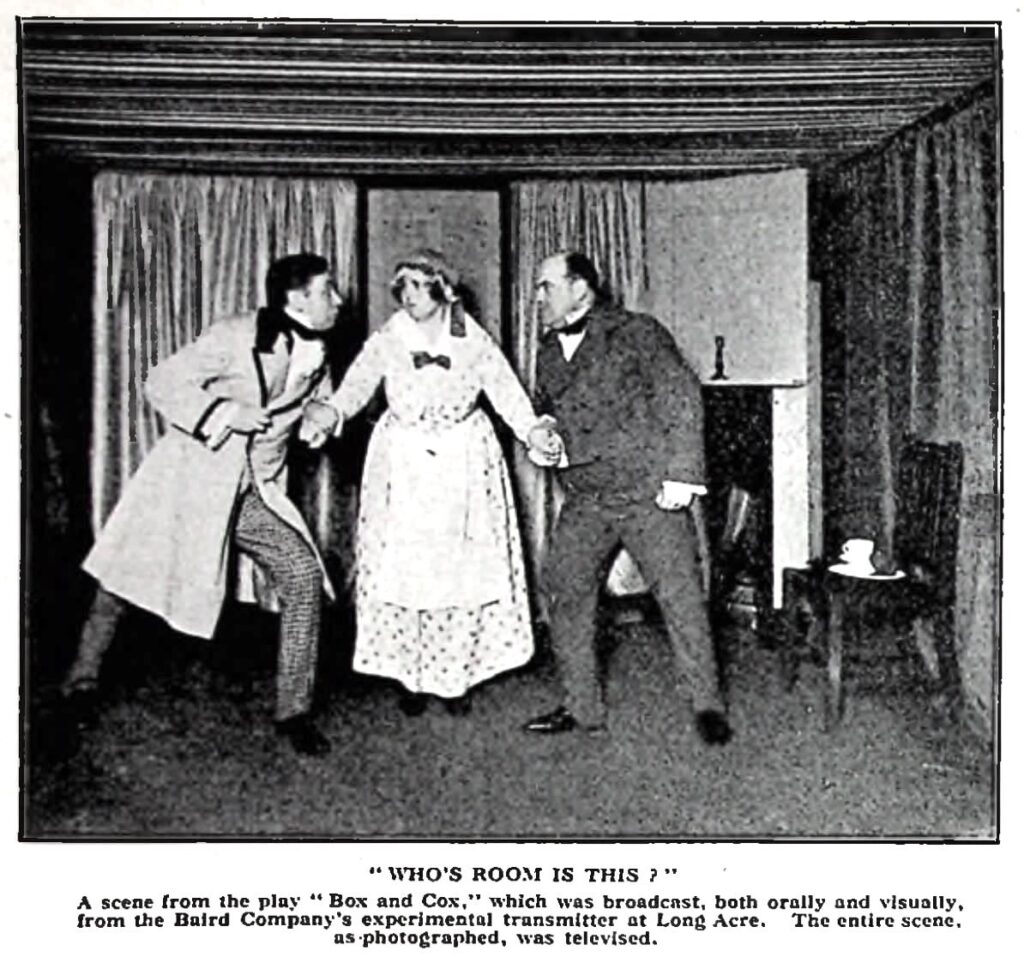
In the following months cooperation was cautiously extended by the BBC, with the Corporation permitting use of its London transmitter for the Baird company transmissions. Then just ahead of this shift, the inventor unveiled one further innovation. All of the broadcasts to date had been of live images, but – especially given his sense of how television could become central to the film industry – he was inevitably concerned to transmit film sequences.
The technical barriers, caused by a television scanner attempting to reproduce a conventional 24-frames-per-second film image, were far from trivial, but engineer Desmond Campbell suggested that using a special continuous motion film projector would avoid the flicker and black lines that otherwise marred the television image. Adapting such a German-made machine, purchased from a cinema in Charing Cross Road, allowed Baird to debut what he called his Tele-Talkie system.
In mid-August 1929. he used this to show the press a short sound film called The Bride, made with George Robey, one of four that the popular comedian had made for DeForest Phonfilms; the filmed skit was also broadcast the following month. Surviving frames of The Bride monologue feature a head-and-shoulders shot of Robey cross-dressed in an elaborate trousseau complete with tiara.
The comparison of these earliest broadcasts with the first days of the cinema was one that many contemporaries made, with remarks such as ‘The general reproduction reminded me considerably of the early “movies”. One of the harshest critics of Baird’s system was BBC controller of engineering Noel Ashbridge, who finally acknowledged its worth in October 1931 when he said of a Long Acre demonstration,
The first picture I saw was easily the best television I have seen so far and might be compared, I think, with a cinematograph close-up of, say, fifteen or twenty years ago.
Both Baird booster and business partner Sydney Moseley and the inventor himself also employed the comparison in 1930. ‘The first cinematograph film I saw in 1896 had the same faults as television today,’ Moseley wrote. By contrast, Baird felt that television was rather more advanced, for he stated that,
Roughly, I would say that Television is, at the moment, in the same state of production as the cinema was in, say, 1911.
A ‘television of attractions’
The Baird company produced live programmes regularly for twenty-seven months after November 1928, and these were followed from the summer of 1932 by a further three years and three weeks of 30-line transmissions by the BBC. These hundreds of hours of broadcasts have largely been ignored or dismissed by almost all of those writing about early television – not to mention of course by cinema historians.
Part of the reason for the lack of interest is that, excepting a vanishingly few lovingly restored, seconds-long fragments, no recordings exist. A strong sense of the transmissions, however, can be derived from other archival traces, including the ‘Programme as Broadcast’ records, as well as from press reports and participant reminiscences.
To the extent that these single-camera, low definition and initially fixed-frame transmissions have been considered, they have been judged, and found wanting, by the technical and aesthetic standards of later television. But as long as they are approached not simply as ‘impoverished’ or ‘primitive’ versions what was to come, they reveal a great deal about the development of television’s screen language and aesthetics.
One of the most influential ideas in the study of early cinema is Tom Gunning’s characterisation of film prior to roughly 1906 (although the periodisation is much disputed) as ‘the cinema of attractions’. This is a cinema from which narrative was absent, a cinema of vaudeville tricks and gags, of magic tricks and one-shot views of the world known as ‘actualities’. Plus, there were tableau recreations of real-world events too, many of them sensational or shocking.
For Gunning, this is a cinema based on ‘its ability to show something’ rather than, as would soon arrive, an engagement with telling. ‘The cinema of attractions’ Gunning summarised,
directly solicits spectator attention, inciting visual curiosity, and supplying pleasure through an exciting spectacle… It is the direct address of the audience, in which an attraction is offered to the spectator by a cinema showman, that defines this approach to film making. Theatrical display dominates over narrative absorption.
My argument is that the first Baird broadcasts, from 1928 on, can be understood as ‘the television of attractions’. The absence of any extensive recordings complicates a direct comparison, but descriptions of the shows highlight how central was the idea of television’s ability to show something. Much of the excitement, as with early films, was the attraction of simply seeing and in this case too hearing something. And the somethings were initially head and shoulders shots of singers, comedians and solo musicians, and subsequently full-length shots of dancers and others, each a theatrical display offered directly to the viewer as an attraction unburdened by narrative or thematic association.
Television on the variety stage
I want to highlight one other instance of television in 1930 echoing the first days of film. In June that year the Baird company and the BBC collaborated on a 23-minute broadcast of Luigi Pirandello’s The Man with the Flower in his Mouth. As well as being broadcast, this was shown on the roof of the Baird offices in Long Acre on a display of 2,100 incandescent bulbs.
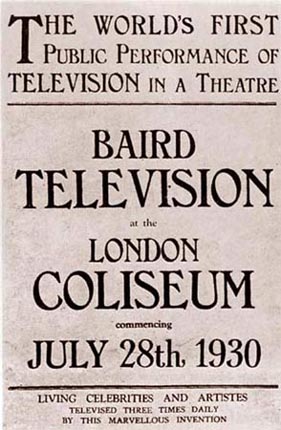
A few days later, mounted above two loudspeakers on one end of a black-painted caravan, this was manouevred the few hundred yards to the London Coliseum. Here television became a three-times-a-day novelty act on one of the capital’s most prestigious variety bills. In doing so, television followed early film which had been frequently featured in variety programmes.
Singers and politicians were featured in the ten-minute turn transmitted from the Baird studio back in Long Acre. So too was Sydney Moseley, who responded to requests telephoned to the studio. American sopranos Helen Yorke and Virginia Johnson imaginatively performed a duet with Helen on stage and her partner on screen.
Across the fortnight, press responses to the show were mixed, and can be fairly represented by the judgement of the London correspondent of The Yorkshire Post: ‘As an entertainment television is at present barely on a technical level even with the earliest moving pictures. But to be able to transmit even these rough images on a scale that makes them visible to a large audience is a definite achievement.’
A month or so later, the Baird company gave to the film trade press a briefing that had more to do with inflating its stock price than with reflecting reality. Two of the biggest cinema circuits, it was claimed, had arranged to purchase screens similar to those used on the variety bill to be operational in cinemas before Christmas. At this stage, the company was proposing that the primary use of screens could be for ‘personal appearances’ by stars ahead of new feature films, and programmes, it was promised, would be available at all times to suit the convenience of exhibitors.
The story of what came to be called ‘cinema television’ is a fascinating thread through the entanglements of film and broadcasting in the 1930s, especially after Gaumont-British achieved a controlling interest in the Baird company in 1932. But that is a tale for another day, and I want to conclude with a modest speculation.
Studio technique at Alexandra Palace
One of the mysteries about the establishment of the Marconi-EMI studio at Alexandra Palace in 1936 is how the team made the jump from the essentially single, fixed camera broadcasts of the 30-line system, and indeed of the Baird set-up at AP, to the far more flexible four-camera system with mixing desk introduced in Studio B.
Crude versions of image mixing switchers had been used as far back as The Queen’s Messenger, a television play transmitted in Schenectedy in the United States in September 1928. And audio mixing of multiple audio channels was a standard procedure at Broadcasting House and elsewhere.
But the configuration of four cameras constructing narrative space was quite new, and my speculation is that this was influenced by the mutli-camera photography used, as Geoff Brown details in his exceptionally good Silent to Sound, on Rookery Nook (1930) and a handful of other films at the time in 1929-30.
As Geoff notes, this was also used for the ballet sequence in Dark Red Roses, and was
championed by Warner Bros. in America in order to ease the new problem of editing sound while reviving some of the visual variety developed in late silent films.
Cinematographer and director Byron Haskin had experimented with this on the 1928 courtroom drama On Trial, using four cameras place in a semi-circle (much as, albeit in simplified form, at AP), alternating between long-shots, medium shots and close-ups.
But the possible entanglement here between film and television is a subject for future research – and for the writing that I’m advocating of a entangled moving image history. For the moment, having I hope indicated some of the connections and echoes between the two media in the endtimes of British silents,
I’ll leave you with the enthusiasm of Sydney Moseley in an August 1930 press article, in which he predicted that
the cinema theatres of the future will be equipped with television screens and, just as one can see news items on the screen second-hand today [in newsreels, he means], in the future these events will be seen and heard at the very moment they are occurring.
Further he speculated that readers should,
not be surprised if within ten years you will not only be able to see and hear your friends abroad as if they were in the room, but able, also, to shake hands with them and feel their pulses. Yes, it might even be possible to smell in London the fragrance of a bowl of roses of a fifth floor room of a building in Broadway, New York.
To which I can only reply that, much as with my flying car, Sydney, I’m still waiting.
Leave a Reply