
The Sunday dozen
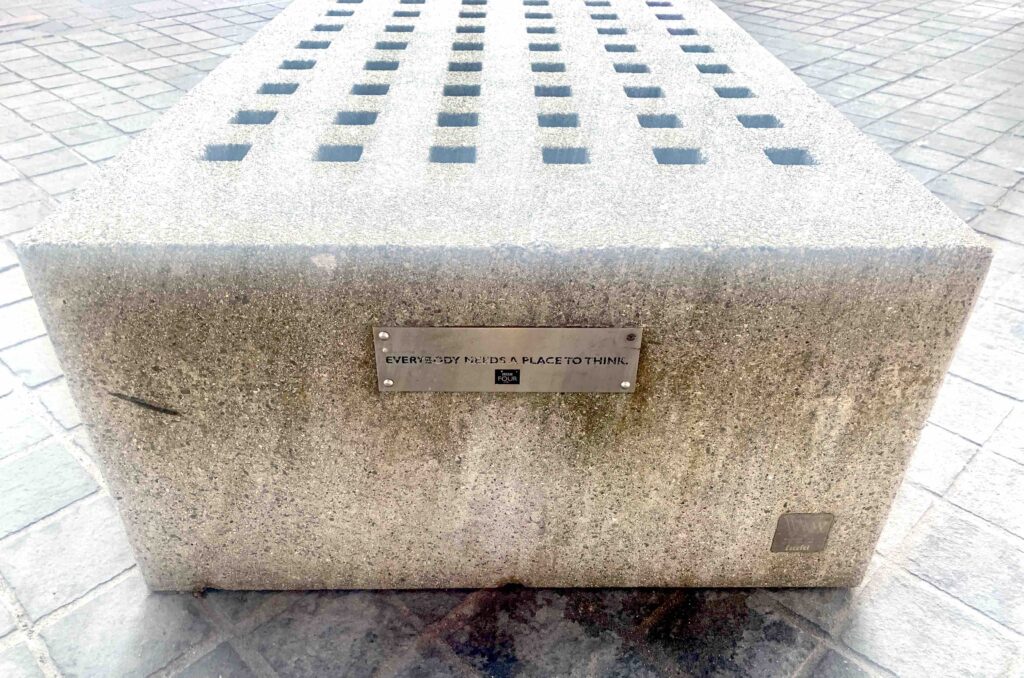
John Wyver writes: My header image is of a somewhat-worse-for-wear concrete bench on London’s South Bank. Attached is a precious souvenir of the 2002 launch of BBC Four — nearly a quarter of a century ago! I feature it here as a complement to the first item in today’s list of articles and more that I have found engaging and enriching over the past week.
• The disappearance of the public bench: although this excellent Gabrielle Bruney essay for Places journal is focussed on US examples, the arguments she makes are absolutely applicable this side of the pond too:
Benches, like other public amenities, are places where optimistic visions of civic life meet messier realities. They’re sites of leisure and contestation that invite a range of constituencies with vastly differing needs and desires… To remove benches, or to curate who gets to sit, is to abandon the work of defining a civic ideal and determining, together, how to live up to it. When seating disappears, our relationship with public space becomes more grudging and utilitarian. Benches are symbols of hospitality, an invitation to participate in the civic realm.
• DTF St Louis is an utterly original drama of male loneliness: I have enthused previously about this uncategorisable show that is available here on Sky, and Philip Maciak for TNR does a good job at capturing its peculiar and particular beauty.
• Inside the world-conquering rise of the micro-drama: Change Che for The New Yorker [£; limited free access] with an astonishing report on the production of serial dramas in one-minute segments:
China’s discovery of a new form of entertainment—one already worth billions of dollars—has put it on a collision course with the incumbents in Hollywood. In October, Fox Entertainment said that it plans to produce more than two hundred micro-dramas in the next two years… On a podcast last June, Kevin Mayer, a former C.E.O. of Disney and TikTok, explained that there was “no longer the revenue base” to sustain the old pipeline of expensive television productions. Micro-dramas, with their low-cost, fast-paced storytelling, may be the new frontier.
• Militant chemistry – an interview with Alice Lovejoy: from The Photographers’ Gallery, a very good interview by Jon Uriarte with the author of Tales of Militant Chemistry, The Film Factory in a Century of War, a new study of two of the most powerful film companies of the twentieth century: Kodak and Agfa.
• Michelle Henning: Photography’s Dirty History: also from TPG, a complementary presentation in the form of a richly illustrated lecture by the author of A Dirty History of Photography: Chemistry, Fog, and Empire:
• The precarious deaths of monuments and This liminal moment: two complementary responses to the important MONUMENTS show at the Museum of Contemporary Art, Los Angeles and the Brick, by Jillian McManemin and Bridget R Cooks respectively, for LA Review of Books.
• The rise and fall of David Adjaye: a fascinating essay by Martin Filler for New York Review of Books [£; limited free access] — ‘Three high-profile buildings by the eminent Ghanian British architect have just been completed, but allegations of sexual misconduct have severely damaged his prospects for future commissions.’
• How a museum doubled its attendance in just one year: such a positive story about MoMI, New York, by Melena Ryzik for The New York Times [gift link], with great visuals by Gus Aronson
• Against the grain: London’s last jukeboxes: I enjoyed Deborah Nash for The Wire on the last few remaining jukeboxes in London pubs.
• Victor Serge was one of the great revolutionary writers: responding to a new biography, Victor Serge: Unruly Revolutionary by Mitchell Abidor, Ian Birchall for Jacobin on the remarkable author and, for many, hero of the Left.
• The conundrums of Jan Morris – a conversation with Sara Wheeler: for The Paris Review, Jamie Lauren Keiles speaks with the biographer of the remarkable writer.
• Civil war in the UK: nightmare or far-right fantasy: reflections about language and politics from Jonathan Portes for UK in a Changing Europe:
Language influences how people interpret politics. Repeated claims that institutions are illegitimate, that democratic outcomes cannot be trusted, or that the state no longer represents “people like you” do not simply reflect dissatisfaction. They help construct a narrative in which democratic processes are seen as fundamentally compromised.
• Don’t use A.I. to do this: wise (and funny) words from author Colson Whitehead, for The New York Times [gift link].
• Vanishing Culture: a Report on Our Fragile Cultural Record: an important free-to-download report from Internet Archive, written by Luca Messarra, Chris Freeland and Juliya Ziskina, about the fragility of today’s digital culture and the importance of attending to how it can be maintained and preserved.
• And finally…: I go on holiday to France on Wednesday, which is unquestionably a good enough excuse to include Anna Karina performing Serge Gainsbourg’s ‘Roller Girl’ in Pierre Koralnik’s 1967 television film:
Leave a Reply