
‘Checkmate’ on pre-war television
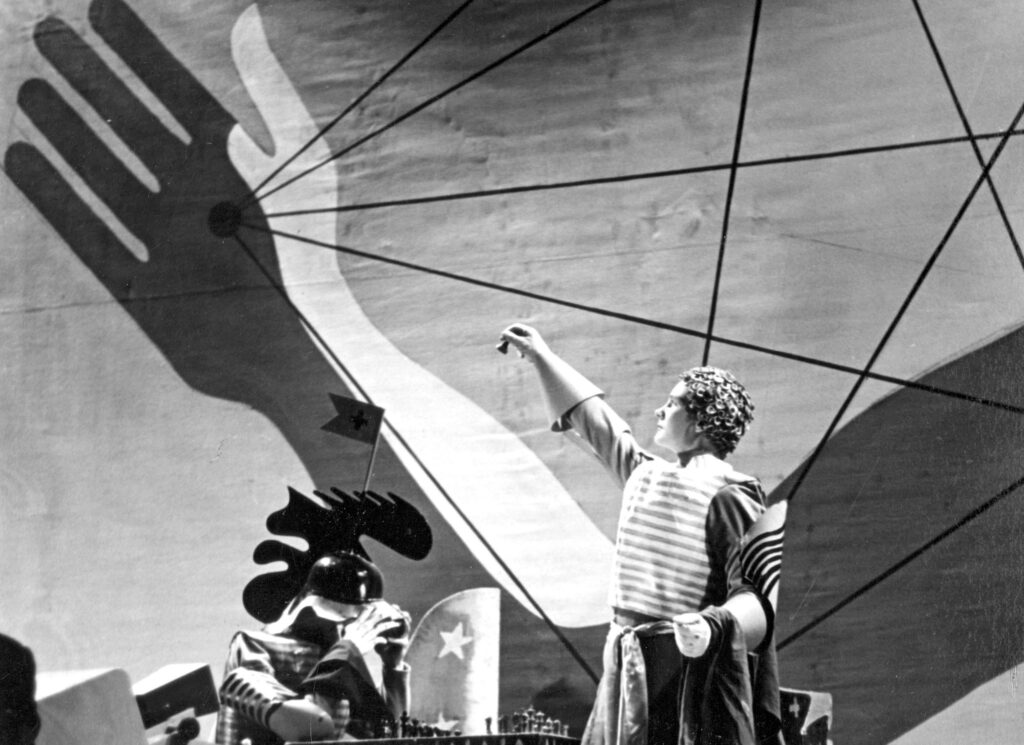
John Wyver writes: I am something of a fan of the Voices of British Ballet podcast, which features oral history recordings made since 2002 as well as new exchanges with dancers, choreographers and critics. A current strand is celebrating the great dancer and choreographer Ninette de Valois, marking the 100th anniversary of the founding of Ninette de Valois’ Academy for Choregraphic Art in March 1926 and 25 years since de Valois’ death.
One recent fascinating edition features Patricia Linton talking to Dr Anna Meadmore, archivist at The Royal Ballet School about de Valois’ ballet Checkmate. As the Voices… website notes,
Checkmate is one of the only two ballets by Ninette de Valois to survive in the repertoire. It makes allegorical use of a chess game to represent a battle between love and death. Arthur Bliss, the composer, and Edward McKnight Kauffer, the designer, worked with de Valois’ ideas in a way that made perfect sense of the ensuing battle, and testified to her commitment to Serge Diaghilev’s ideas on the importance of music and design in ballet…
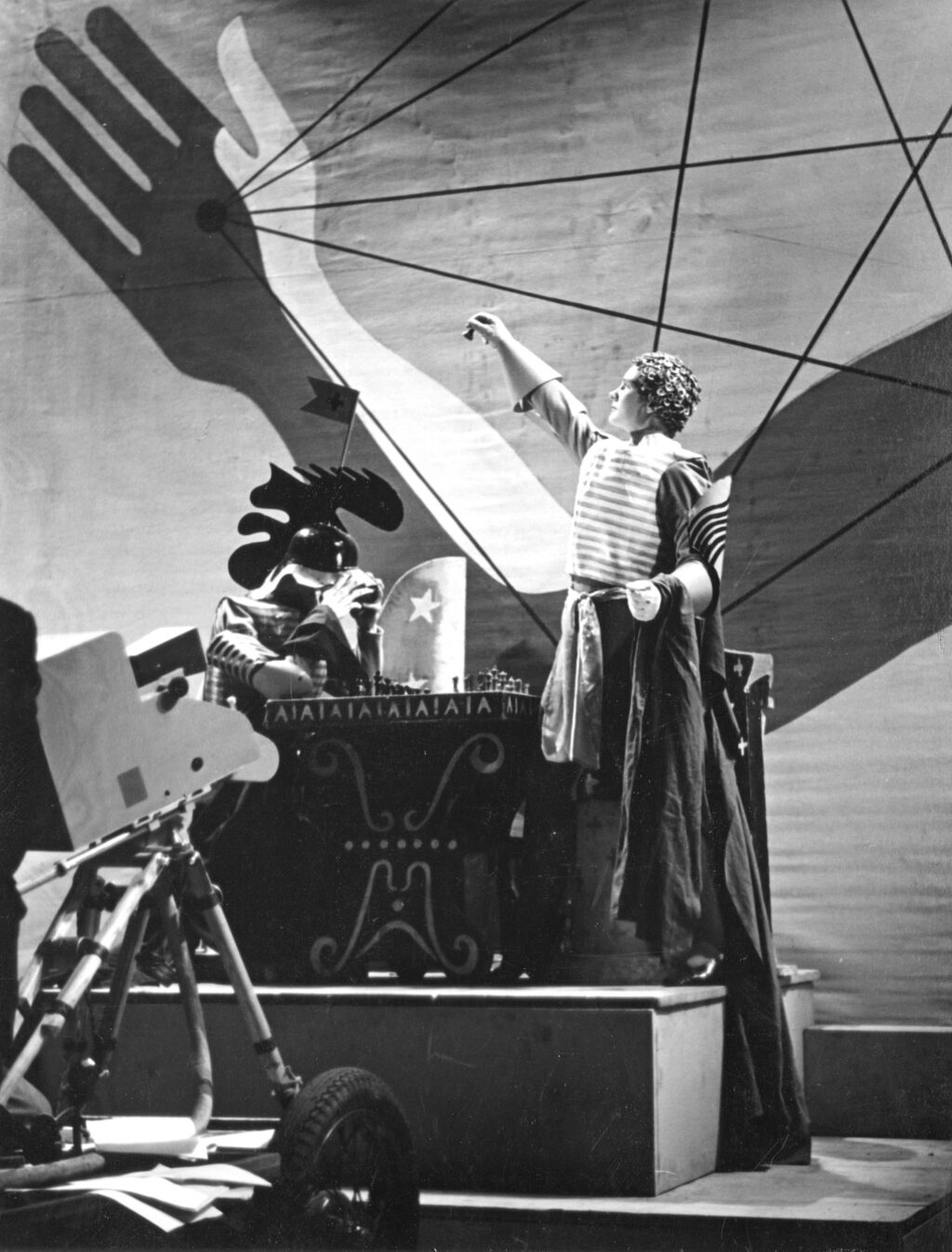
As well as reflecting on the ballet’s genesis and its key dancers, the podcast is especially interesting on the possible political meanings of the ballet. Although neither the Voices… website nor the podcast notes, Checkmate was also broadcast on several occasions by the BBC television service from Alexandra Palace, and this gives me the excuse to showcase one of my favourite images from Magic Rays of Light: The Early Years of British Television.
Checkmate was first performed by de Valois’ Vic-Wells company at the Théâtre des Champs Élysées, Paris in 1937, with June Brae as the Black Queen, Harold Turner as the Red Knight, and Robert Helpmann and Pamela May as the Red King and Queen.
The ballet was given the following year on television on 8 May 1938, although the spectacular BBC publicity image of the Prologue above, highlighting McKnight Kauffer’s modernist backcloth and an Emitron camera in the foreground, appears to come from one of the broadcast reprises on 19 and 22 February 1939. The figure with the outstetched arm is ‘Love’, danced by Jean Bedells.
By the spring of 1938 the Vic-Wells company was to be seen regularly on the service, although this 40-minute ballet, with the same principals as in Paris, was their most ambitious broadcast to date. The critic for The Times enthused about producer D.H. Munro’s presentation as ‘something new, a dramatic emotional picture in terms of photography.’ The anonymous reviewer continued,
The most interesting innovation in the televised version of the ballet was the use made of shadows. Mr. Frederick Ashton [sic; the dancer being praised was Helpmann] was an extraordinary picturesque figure, flanked by the red pieces who cast interesting shadows on a plain backcloth. Later he was even more impressive sitting on his throne in lonely and terrified majesty, while the menacing shadow of the attacking Black Queen advanced towards him sword in hand.
When Munro reprised the ballet in February 1939, with the same cast, the Radio Times correspondent ‘The Scanner’ also praised the interpretative work of studio cameras:
Television gives something that the theatre doesn’t, a trained eye… One [camera] can be used for showing the general scene, an “establishing” shot, the other two for closeup and angle shots. The cameras, in other words, are doing exactly the work of trained human eyes – first the scene as a whole, then concentration without distraction on some salient feature.
In Dancing Times, the regular, knowledgeable critic Jeannette Rutherston also enthused extravagantly about the re-run. ‘The ballet was a triumph of skill on the part of everybody in any way connected with its televising,’ she hymned.
Leave a Reply