
The Sunday dozen
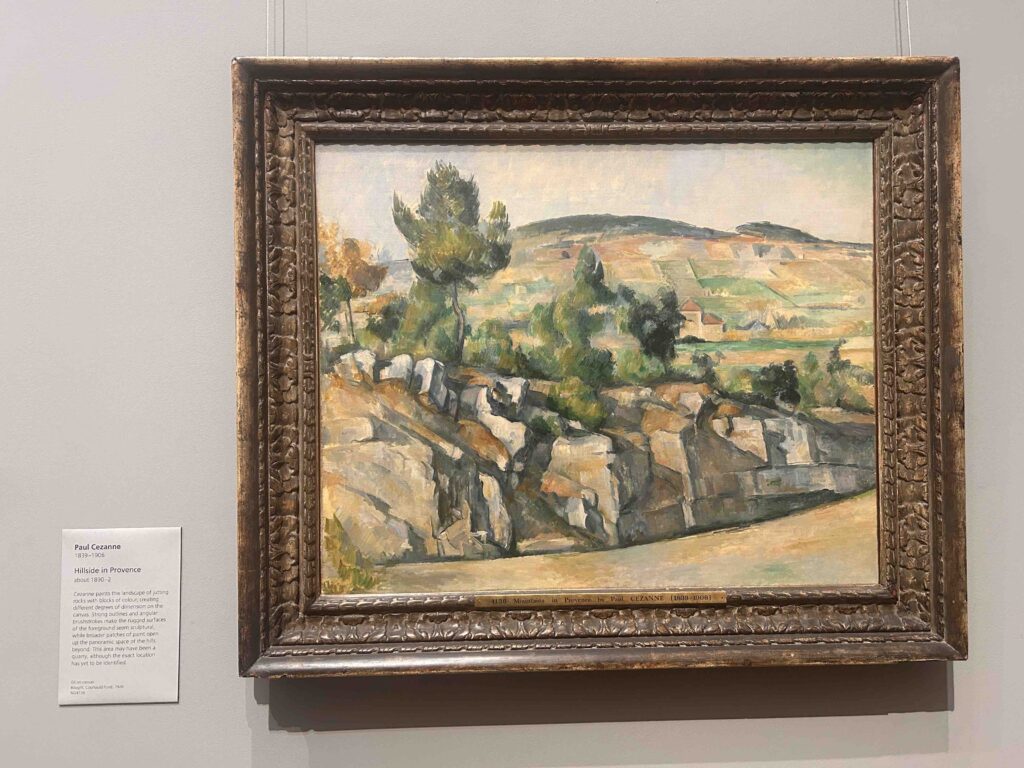
John Wyver writes: I am in Provence, deep in the Luberon, which makes me appreciate all the more the wondrous Cezanne above, Hillside in Provence, about 1890-2, hanging in the National Gallery in London. Everywhere I look there are views suggestive of the great artist’s work. It has rained here rather more than we had hoped, which at least has given me time to read a wide variety of bits and pieces, including the following that have attracted my interest and repaid my time.
• Why? Because… with Jean-Pierre Gorin: most of us will not get to the film season that one-time Godard collaborator Gorin has programmed for L’Alliance in New York, but we can all enjoy his idiosyncratic programme notes; as Richard Brody says, ‘he’s one of the greatest critics, or, more, cinema-thinkers’.
• Mike Figgis looks back on Leaving Las Vegas: “My credit rating had gone down a lot. I was known as a troublemaker”: a very engaging interview with the filmmaker by Lou Thomas for BFI, tied to a new restoration and re-release of the film.
• How the The Fast and the Furious tells the story of Hollywood: for The New Yorker [£; limited free access] Hua Hsu responds to Dan Hassler-Forest’s new book, “Fast and Furious Franchising,” that argues that ‘the series is central to understanding the evolution of Hollywood over the past twenty years’.
• First Look 2026: The Misconceived: for Reverse Shot, Chloe Lizotte writes about James N. Kienitz Wilkins’ latest, a low-budget feature made entirely in the 3D graphics system, Unreal Engine, that is mostly used for video games:
it’s… impossible to imagine the film being made with live actors; if it were, it would lose a crucial source of tension. As so many key conversations in the film swirl around authenticity in artmaking and identity, it’s pointed for the film’s visuals to encourage you to question everything you are watching.
• How Billie Eilish and James Cameron captured a pop show in 3-D glory: background on the ground-breaking concert film from Steve Knopper for The New York Times [gift link], with contrasting reviews from Brandon Yu for the same paper (‘an often electric document of Eilish’s show: the pure quality of image and visceral sense of 3-D immersion is spectacular, as if we’re feeling a new form of presence in performance}, and the Guardian’s Owen Myers (‘Eilish and Cameron are mismatched in flashy pop documentary that misses the subtlety of her music’); and here is the trailer (with – thanks to my hols – subtitles in French):
• Being Eugène Atget: sparked by another New York cultural event most of us will miss (a show curated by David Campany at the International Center for Photography. that in any event just closed), this is nonethless a very fine essay for LA Review of Books by Tobias Czudej about one of the truly great figures in the history of the medium.
• V is for vagina: a typically knotty yet immensely rewarding essay by T.J. Clark for LRB [£; limited free access], prompted by Willem de Kooning’s 1958 painting ‘Suburb in Havana’.
• What does a woman swimming in urine tell us about the state of the world? Lots! – Venice Biennale review: Eddy Frankel with a very fine extended Guardian report from the art world focus of the month, including details of what’s clearly a remarkable Florentina Holzinger installation-performance.
• Quest for a nostalgia I never lived: materials decay faster than images: as if there wasn’t enough US culture in this week’s selection, here is Rory Peckham for The Brooklyn Rail looking for a largely lost Route 66 (with some fine photographs too):
Nostalgic memory and physical reality rarely align, especially not ninety years later. But images have a strange endurance. Long after buildings deteriorate or disappear, the pictures people carry—postcards, signs, stories, bits of neon—continue to circulate. The Route 66 I encountered could not have existed in quite the way it was imagined from the 1930s through the ’80s. If anything, the road now holds a layered history: motels, preserved signs, demolished buildings, and the memories that continue to shape how the place is understood. Images cannot decay, but the material that produced them can.
• 5 minutes that will make you love Ron Carter: this is such a great New York Times series [and this is a gift link], with Giovanni Russonello here, and a clutch of distinguished musicians, hymning ‘history’s most recorded bassist, who turned 89 on Monday and is currently celebrating the milestone with a five-night run at the Blue Note in Manhattan.’
• Auden by Peter Ackroyd: I appreciated Mathew Lyons’ review of the new study, for the blog The Broken Compass.
• How to survive the information crisis: ‘We once talked about fake news – now reality itself feels fake’: also from Guardian this week, a really thoughtful essay by editor Katharine Viner.
• And finally…: just because:
Leave a Reply