
The Sunday dozen
John Wyver writes: Something of a catch-up today, and even so my posting is both late and melancholy. The past few weeks have been somewhat consumed by The Cultures of Early Television conference, and only now am I getting back to the blog and a selection of Sunday links. I’ll aim to do better going forward, but here are pointers to stuff that has engaged and interested, and it has to be said saddened me recently. No Andy B and no AI, or only glancingly, but those are topics to which we’ll most certainly return in future posts.
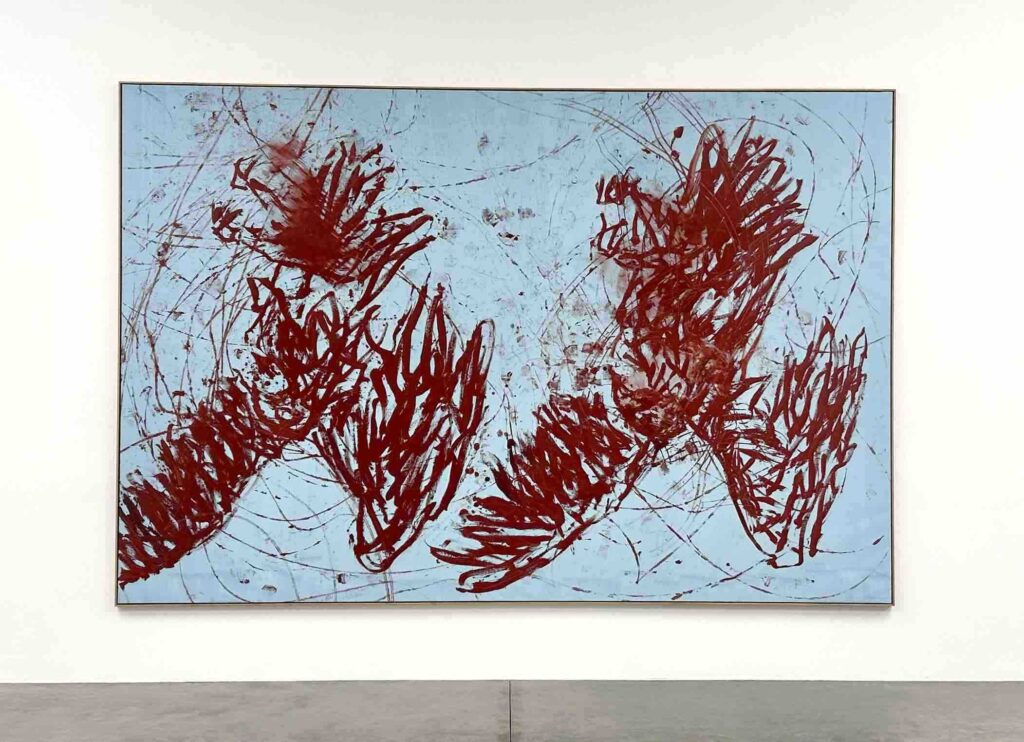
My image is of Objekt naiv (Object Naive), 2024, from the stunningly good exhibition Back Again of the late paintings of Georg Baselitz at White Cube Bermondsey, on until 30 August.
• Remembering Simon Field (1946-26): programmer, producer and dear, dear friend: very fine and moving words from Geoff Andrew about a mutual friend who we lost this week. I knew Simon since the mid-1980s, when he programmed the ICA Cinema, and I worked alongside him, and I already miss him very much.
• Features and reviews by Tony Rayns: it has been a bad few weeks for losing friends and collaborators, since the critic, programmer and cinephile Tony Rayns is also with us no more; here are links to a strong selection of articles that he wrote for the BFI, each of which demonstrates his knowledge, his critical acuity and elegant writing style.
• The Japanese American Toy Theatre of London presents James Bonk in Matt Blackfinger: there was news this past week too of the sad death of the artist and special person Akiko Hada, who back in 1988 I worked with on a commission for my Channel 4 series Ghosts in the Machine, and which still makes me smile…
• Elizaveta Svilova and Meyerhold’s The Picture of Dorian Gray: a richly interesting and finely illustrated blog post from the Daydreams Early Cinema Database, written by Kirill Goriachok about a 1915 Russian film directed by Vsevolod Meyerhold and edited by Elizaveta Svilova, who would later be known as the editor and wife of Dziga Vertov.
• The costs of consolidation: arguments and evidence for blocking the Paramount-Warner Bros. merger: a major and extensive report from MACROLab that contains so much of importance about the contemporary media industry.
• Fault lines & frontiers: mapping the evolving geography of European documentary: a very useful and interesting tour d’horizon by Davide Abbatescianni for the Canadian documentary magazine POV.
• Physical media matters, now more than ever: a familiar argument that cannot be revisited too often, in this case by Alison Foreman for IndieWire.
• Lost resources: Luke McKernan is rightfully frustrated at the disappearance of four important databases for media research, and he has some valuable thoughts about how such resources might be preserved:
Databases are difficult to archive – certainly they can’t just be hoovered up by a web archive, as noted above. You need to be able to capture the constant changes if it is a live, dynamic database. Alternatively you need control of, or be able to duplicate, the underlying management system. You may also want to archive the web front end, with any associated web pages, and the digital files to which the database provides access. There are huge challenges involved.
• Why screen tourism is becoming film’s next billion-dollar success story: interesting from Kianna Best for thelocationguide.
• Celebrating Maida Vale: a very fine BBC Canvas tribute by John Escolme to the Corporation’s much-storied music studio which they have just vacated.
• A brief history of flow: for LA Review of Books, Max L. Feldman revisits Raymond Williams’ influential concept to mull on the question of ‘what the internet learned from television’.
• Image crazy: for New York Review of Books [£; limited free access], David S. Reynolds reviews A Flood of Pictures: The Formation of a Picture Culture in the United States by Michael Leja:
In the decades before the Civil War, the nation experienced what contemporaries called an ‘illustration mania.’ As Michael Leja shows in A Flood of Pictures, this was not merely a matter of quantity. It signaled a shift produced by new technologies and a widening popular culture that reshaped how Americans encountered art, absorbed information, and imagined their world.
• My 5 favourite places for art in Venice: Jason Farago for The New York Times [gift link] is a very good guide.
• Trung reads Pride and Prejudice: author and illustrator Trung Le Nguyen gave many, many of us pleasure in recent days with their Bluesky readalong during a first read of the Austen classic.
• The voice of Google: Claire Stapleton’s must-read essay from the belly of the beast, for The New Yorker [£; limited free access], and drawn from her new book Don’t Be Evil: Bad Bosses, Fake Promises, and My Escape from Big Tech.
• Parsing Farage’s demarche farce: a semi-regular reminder about the importance of Chris Grey’s fortnightly (or so) analysis of the ongoing impact of Brexit on the political scene; this edition is particularly good.
• A world-historic chance: Thomas Zimmer’s galss-half-full reflections on the state of the American nation are well worth your time.
• ‘I wouldn’t pay it either’: the FIFA World Cup has prompted much fine writing, including Barney Ronay’s (see most recently Tuchel gets blame for England exit but this is not only about him) and Jonathan Liew’s Guardian reports , and Ian Dunt’s exceptional Football, England and the triumph of modernity, but Simon Skinner’s magisterial overview of the competition’s history for LRB [£; limited free access] is the perfect long read to enjoy ahead of tonight’s game.
• And finally… Bonnie Tyler – ‘Total Eclipse of the Heart (Turn Around)’: the world also lost Bonnie Tyler recently, an event to be marked with another viewing of her astonishing, lavish and frankly bonkers video, which makes only marginally more sense when you learn the song was written for an unrealised Nosferatu musical.
Leave a Reply