
Another catch-up dozen
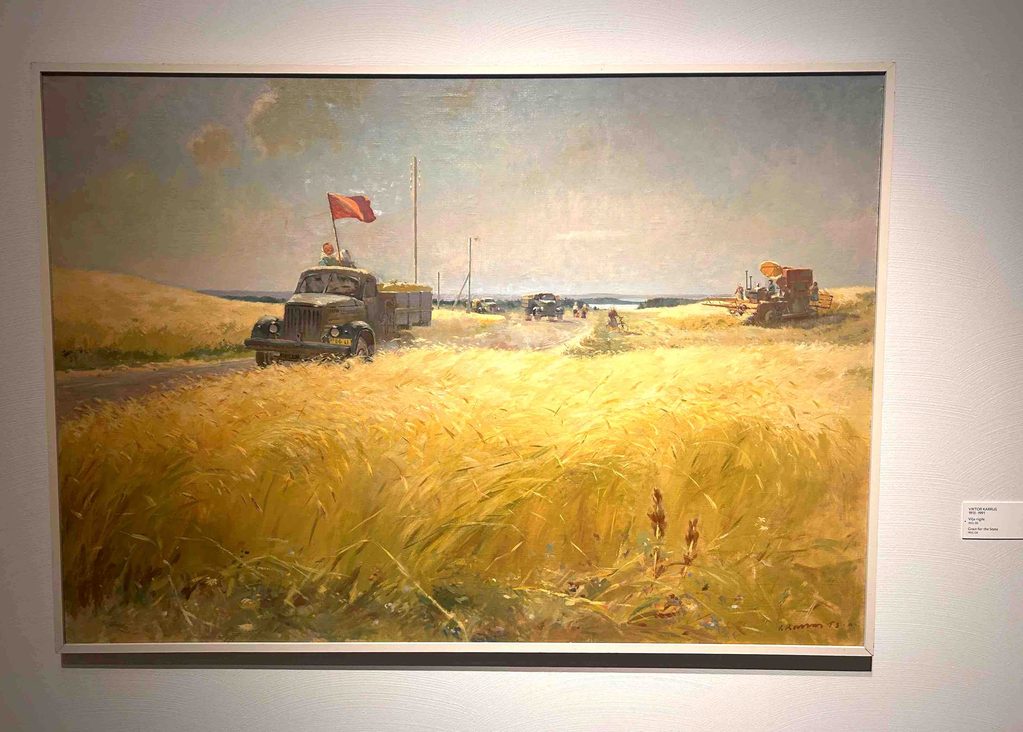
John Wyver writes: My schedule is all over the place, disrupted by family issues and other commitments. But here is a collection of interesting articles and more that I might have contributed last Sunday, and which I hope will get me back to posting more regularly. My somewhat seasonal and socialist realist image is ‘Grain for the State’, 1953, by Viktor Karrus, seen recently in the collection of KUMU Art Museum in Tallinn.
• Anthologized: the world of W. Somerset Maugham on-screen: for Criterion’s Current, Farran Smith Nehme writes about the under-appreciated Gainsborough films Quartet (1948) and Trio (1950).
• The moment of Trevor Griffiths’ Comedians: when jokes became lead pellets: marking the fiftieth anniversary of Griffiths’ great drama, Stephen Wagg contributes a short post on ‘ the decline of a shared national comedy culture, and the growing influence of comedians in shaping political and social conversations’.
• Nonpredictive texts: for LA Review of Books, Elizabeth Alsop is just terrific on perhaps my favourite TV show of the year so far, DTF St Louis, and other works by writer, director and showrunner Steven Conrad.
• On the status of lost films: at the exemplary Weimercinema.org, Andréas-Benjamin Seyfert, who is the grandson of documentary maker Marcel Ophuls, and not coincidentally, great-grandson of Max, reflects productively on the meanings and mysteries of absences in the archives.
• Pirating the pirates: for Mubi Notebook, Devan Scott with further provocative thoughts on film preservation and revisionism.
• Calder’s Clouds return to Senate Office after a mountain of problems: a beautifully told tale, by Olivia Diaz with visuals by Caroline Gutman for The New York Times [gift link], of the complex re-installation of one of Alexander Calder’s last works.
• What changing views of the Young British Artists say about the art world today: a really good essay by Eliza Goodpasture for ARTNews, just in time for Tate Britain’s The ’90s: Art and Fashion show, about which do read Jonathan Jones for the Guardian.
• Invisible visual culture: Paglen’s paradoxes: the cultural critic W.J.T. Mitchell at the Critical Inquiry blog on the work of Trevor Paglen, his book How to See Like a Machine: Images after AI (published by Verso), and a world in which…
Images are no longer representations but operations designed to manipulate our reflexes, desires, and thoughts…. The vast over-production of digital images has created a world of machine vision and ubiquitous photography that is largely invisible to us, but controls our lives as extensions of profiteering and police power.
• Mapping the landscape of community-based archives: a valuable report from the Mellon Foundation about US archives, but with valuable lessons for the UK too.
• Taylor Swift’s new video marks her ghostly return to Daphne du Maurier’s Rebecca: Emma L. Davies is very good for The Conversation on ‘Swift gothic’, ‘a strand of her music that takes on doubles, hauntings and darkness’, in her latest, self-directed video:
• Walking from the 19th to the 21st Century – from Baudelaire’s to Jean-Christophe Bailly’s Paris: a complex piece by Julia Ori for Open Library of the Humanities Journal that is a deeply engaging think-piece about Paris, Haussmann, Baudelaire and the ideas of philosopher Jean-Christophe Bailly.
• Renoir’s endless promenade: I enjoyed Alexandra Wilson’s review for Engelsberg Ideas of Renoir and Love at the National Gallery, which makes a number of points that I haven’t seen highlighted before – and there is a wealth of images too.
• Disloyalty: another of Cory Doctorow’s essential daily (!) columns/threads, in this case on ‘surveillance pricing’; do follow @doctorow.pluralistic.net on Bluesky if that’s your thing.
• And finally… from the ‘Power to the People’ festival last weekend – both video and audio are immaculate, but nonetheless, with Bruce, Joan, Tom and many more, this is great:
The Maugham link isn’t working.