
Conference reflections
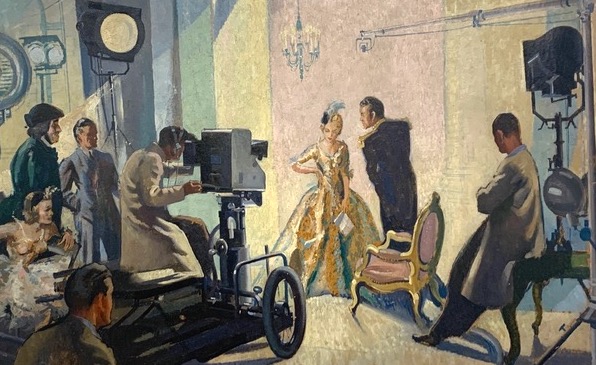
John Wyver writes: Just over a fortnight since The Cultures of Early Television wrapped, with much – although far from all – of the admin done, and with the distractions of a weekend in Paris and the World Cup now past, I have finally settled down to reflect briefly on the conference.
For those of you just joining us, this was a two-day University of Westminster conference about television before the Second World War in Britain, the United States, continental Europe and the Soviet Union. Two events earlier in the year presaged the event: the centenary of the first public demonstration of what John Logie Baird called ‘true television’ on 26 January 1926, and the publication by Bloomsbury/BFI of my book Magic Rays of Light: The Early Years of British Television. The conference programme with abstracts and speaker biographies, as well as a further reading list, can be downloaded here.
In broad terms it feels as if it was a success. More 150 people registered and our venue Portland Hall felt consistently busy but never over-crowded. Thanks to the support of a conference grant from The British Academy, we were able not only to invite speakers from abroad, but also to offer free registration, complimentary teas, coffee and waters throughout both days, and a very welcome drinks reception. It looks like we came in pretty much exactly on budget. For much of the time, the tech worked well, although I still deeply regret that I could not coax Lance Sieveking’s audio message from 1930 to play during my opening remarks.
Across six panels eighteen papers were presented, two of them by Zoom, from Jamie Medhurst in Aberystwyth and Ron Simon in New York, and one by Simon Vaughan as an elegant film package of Desmond Campbell’s pre-war film footage from Alexandra Palace, a version of which is available here:
To open and close the conference, André Lange and Anne-Katrin Weber contributed exceptional keynotes, the former looking back with an extraordinary range of examples and extracts from the press and literature to the pre-history of television, and the latter projecting forward in an exemplary consideration of the idea of ‘useful television’ with examples from the uses of CCTV in rocketry and elsewhere in Germany and the United States.
Attendees watched the 1937 BBC Television Demonstration Film, smartly introduced by Lisa Kerrigan, senior curator for television at the BFI, and elements of other early BBC television and archival fragments from the USA, Nazi Germany and the Soviet Union.
Donald McLean showed his remarkable restorations of early 30-line television as part of his richly researched presentation, and I was able to premiere 40 seconds of an AI visualisation of a mechanical television broadcast, a brilliant experiment by Max Whitby which I hope will be the focus for further research.
As part of his presentation, Ron Simon streamed the surviving footage, shot off a screen on 16mm, of NBC’s 1939 live broadcast of Dion Boucicaut’s drama The Streets of New York, directed in the studio by Anthony Mann long before his successful Hollywood career.
For me at least, this was a revelation, and I am immensely grateful to The Paley Center for Media for permitting it to be showcased during the conference (even if, from understandable concern about possible piracy, the agreement with the Center did not permit the showing to be announced in advance).
Across the two days, attendees heard engaging and informed presentations by many of those interested in the pre-war broadcasts of early television in Britain. In addition to Donald McLean’s and Jamie Medhurst’s contributions, the latter speaking about 30-line BBC producer Eustace Robb, there were very fine papers from
- Kate Murphy, on women working for BBC television before the war;
- Dick Fiddy, with a delightful cavalcade of interwar comedians who appeared on television and whose acts were preserved as filmed fragments for newsreels and other contexts;
- Stephen Bourne, presenting his invaluable research on Black contributors and creators;
- Luke McKernan, reflecting on pre-war television and newsreels, with a couple of stellar examples;
- and Ian Christie, providing an overview of the career in film as well as television of the pioneering and innovative producer, Dallas Bower.
One of my hopes for the conference was that there would be explorations of the links and entanglements between early television and other interwar cultural forms, and these contributions provided exactly that in their discussions of cinema, music, variety and news media. Links of this kind, in particular in relation to radio and the visual arts (as well as theatre with the Bouncicaut drama) were further developed in the papers about early televisions beyond these shores.
These discussions of televisions in the United States, Italy, the Soviet Union and Hungary-plus (since the focus of Oliver Botar’s paper, the artist László Moholy-Nagy, originally from Hungary, moved across Germany, Britain and the United States), were largely new and as a consequence especially interesting to me.
Four papers considered aspects of television in the USA, starting with Doron Galili’s discussion of popular media fantasies of television in science fiction and fantasy stories from American pulp magazines between the mid-1920s and 1940. Later on the same day, William Boddy interrogated the historiography of American television in the 1930s.
On the same panel as William, an academic from New York, British historian Paul Marshall introduced inventor and entrepreneur Ulises Armand Sanabria, who ran Western Television Inc in Chicago in the 1930s, and who even those from the States at the conference were barely aware of. And finally Mark Williams offered a rich exploration of two competing local television outfits in pre-war Los Angeles.
These four papers about pre-war American television, along with Ron Simon speaking and streaming on Zoom, felt like a coherent and original group of presentations, and together they contributed wonderfully to the key aspiration of the conference to develop an international dialogue about early television.
Similarly contributing to the international conversation, and similarly varied in their subjects and methodologies, were the four papers with a broadly European focus on Friday morning. Danielle Simon presented a paper on early television as Fascist spectacle at the Villaggio Balneare in Rome in 1939; Oliver Botar provided an expansive overview of Moholy-Nagy’s interest in television; Angelina Lucento considered Soviet monumental painting as a form of proto-television; and Jeffrey Cohen presented his in-depth research on early Soviet television.
This was the kind of panel that conference organisers always hope for, in which the very diverse topics and approaches, from scholars who knew little if anything of each other’s work, seemed in the room to speak to and illuminate each other in really productive ways.
I am immensely grateful to each of the speakers, some of whom travelled a long distance to join the conference. Thanks too are owed to those who chaired the various sessions across the two days, as well as to the two figures from the University of Westminster who welcomed delegates, Catherine Dormor, Pro-Vice Chancellor, Head of College of Creative Arts and Technologies, and Vice-Chancellor Peter Bonfield. And the catering, tech and on-site teams for Portland Hall looked after us really well.
Next steps are the editing of video recordings of a selection of the presentations, which we will make freely available online, and discussion of a possible publication. Details of those activities will be showcased here, and on Illuminations’ social media activity on Bluesky and LinkedIn. And like I feel sure many others who were there, I came away with a host of thoughts and ideas for further research.
I am especially keen to see further transnational dialogues develop, and for work to continue uncovering the less well-known topics touched on at the conference. I failed to identify any recent work on pre-World War Two television in France and in Germany, but I hope this will be forthcoming.
Early television and Empire seems to me another especially interesting focus, and I am certain that there is far more to explore in the content of 30-line broadcasts in Britain between 1928 and 1935. For the latter, I am sure that the literature on early cinema offers some productive avenues to consider.
Who knows, but perhaps there will be sufficient new work and new collaborators to justify a second edition in, say, two or three years’ time? But in the meantime, and while I know no-one uses the Comment function on blogs nowadays, if you attended I would welcome any thoughts and suggestions for improvement below (or of course privately by email).
A particularly valuable element of feedback sent to me on email by a colleague, and expressed at the conference, is that a revision or rethink of what we mean by ‘early television’ would be fruitful, taking into account the development of television globally, and particularly in the Global South.
This is a really important point, and echoes discussion in early cinema studies, as well as more generally in modernist studies, highlighting the different timescales of development around the world. Definitely a concern to be returned to.
It was amazing to hear how Albert Robida anticipated TV news, video calls, as well as home theatre – “telephonoscope” – in his 1882 publication Le Vingtieme Siecle. I would love to see all the visions of our future from across the globe brought together and explored in more depth. The concept of the democratisation of culture, mentioned by Doron Galili in his talk on televisual fantasies, is still very relevant to society today.
One question which the conference brought to my mind, was how much the pre-war BBC service owed to the 30-line period in terms of programming. Certainly Don McLean’s presentation and Jamie Medhurst’s appraisal of the “terribly competent” Eustace Robb, have shed a new light for me on the “television of attractions” as more than just an extended experiment.
Thanks, Kirsten. Re the influence of 30-line programming on the 405-line broadcasts from AP, I think one key area was dance, where Robb encouraged a wide range of classical ballet and contemporary dance and achieved remarkable results, and this was certainly built after 1936, especially in the broadcasts with the rival companies run by Ninette de Valois and Marie Rambert.
Luke (McKernan) observed that the newsreels he discussed along with the film footage of comedians I showed, demonstrated it was possible to create a ‘phantom schedule’ of what people could have seen. Although I concentrated on comedy acts there are of course also musical artists and other variety acts who did appear on pre-war televisional and were captured at the time on film, .