
Silences of the sea
John Wyver writes: To the ICA on Saturday last for another fascinating programme in Michael Witt’s Jean-Luc Godard: Unmade and Abandoned series. This has been a revelatory season, shown more or less monthly, of films by Godard and others that, as Witt claims, ‘sheds light on the huge and varied phantom body of unmade and abandoned ventures that lies behind or in the intervals in his completed oeuvre.’
The screenings have been spun off from Michael Witt’s essential book Jean-Luc Godard’s Unmade and Abandoned Projects, published by Bloomsbury, and now with a comparatively affordable paperback promised for September. Each line-up has been full of rare treasures, and Saturday’s quartet of films loosely themed as ‘History’ was as rich as the other showings that I have been able to get to.
At the heart of the screening was JLG’s 2004 Notre Musique, a film that I continue to find both engrossing and mystifying. Structured in three distinct acts, with an opaque central narrative, it is about war and colonialism and art and memory and the Balkan conflict and Palestine and the morality of depicting violence. Preceding it was the filmmaker’s two-minute short from 1993 on many of the same concerns, Je vous salue, Sarajevo.
And following Notre Musique we were privileged to see Notre musique/Séquence 23, shot more than twenty years ago during the making of the main feature by Simone Bitton and recently edited by Paul Grivas, Godard’s nephew and collaborator. Grivas is one of the central figures in the Fondation Jean-Luc Godard, established in January with a ‘mission is to create an inventory of Jean-Luc Godard’s works and contribute to their preservation, promotion, and dissemination’.
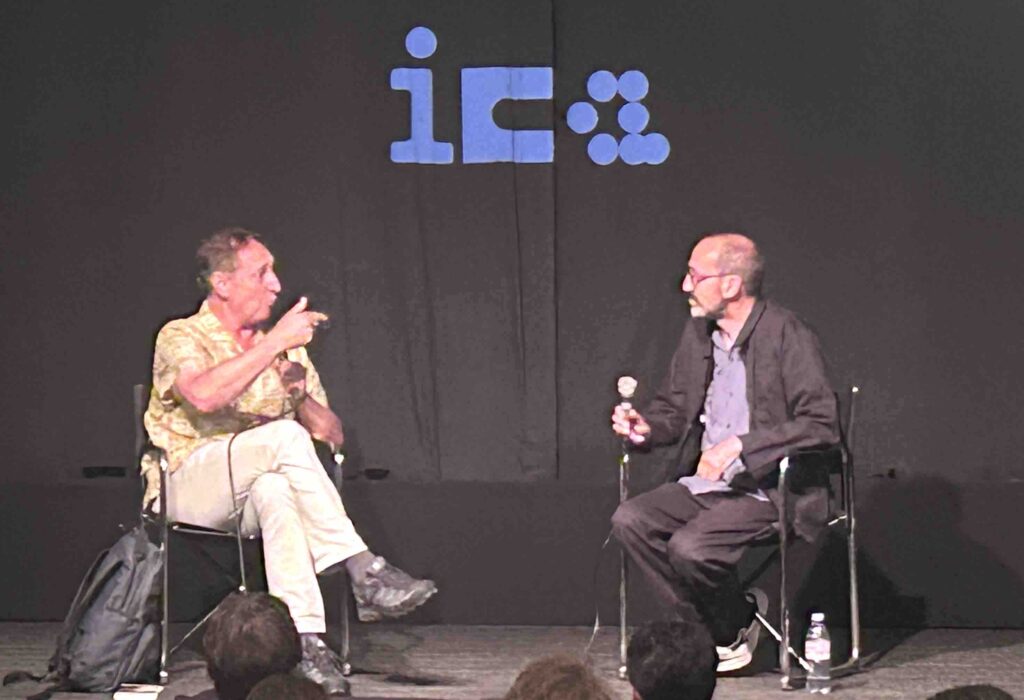
This 11-minute ‘making of’ study had apparently not been shown in public before, and it offers a vivid glimpse of Godard at work with his partner and co-creator Anne-Marie Miéville, and with a small 35mm film crew, crafting the sequence in Notre Musique with the celebrated Palestinian poet Mahmoud Darwish. Following which Michael Witt (below, left) spoke with Paul Grivas in a conversation that was both engaging and illuminating.
The generous four-hour programme began with Jean-Pierre Meville‘s Le Silence de la mer (The Silence of the Sea), shot in 1947 and released in France in 1949 [link: a cineoutsider review by slarek of the Eureka DVD]. This was Melville’s debut feature as a director and it is an astonishing work, extraordinarily precise and controlled, with Henri Decaë‘s inventive images, the majority shot in a single room. The disciplined performances are remarkable too, especially from Howard Vernon, a Nazi officer billeted in a village in Brittany on a reluctant French man and his niece during the war.
In her 2023 studyResistance: The Underground War in Europe, 1939-45, Halik Kochanski details that the text from which the film was adapted was a novella by ‘Vercors’ published by an underground press in France and then in London, from where it was distributed internationally:
Vercors was the pseudonym of a satirical cartoonist and engraver, Jean Bruller, who had never written a book before. Vercors decided to write the book in 1941 because, ‘There were French writers who collaborated. We needed to counter them by urging silence. The idea for my book came from the German Ambassador, Otto Abetz, who had drawn up a list of forbidden authors – principally Jews, Communists, and those with a left-wing political orientation.’
In book and film the French couple silently agree not to speak to or otherwise acknowledge the officer, who night after night feels the need to extol to them his love of France and French culture. This continues until on a trip to Paris the officer is cruelly disabused by fellow Germans of his dream that the two countries can be joined as equals under Hitler. The film is an immensely powerful reflection on occupation, resistance, culture and delusion.
As Michael Witt explained on Saturday, in the late 1990s and 2000s Godard developed a series of unrealised projects with Claude Lanzmann, Bernard-Henri Lévy and Marcel Ophuls relating to the Holocaust, Jewishness and Palestine–Israel. One of these was to be a contemporary version of Le Silence de la mer.
In Godard’s planned film, which was to be called Le Silence de la terre (The Silence of the Earth), the action was to be transposed from occupied France to occupied Palestine. He envisaged replacing Vercors’ German army officer billeted in a French home with a cultivated Israeli officer, intellectually close to Hannah Arendt or Martin Buber, living in a house with its Palestinian owners.
The Silence de le mer on television
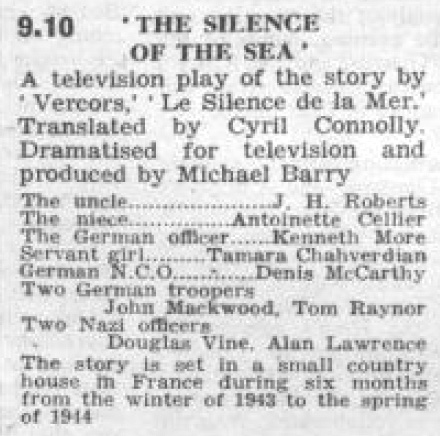
I had long wanted to see Melville’s film, in part because of my admiration for his precise, classical cinema, but also because Le Silence de le mer was, extraordinarily, adapted by BBC producer Michael Barry for a live broadcast on 7 June 1946, the first night of the returning television service. The Radio Times listing (which mis-states the time of the drama) is reproduced as the header image, the production was played again on an afternoon the following week, and of course there is no recording. Nor do there appear to be any photographs or reviews.
What we learn from the billing is that the television adaptation was from the translation by Cyril Connolly, and at 50 minutes was only just over half as long as Melville’s feature. The young and then comparatively unknown Kenneth More led the cast as the German officer. We also, fortunately, have Barry’s account, in his invaluable memoir From the Palace to the Grove, of how he came to select the text and bring it to the screen.
Before the war Barry had been a successful drama producer for the BBC television service at Alexandra Palace, but as he was demobbed he was unsure what to do next. To help face the future he decided to burn many of the letters and pamphlets he had collected…
I stopped when I found in my hand a small volume that I did not recognize. It had been published as recently as 1944 and how it came to be among the litter awaiting the fire, I could not tell. The blue jacket carried the large word Vercors and, under a title, Put Out the Light, the information that it was a short story translated from the French by Cyril Connolly. I read the book in bed that night and by the time I finished in the small hours, a light had been switched on in head and there was no longer uncertainty. I remember saying to myself, “This is what television is all about”.
As I read, pictures had been had been forming in my mind. The story produced its own vision of how it might be told to our particular audience, perhaps better than by any other means. Film at that time seldom attempted a story as finely etched as The Silence of the Sea; in fact I believed that only David Lean would consider it. I intended to try.
Visual recording was still several years away but we were, of course, able to use sound recording and also to insert film into drama, although there were few opportunities to obtain original film for inserts at the beginning of 1946. I wanted to begin the play with a shot of the sea, starting at the water’s edge and moving out across the waves. Simple! But a more difficult item than you would think to find in a library of film clips.
Eventually, I was able to persuade my brother in the Fleet Air Arm to shoot it, using a hand-held camera, from the cockpit of his Swordfish aircraft. Library shots of the German occupation of France were easier to find but I decided that the visual emphasis must be upon the three antagonists within the Frenchman’s house and that the introduction of filmed shots of war would be a distraction.
The heart of the narrative lay within the subjective beings of the German, the old Frenchman and the silent girl. I believed that the meaning of the external world would be best conveyed to our audience by listening to the sounds that those three heard, coming to them from outside the house. The main thread of spoken sound in the play was going to be almost a monologue from the German officer, interrupted by minimal response from others.
On the other hand, Jean Bruller uses the old Frenchman as his story-teller and in the play I intended him to be the interlocutor for the audience. The necessary alienation could best be maintained, it seemed to me, by pre-recording on sound the thoughts and observations of the old man. Broadcasting would allow these to be transmitted on a more intimate level than the spoken dialogue, associating the audience in close and familiar terms with the visual narrative.
It used to be a commonplace that producers, absorbed by their interest in the new uses of vision, neglected sound. At a time when vision possessed many limitations, I was intent upon making the maximum use of sound. On account of the intense pressure on live performance at the moment of transmission, this was best done by pre-recording many sounds and sound effects.
Not for the first time do I deeply regret that we have no recordings from this time, and that Barry’s version, which was clearly ambitious and a creative response to the limitations of television at that point, is as ‘lost’ to us as Jean-Luc Godard’s unmade adaptation.
Great to have this account as I could not attend that session. Thanks.