
The Monday dozen
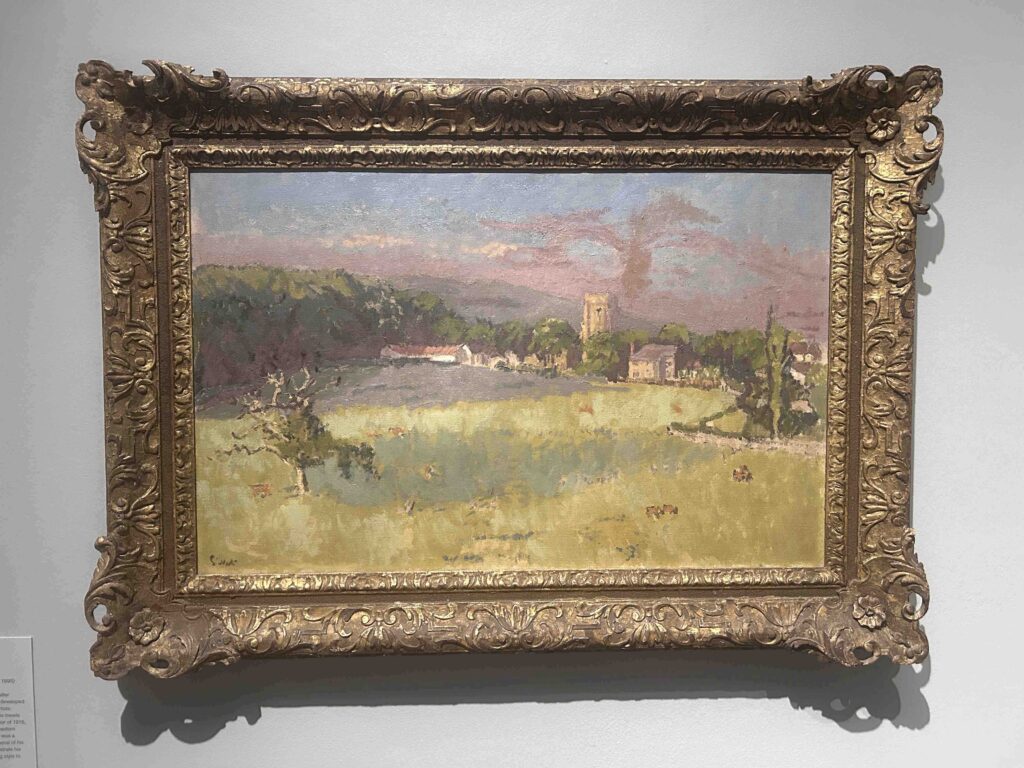
John Wyver writes: A splendid wedding on Saturday and generally just life got in the way of producing my usual Sunday collection of stuff that has interested me in the past week. So here it is a day late. The header image is a 1916 English landscape by Walter Sickert, Chagford Across Fields, hanging in British Landscapes: A Sense of Place, until 1 November, at Chichester’s Pallant Gallery. I found the show as a whole disappointing, but this is one of its surprising treasures.
• Florentina Holzinger’s naked ambition: an exceptional profile of the Austrian performance artist by Lauren Oyler for The New Yorker [£; limited free access]; I saw Holzinger’s production of Ophelia’s Got Talent last summer in Paris and it has stayed with me in ways that few shows do.
• Pluralistic: daily links from Cory Doctorow: the entirely essential guide to the contemporary world, full of richness about tech and ideas and democracy and more.
• Inside the Archive #74: Nitrate screenings, a preservation seminar, and asexual screen histories: lots of valuable notes here about the recent work of the BFI National Archive, with extensive preservation links too.
• Where was the drum kit?: Jonathan Coe for LRB [£; limited free access] is very enjoyable on Bernard Hermann and Alfred Hitchcock.
• Does the epic adventure of The Odyssey really demand an epic format like IMAX?: lots of good writing this week, as you’d expect, about Christopher Nolan’s film, but as someone who saw (and loved) it at BFI IMAX last Wednesday I was especiually intrigued by this IndieWire feature by Jim Hemphill who watched it six times in six days in six different formats.
• “The Dziga Vertov Group rises again, and it needs you” — Jean-Pierre Gorin in New York: a fine account by Carlos Valladares for MUBI Notebook of a appearance in New York of the radical filmmaker and one-time collaborator with Jean-Luc Godard.
• Scripting the Spy of the Century – Arthur Hopcraft’s unproduced biopic of Kim Philby, 1975–1980: a generous link to a freely accessible .pdf of Joseph Oldham’s new academic essay for Journal of Cold War Studies. It turns out that the scriptwriter of the BBC adaptation of Tinker, Tailor, Soldier, Spy (BBC, 1979) was working on a parallel project:
Over 1975-80 [Hopcraft] worked on screenplays for a potential feature film biopic of the real Philby for S. Benjamin Fisz Productions. Although ultimately never produced, Philby (as it was consistently known throughout its development) gathered significant momentum at key moments, attracting the involvement of three notable directors (Mike Hodges, Don Sharp and Michael Winner) and two major film stars (Michael Caine and Robert Shaw).
• How Netflix broke TV’s most important promise: a short but very sharp Slate essay [gift link] by Sam Adams about the ways in which we watch streaming services:
Netflix’s competitors have been turning away from the binge-drop model in favor of more or less weekly schedules, because they’ve realized—or relearned—that the time when a show’s not on the air is as important to building its audience as the time when viewers are actually watching.
• He’s the last great land artist you’ve never heard of: Travis Diehl for The New York Times [gift link] explores the work and world of Charles Ross, who has almost finished his ‘Star Axis’ on a mesa in eastern New Mexico.
• Stow Road, Ixworth – ‘Thingoe’s follies’: a fascinating tale from Municipal Dreams about ‘the first council housing built (in 1894) in the English countryside’.
• Fakes of the future: Krzysztof Pelc for LA Review of Books on writing and AI:
We have, I believe, crossed a new threshold, and all authored writing—novels, poems, screenplays, newspaper columns, not to mention love letters—will be judged according to which side of that divide it falls on. On one side are texts produced before the arrival of generative large language models (LLMs). On the other, everything that has followed—texts that might still be useful, even compelling, but that will always face a lingering suspicion of not being entirely human, of having been smoothed by systems trained to predict the word that comes next. We will come to prefer the former over the latter, not because it will be better, but because we will be more certain of its origins.
• Who owns an AI generated song? What we can learn from the phonograph and the evolution of copyright laws: richly interesting from Anna Monnereau for The Conversation.
• And finally… Everybody Digs Bill Evans: how much are we looking forward to this?
I can’t get the link to Joseph Oldham’s essay to work (in two browsers).
Thanks, Billy – apologies about that. I hope it is fixed now.