
The mystery of Alexandra Palace Studio A
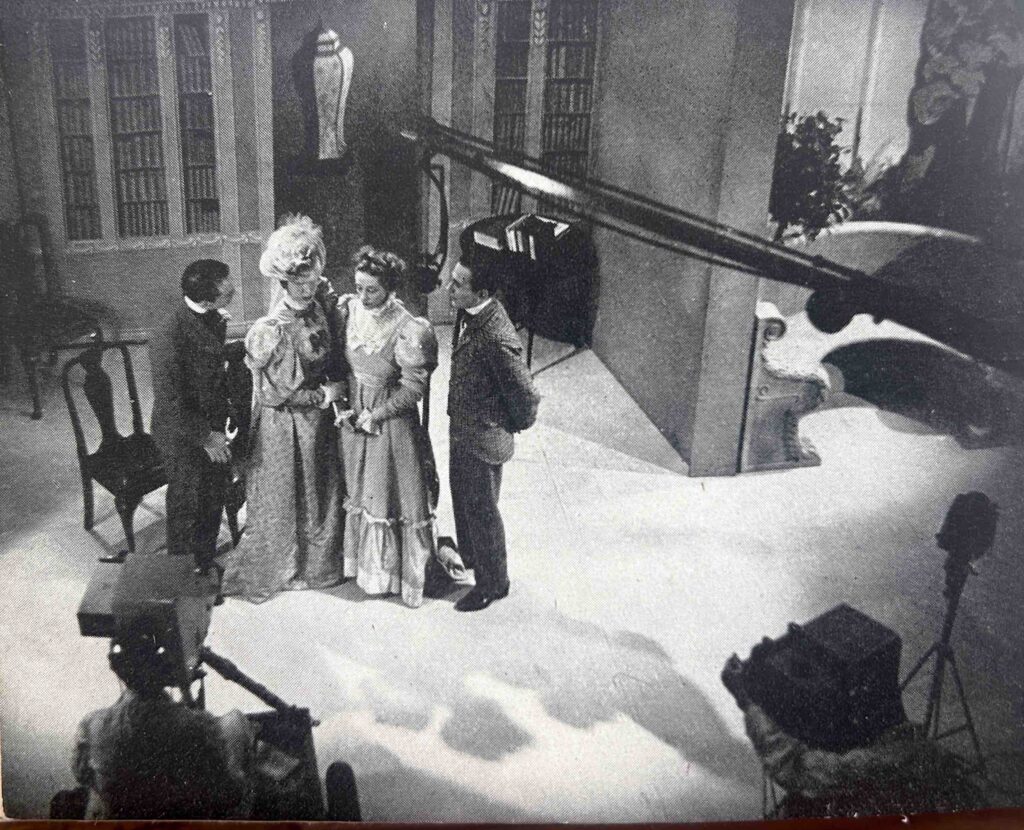
John Wyver writes: When the BBC television service at Alexandra Palace began operations officially on 2 November 1936, Studio A was fitted out with four Emitron electronic cameras supplied by the recently-established joint venture company Marconi-EMI. One or more of these 405-line cameras was mounted on a crude dolly, and so was minimally mobile.
There were two further cameras linked with a pair of film projectors to provide telecine facilities to play in film sequences. And the six vision channels fed into a control room that allowed producers to mix between them. In very basic terms, this is the set-up that television studios have worked with ever since. (The image, from John Swift’s Adventure in Vision, 1950, shows two cameras in the studio for The Importance of Being Earnest, December 1937.)
The mystery is that there appears to have been no model for this configuration. The BBC’s two television studios before this, operational from 1932 to 1935, as well as that used by John Logie Baird’s company before them, were effectively black boxes. Through a hole in one wall a single scanner beam was projected into near-darkness. Reflections from the subject were picked up by photo-electric cells above the beam, and these converted the visual image. Mixing was initially impossible, although it was introduced in a crude manner later with a subsidiary caption card scanner.
At AP, the Baird camera set-up which was installed in Studio B combined a refinement of this ‘spotlight’ scanner system and a fixed internmediate film system. This was quite distinct from, and quickly proved inferior to, the Marconi-EMI set-up. So where did the idea of Marconi-EMI’s 4-plus-2 camera set-up and mixing desk come from?
This question of how, in the absence of any existing model, the Studio A configuration was settled on, was one that I failed to solve in writing Magic Rays of Light: The Early Years of Television in Britain, which was published in January. So I was very pleased to be directed by a colleague to a book that, shamefully, I was not aware of when I wrote my volume.
Pinsk to the Palace: Sir Isaac Shoenberg and the Birth of Television by J.B. Williams was published in 2021, and very pleasingly is available open access as a free .pdf (click on the title). This is a richly detailed biography (although I would have liked more citations) of the man who, as the book’s webpage details, ‘created, inspired and led the brilliant Marconi-EMI team that produced the first real high definition broadcast television system in the world.’
Among much else (since Shoenberg was involved in many other significant advances), the book is an invaluable counter-balance to a history of pre-war television in Britain that remains dominated by John Logie Baird. I really wish that I had known of its existence before completing my own study. Had I done so, I would have been able to do more justice to the work of Shoenberg and EMI.
In chapter 13, ‘Electronic Television’, Williams writes about the efforts of Shoenberg’s team to develop in 1932-34 the cathode ray tubes for what would become the electronic camera known as the Emitron. When in early 1934 this aim was largely achieved, Williams writes (p.84) that:
Isaac Shoenberg was now ready for his next moves. The electronics team were ready to put the circuitry around the tubes and turn them into prototype cameras. The next step was then to design the studio equipment so that a demonstration studio on the ground floor of the research building could be equipped. This was to have 6 cameras, 4 as free standing or mobile units and two connected to film projectors as telecine machines. All this needed to be run from a control desk to provide the means of switching between the cameras.
So here is confirmation that Shoenberg established at Hayes the studio configuration that was later transferred to AP. And we further learn from Williams that in 1935 Marconi-EMI submitted to the BBC an offer to supply at £24,530 for the studio equipment, along with a price of £15,657 for the vision transmitter. The cost appears to have been accepted without argument.
The mystery then is partly solved: Studio A followed the model of the experimental Hayes studio. But the puzzle is only pushed one stage further back, for Williams offers nothing about how and why Shoenberg and colleagues settled on this specific set-up. Nor do we have, as I would dearly like, any details of what kinds of broadcasts were mounted from Hayes. As ever, more research is needed –and, as ever too, I would be grateful for guidance, suggestions and corrections from readers.
UPDATE: A colleague has pointed me to pp.103-4 of Bruce Norman’s 1984 book ‘Here’s Looking at You’, where he writes
‘Shortly after the first camera had been made, EMI devised a system of electronic television with six camera channels – four Emitron cameras and two telecine cameras, and built it on the ground floor of the research department. Here, in a small studio, a girl from the office “would walk around and smile” for the studio cameras’.
Which is useful confirmation, but again gets us no nearer to understanding the choice for the specific configuration. Why did they not put in place a simpler 2+1 set-up or some other more modest configuration? Their testing and demos for potential customers, which essentially meant BBC execs, could have been just as successful with a less elaborate set-up.
I think the explanation is fairly simple. At the time the team had probably built 6 good tubes and so it was sensible to build six cameras. The two telecine would have been needed for change overs between reels when showing film. The four studio cameras were divided between fixed positions and movable dollies. This gave flexibility in use. As the cameras were not very reliable it was sensible to have two of each in case of problems when they could be quickly switched over. Having just 2 cameras would be too risky!
Thanks so much. This makes a lot of sense, but I still wonder why the Hayes team felt that they needed such an elaborate set-up. What kinds of broadcasts were they working on in the experimental studio? Bruce Norman’s book suggests the tests were simply one person walking around and smiling. In which case the back-ups and multiple configurations would hardly have been necessary. Or do you think that the team was developing more elaborate formats for which the 4+2 configuration was required?
I think that the Hayes team were only interested in the technology and not in programs. They were under enormous pressure to get the system working. They were all engineers or scientists. I don’t think that they produced any real programmes. As far as the number of cameras was concerned I understand that the normal set up was one fixed camera and one mobile on a dolly. To be ready move smoothly into the next item they would need another set up ready to take over. Hence 4 cameras. There may well have been conversations with the BBC over this.