
The Sunday dozen
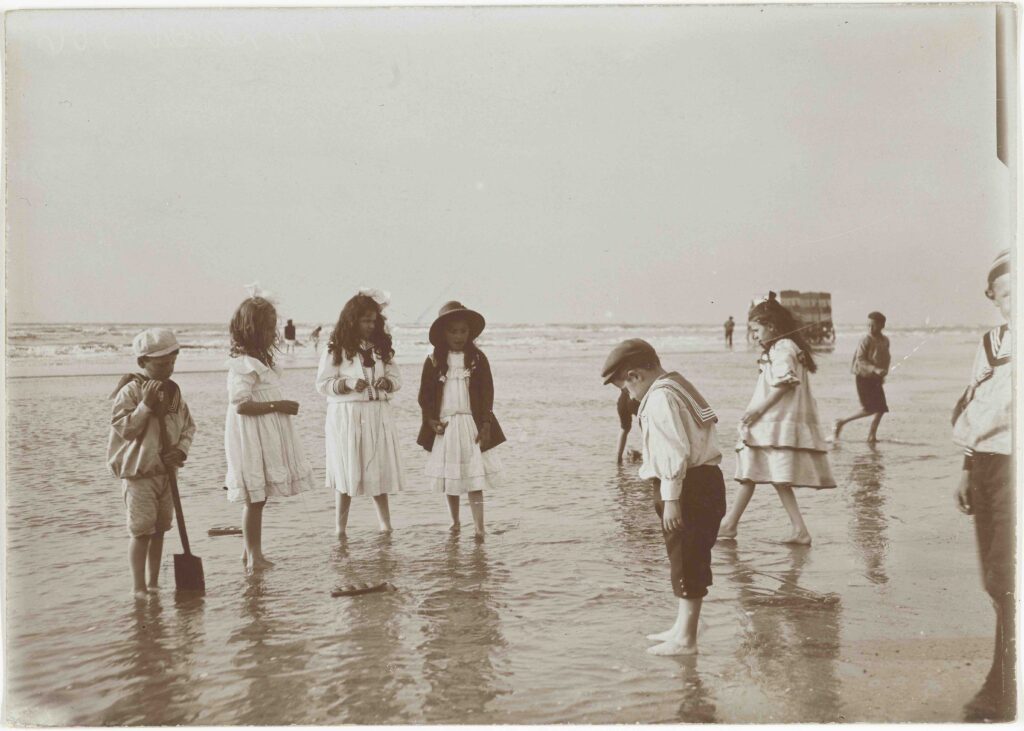
John Wyver writes: As I manage to do on most Sundays here is a collection of links to stuff that I have found interesting and rewarding over the past week. The header image, which seems suitably seasonal, is ‘Paddling at the beach in Zandvoort’ by the German firm of Knackstedt & Näther, from 1900 – 1905; the image is part of the collection of the Rijksmuseum in Amsterdam.
• Red & Black – Hollywood Left and the Blacklist: Ehsan Khoshbakht’s retrospective for this year’s Locarno Film Festival could not be more timely; I’m not there, but the full and tantalising list of films means I can recreate much of it at home; see also the press release for background, and there is a six-part podcast as well.
• Turbulent waters – The cinema of Jean Epstein: a welcome introduction to the French filmmaker by Leonardo Goi for MUBI Notebook.
• Careless whispers: what really happened between George Michael and Lindsay Anderson? The Wham! movie producer reveals all: a great tale by Martin Lewis for the Guardian recounting the behind-the-scenes story of the director’s final film.
• What makes an adaptation good?: Richard Brody for The New Yorker [£; limited free access] is as good as ever on questions of fidelity in films based on books.
• Night Visitors: T.J. Clark’s wonderful long essay for LRB [£; limited free access] on the Chauvet cave paintings.
• 10-Minute Challenge: ‘A Sunday on La Grande Jatte’: the monthly slow looking feature from The New York Times [gift link] focuses on Seurat’s great 1884 canvas.
• Fashion forward: in writing for NY Review of Books [£; limited free access] about the Metropolitan Museum of Art’s ‘incoherent and pretentious’ exhibition ‘Costume Art’ in its Condé M. Nast Galleries, Jed Perl raises the ‘fundamental matter of how museums make sense of art and culture’.
• Nothing moves the needle: Craig Unger at his American Kompromat is really good on the state of American media, and he has a bleak conclusion that I increasingly believe to be the case:
So, can Trump be stopped? I keep arriving at the same uncomfortable answer: What might stop Trump is not a story, but a body count. If the pattern already in motion — the draft emergency order, the Insurrection Act threats, the troops already staged in American cities — resolves into actual violence around this fall’s election, the casualties themselves may do what fifty years of investigative journalism apparently can no longer manage: force a reckoning that doesn’t depend on which information ecosystem you happen to trust.
• Writing by hand is good for your brain – here’s how to do it: author Neal Stephenson hymns the positives of writing by hand. I agree wholeheartedly with everything he says, except his recommendation of using a pen rather than a pencil; I do all my writing with a rotring rapidPRO mechanical pencil with 0.5mm leads which is simply a joy to use.
• Why you keep buying books you don’t read – and why it feels so good: a short, fun piece by Michelle Spear for The Conversation.
• Clio reads a book.: Christopher Smith at his Anatomies of Power blog on history, memory, Carlo Ginzburg, Ian McEwan and the art of reading.
• I jumped at the chance to narrate the audiobook of my debut novel without thinking it over first: Isabella Verleri is interesting on the experience of making the audiobook of her own work.
• Want to fight back against big tech? Start here: for The New York Times [gift link] Tressie Macmillan Cottom proposes a reading list to make us all more informed about AI and data politics; as she says,
Each of these books aims to explain how technology, politics, money and power are reshaping our world. I am reading some of these books for the first time; others, for the third or fourth. In reading them together, I’m looking for common themes, patterns and novel questions about data politics. The goal isn’t to find answers to a huge political challenge but to ask better questions about our political obligations.
• Neuroplasticity as a praxis: … and this is another great reading list plus reflections, complementary to (and warmly acknoweledging) the previous link, from Matt Seybold at The American Vandal – books about tech and power and fascism and resistance.
• And finally… Pavel Kolesnikov performs Chopin’s Nocturne in E minor, Op.posth.72: I’m fortunate to be going to see this brilliant pianist play Chopin’s complete Nocturnes at Aldeburgh in just over a week, so this seems appropriate (for me at least) – and is very beautiful.
Leave a Reply