
The pianist of Studio BB
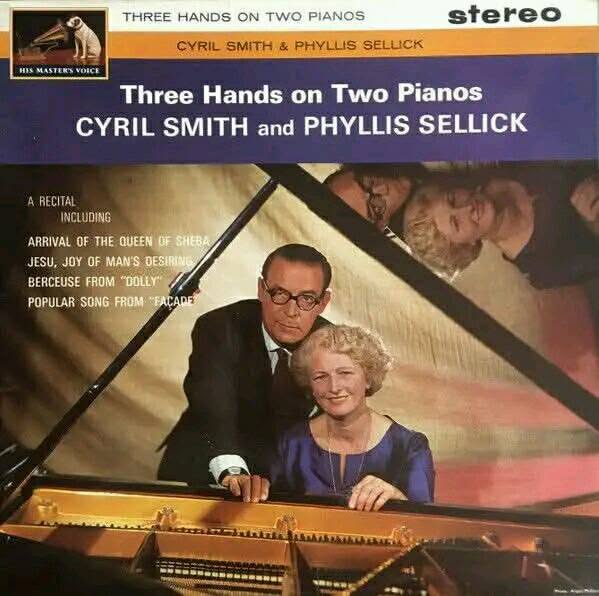
John Wyver writes: Come with me a little further down the rabbit hole that is Studio BB in the original Broadcasting House. This post follows my two-part ‘This temple of the arts and muses’, the first element of which is here and the second here. And it is prompted by the presence of the grand piano in the photos of Studio BB, as below. This is the story of who played that piano for much of the time during the television years of 1932 to 1934. And unlike the majority of posts on this blog it has romance at its heart.
Cyril Smith was a young classical pianist who studied at the Royal College of Music between 1926 and 1930. Despite making his professional concert debut in 1929, he found bookings hard to come by, and so he took what he later described as a ‘bread-and-butter’ job with the Baird television company.
‘The firm’, he recalled in his autobiography Duet for Three Hands, ‘then very new and amateurish, wanted an accompanist to provide a background to the strange entertainment which they put on’. Cyril had few illusions about the musical taste of the tiny number of committed viewers for mechanical television, who ‘were more concerned about whether the sound reproduced well, and whether the blurred, jumpy picture on the screen could be recognised as a man at a piano’.
Producer Harold Bradly, however, was pleased to showcase Cyril on screen at the start of the 1930s. ‘Perhaps one of the most fascinating pictures which the “extended scene” [that is, wide-shots] has made possible’, he enthused, ‘is what would otherwise be a very tame item from the television point of view – a pianoforte solo. Even if one has not an ear for music one cannot fail to be interested in watching the movements of the hands along the keyboard as seen on the television screen.’
‘I performed,’ Cyril Smith described, ‘sometimes for half an hour in the mornings and sometimes around midnight, in a room about twelve feet square which comprised the entire Baird television studio in Long Acre, London. I had to accompany ballad singers, ballet dancers and gentlemen trying to coax melodies out of saws. I was paid £4 a week, and the casual artists got a guinea a go. The job had no prestige, but at least it was a job.’
When the BBC took over the Baird trasnmissions in the summer of 1932, Cyril transferred across to the corporation, and it was then that he started playing the grand piano in Studio BB (below). ‘The BBC’s methods,’ he remembered, ‘even in those early days of television, were far superior to those at Long Acre. Rehearsals lasted longer and were more thorough.’
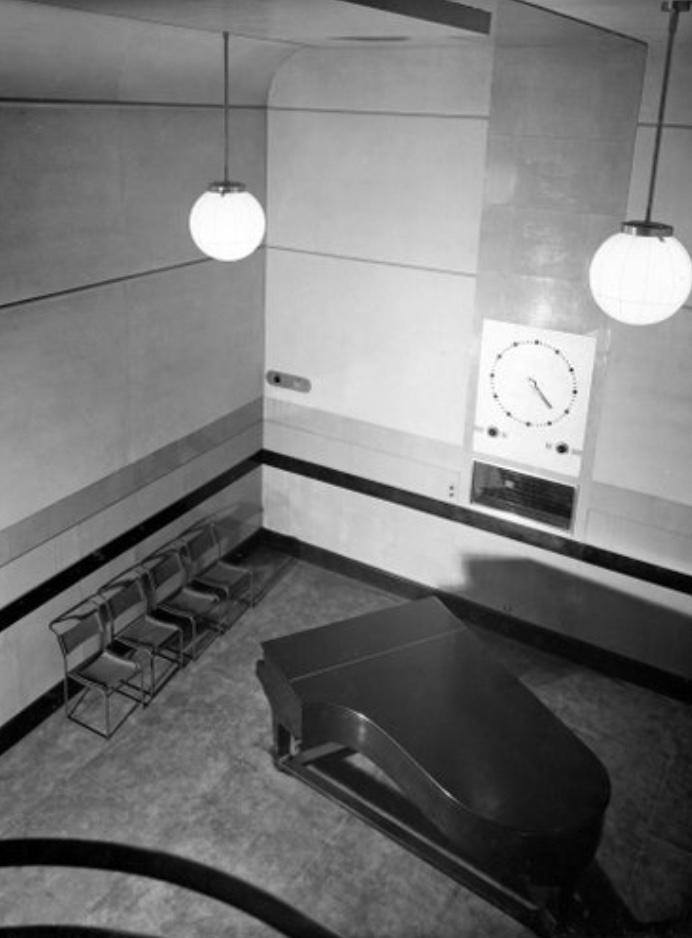
His enthusiasm, and probably his penury too, ensured Cyril’s commitment, even though in the near blackout of the studio he had to play behind a curtain, looking at the performer in a car driving mirror attached to his instrument, with a shaded light to read the music, and with the sound of his instrument muffled to balance the voices of performers.
Just outside Studio BB,
there was a foyer, common to our studio and to the sound studio next door [that is, Studio BA], with a long leather seat running round it where I would try to settle down until I was needed. Often there were auditions going on in the sound studio…
One day, to my sudden delight and surprise, I noticed a girl waiting there: a girl whose face was more than familiar to me. I looked hard at her, as I had done many times in my student days, and this time she looked back. I was twenty-four, and had acquired a little more wisdom in the ways of the world. Without hesitation I walked straight across to her and demanded, almost accusingly, “Do you realise I have been trying to get to know you for years?
Reader, after Cyril took Phyllis ‘Phyl’ Sellick out to tea that afternoon, they courted and were married in 1937. By which time Cyril had taken up a professorship at the Royal College of Music. Having left television in 1934, he nonetheless returned for the final night of the 30-line service, now transferred to the BBC’s larger studio at 16 Portland Place.
On 11 September 1935, Smith played a defiantly upmarket programme that included operatic offerings from The Barber of Seville and Les Huguenots, Russian dances and two pieces to accompany solo dances by Lydia Sokolova, with the second being part of Mussorgsky’s Night on the Bare Mountain.
One last quote from Duet for Three Hands, which was published in 1958 and credited ‘as told to Joyce Eggington’:
Phyl also did some work for the Corporation’s television station which had now moved to Alexandra Palace. She had the job of playing a lullaby last thing every evening; a sort of fade-out called a “Goodnight” As the programme was ending, the camera would close in on a picture of feminine hands moving over the keyboard. It was a charming touch which present-day television producers would do well to re-introduce.
In the later 1930s Cyril appeared regularly at the Proms, then based in the Queen’s Hall, and after that venue was destroyed by a German bomb, he was the soloist in the first-ever Prom at the Royal Albert Hall, on 12 July 1941. That evening he also played with Phyl in ‘Carnival of the Animals’ by Saint-Saens, and from then on they increasingly performed as a piano duo.
In 1956, however, while travelling to Kharkov in Ukraine, Cyril Smith suffered two strokes that permanently paralysed his left arm. After two years’ therapy and training, however, he was able to perform again in a three-handed act with Phyl (as in the header image).
A number of British composers, including Arthur Bliss and Gordon Jacob, wrote new pieces especially for the pair, while Malcolm Arnold’s ‘Concerto for Two Pianos (3 hands)’, Op. 104, was premiered at the Proms in 1969 and recorded in 1970. Cyril died in 1974, while Phyllis lived until 2007. She can be heard here in 2002 in a lovely Desert Island Discs with Sue Lawley. She requests a Rachmaninov piece played by Cyril and, as her luxury, a clockwork radio tuned to Radio 4.
Leave a Reply