
‘This Temple of the Arts and Muses’, part 2
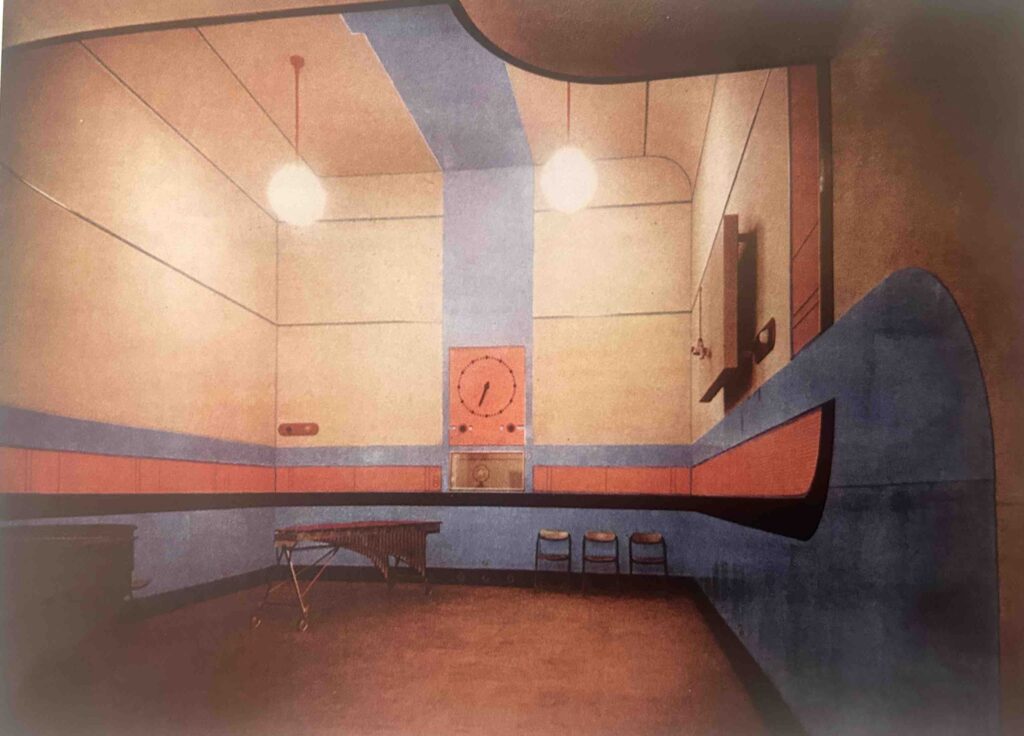
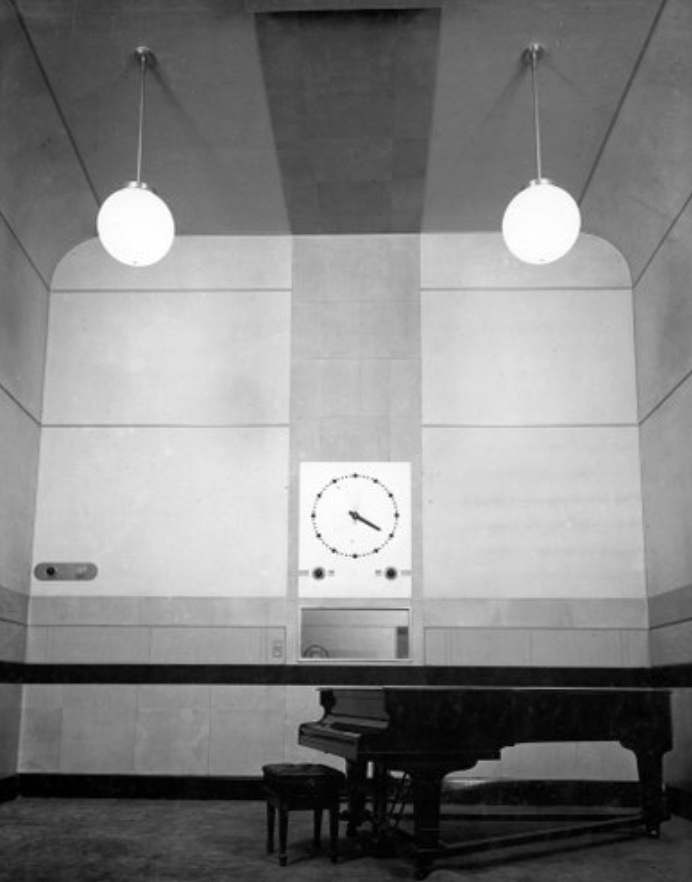
John Wyver writes: In my previous post I enthused about Elizabeth Darling’s new book Palace of the Ether: Broadcasting House and the Architecture of the BBC, 1922-1932. Here I want to focus on just one aspect that Darling throws some light on, but which I am keen to explore further: the use from August 1932 of Studio BB (above, and in the images below) in the newly constructed BH for regular television transmissions by Baird’s 30-line mechanical system.
BH officially opened on 15 May 1932 (the first transmissions were in March), and little more than two months later, the first of six ‘test’ television broadcasts was made from there, ahead of the official first night of 22 August. Although the standard histories acknowledge Studio BB, it is always described simply as being in the basement with no further details supplied.
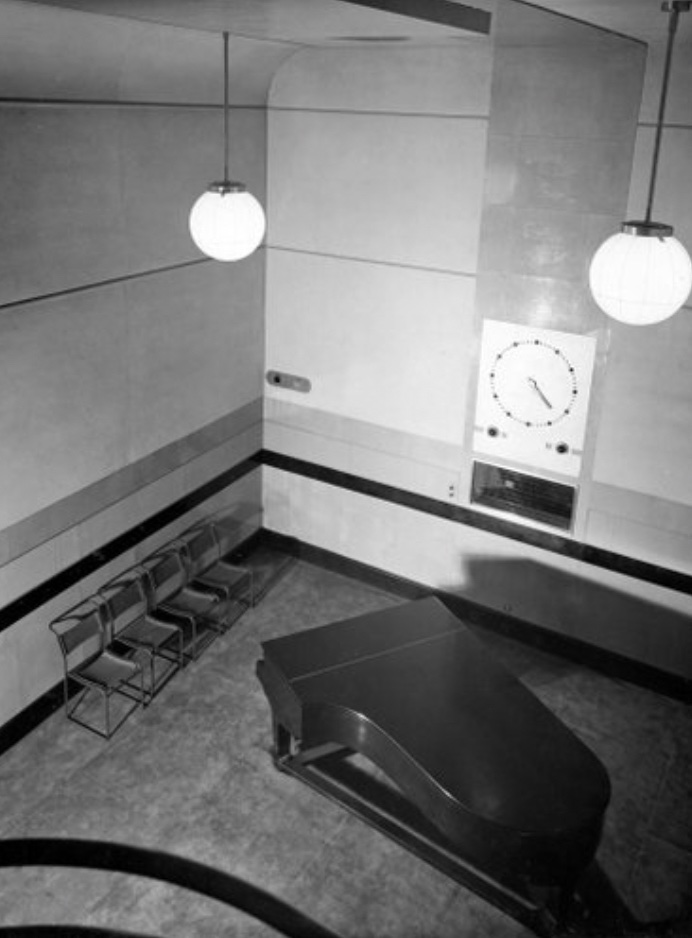
Even the bare designation ‘BB’ somehow suggests this space was a marginal afterthought, an impression reinforced by the invariable note that it was underground. Yet as Darling’s book reveals, Studio BB was designed with the same care and modernist flair as the other dozen or so studios in the building. The image above gives a strong sense of Raymond McGrath’s surfaces, colour layering and clear lines, together with the of-the-moment clockface and spherical lamps.
McGrath was ‘Decoration Consultant’ for the whole building, responsible for the ‘connective tissue’ of the complex of studios, including much of the furniture and equipment as well as lettering, telephones, signal lights and signposting. McGrath also designed the companion Studio BA, which was larger than BB and similarly double-height, and intended for broadcasts of vaudeville and light musical programmes.
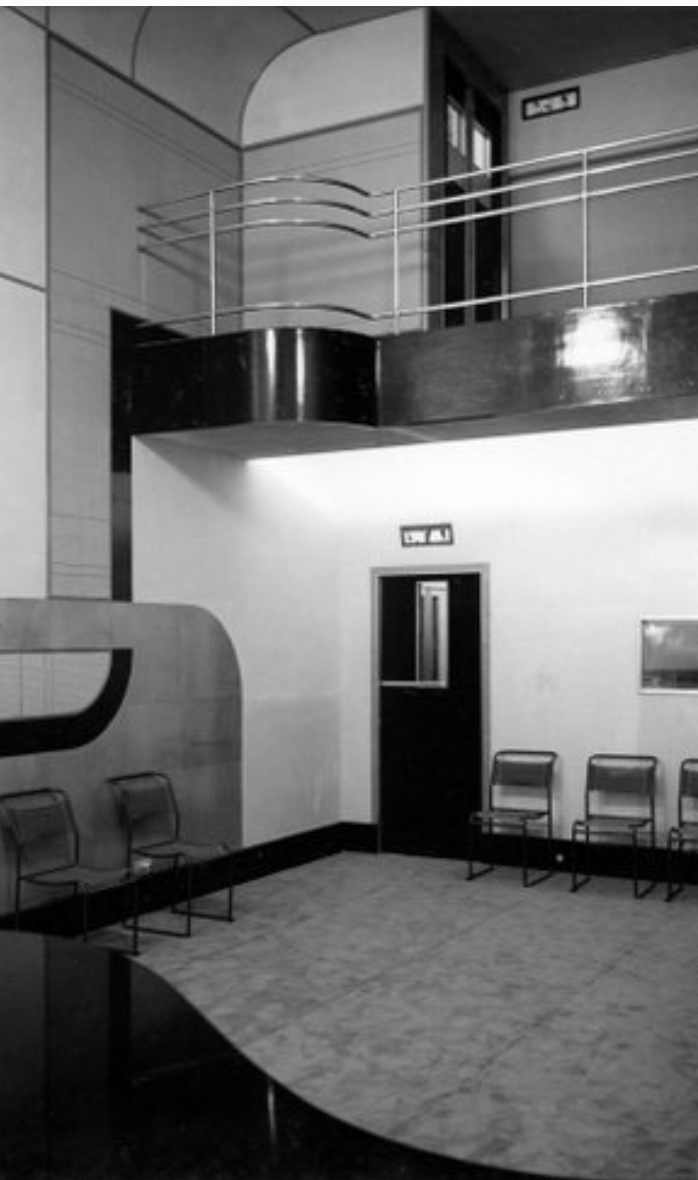
The original plan was that Studio BB should be a home for dance bands, octets (a strikingly specific use) and chamber music in general, and it is not clear how much service it saw in this guise before conversion for television began. The main studio space would have required little work, but the scanner/projector seen in operation below, together with the control desk, had to be installed. This must have been behind one of the windows, either beneath the balcony, visible to the right of the photograph above, or cut into the opposite wall, as in the colour image.
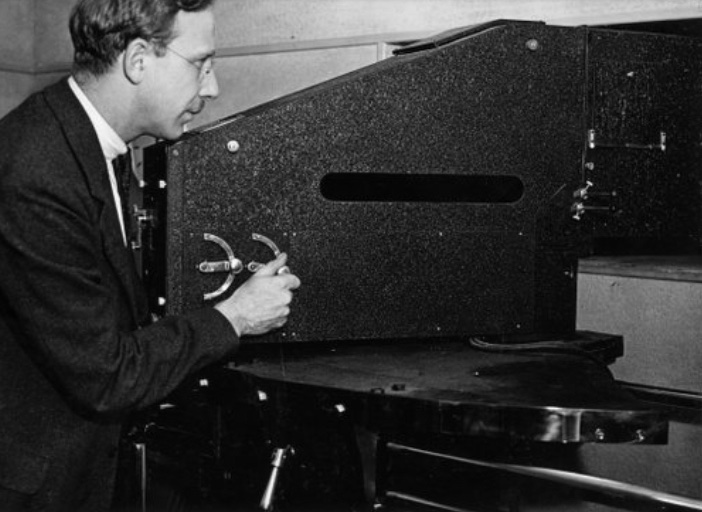
In use the studio would have been in almost total darkness, with the vaudeville artist or dancer who was being televised positioned before the window and illuminated by the rapidly scanning vertical strips of light from the scanner/projector. It took a year or so before full-length images were achievable and before the scanner/projector could move, albeit minimally, to follow a figure in movement.
Half-hour broadcasts were made four or five times a week, mostly late at night, and under producer Eustace Robb these featured a remarkable range of singers, comedians and dancers. Robb built on the work that Harold Bradley had done for Baird Television Ltd in the company’s studio in Covent Garden’s Long Acre, and reception reports record that broadcasts were seen with varying degrees of distinctness not only across London but in Leeds, Newcastle and occasionally beyond.
Anything resembling reviews of these broadcasts are rare, but one early response noted that ‘Now that the first month is past . . . all the evidence points to the conclusion that the broadcasters are seriously attempting to popularise the new science. Ingenuity and enthusiasm are at work and a high standard of artistic performance has been achieved.’
Variety artists filled the overwhelming majority of slots, and a semi-regular company coalesced including Peggy Cochrane, Jane Carr, Betty Bolton, blackface singer Fred Douglas and dancer Ailsa Bridgewater. More prestigious one-night-only bookings included variety star Madame Alice Delysia and noted Danish actor and singer Carl Brisson. Introduced by John Logie Baird, Brisson’s appearance in early November 1932 was also presented in Copenhagen’s Arena Theatre as part of a week of large-screen showings organised by the Danish newspaper Politiken.
Overall, the choice of songs was broadly cosmopolitan, including numerous numbers from Broadway, but also from a range of European traditions, while at the end of the first month, Robb mounted a first predominantly classical programme of Debussy, Chopin, Bach, Brahms and Albéniz. Among the performers was the Hungarian violinist Adila Fachiri, dedicatee of two Bartók violin concertos. Robb also began to theme broadcasts around national traditions, starting with a Japanese gala in late September.
Among the songs and dances was a sprinkling of novelty acts, such as cartoonist Rupert Harvey and Max Templeton’s shadow play. Visual invention was demonstrated when a spinning top in the act of yo-yo champion Joe Young was first shown as an indistinct shape in the centre of the screen which only came into focus as it retreated away from the camera. A journalist hailed the effect as ‘cinematographic’.
Talks were less frequent than had been the case with the Baird transmissions, although it was counted an early coup to secure a five-minute address by Scottish aviator Jim Mollison, recent hero of an east-to-west solo transatlantic flight lasting thirty-one hours. Accompanying him was his recent bride and aviatrix Amy Johnson.
Studio BB also hosted a showing of objects from the extensive Art Treasures exhibition on display at Christie’s. Robb persuaded Lord Lee of Fareham, collector, philanthropist and founder in 1932 of the Courtauld Institute of Art, to speak about a selection of artworks placed carefully before the flickering scanner beam by three art handlers.
With this booking, Robb demonstrated how he could start to draw together his new medium and the traditional establishment. The writer using the psudonym ‘Spectator’ approved of the peer’s comments to the effect that, ‘Television was a means for awakening and stimulating public interest in works of art, and people were assisted to recognise and admire what was beautiful or good and to reject what was ugly or bad.’ Links with the nation’s aristocracy were also on display the night after the Art Treasures transmission, when the broadcast presented a mannequin parade of gowns by high-end couturier W. W. Reville-Terry, dressmaker for Queen Mary.
At the end of the first year an elaborate Boxing Day pantomime devised by Robb was shown ‘complete with cat, property rats, subtitles showing changes of scenes, drawings of mosques and minarets and [of] the Mansion House London.’ The producer was constantly trying out new ideas, including in October 1933 a six-foot-high stepped platform on wheels for a half-dozen Russian balalaika players, which could be pushed away from and towards the camera by two studio assistants to facilitate long shots as well as close-ups of each instrumentalist.
By May 1933, just 10 months into the service, Eustace Robb was sufficiently confident to produce a detailed report for his managers. Acknowledging the key restriction of inferior image definition, he nonetheless claimed that ‘great progress has been made in the artistic and technical use of the apparatus’. Before detailing the achievements, he also offered a lengthy list of problems, including studio and control-room accommodation, ventilation, mobility of microphones and lack of a gramophone unit.
As for his advances, these included ‘the invention of proper make-up’, visual announcements and illustrated subtitles, scenery and sets, appropriate modification of costumes, the successful presentation of ‘animals, trick cycling, balancing sets and roller skating’ as well as ‘bringing representatives of different schools of dancing to broadcasting and adopting their art to the exigencies of television’.
Robb and his team still had a further nine months of working in Studio BB, before the television operation was moved in February 1934 to a new home in 16 Portland Place. Here the control room was larger, ventilation was better and the scanner/projector could be moved more easily from side to side. From this space, increasingly ambitious broadcasts continued until 11 September 1935, on which evening the dancer Lydia Sokolova was one of those taking part in the final 30-line transmission.
What happened to Studio BB when television moved out is uncertain, although even by early 1934, and under the pressures of rapidly increasing production demands, the strictly determined individual roles for each of BH’s studios were becoming increasingly blurred. And today, in part because of bomb damage during the war, nothing of the original studio set-up remains. Nonetheless, thanks to Elizabeth Darling’s book, and these photographs I have a much stronger sense of the home of early television at a formative moment.
Leave a Reply