12th July 2025
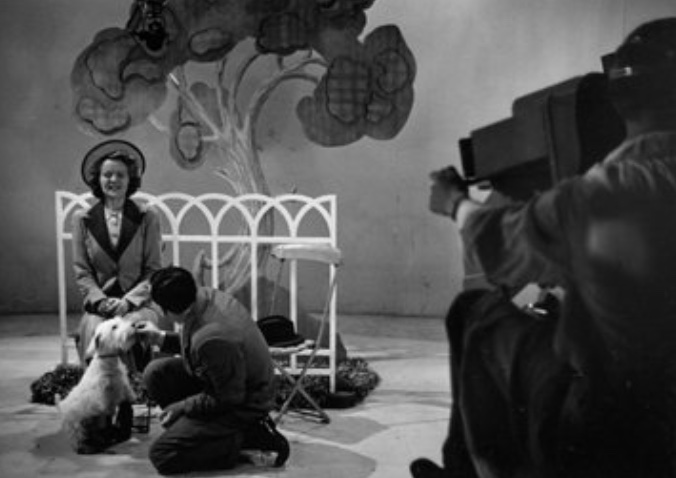
John Wyver writes: Another first – the opening 10-minute episode on the evening of Tuesday 12 July 1938 of television’s earliest serial “soap”, written by venerable actor Louis Goodrich and titled Ann and Harold.
The main characters are Ann Teviot, in the language of the cast list ‘a spinster’, played by Ann Todd, and bachelor Harold Warden, a role taken by William Hutchison. Since the episode is called ‘Their First Meeting’, this is clearly what fans would later recognise as ‘the meet-cute’. Presumably the dog in the photo above, a Sealyham Terrier called Tuppence, is key to the encounter.
read more »
11th July 2025
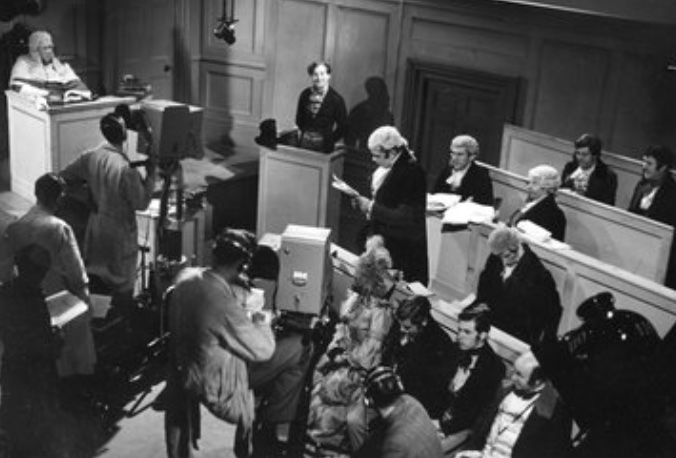
John Wyver writes: We have already seen how in May 1938 television’s love affair with Jane Austen began with a compacted adaptation of Pride and Prejudice. Less than two months later, the new medium first entered the world of Charles Dickens with the lawsuit scenes from The Pickwick Papers, billed as Bardell Against Pickwick. First shown on the evening of Wednesday 6 July, the production was played again on the afternoon of Monday 11 July.
The 37-minute adaptation was undertaken by producer Stephen Harrison who, as Radio Times‘ ‘The Scanner’ informed readers,
had had to write a few words here and there to maintain the continuity, but an examination of the script shows that Dickens might well have written the scene especially for television.
read more »
10th July 2025

John Wyver writes: Under producer Eustace Robb, the BBC’s 30-line Television service mounted increasingly elaborate productions of classic ballets. Among his most enthusiastic collaborators was former Diaghilev star Lydia Sokolova, who first adapted the one-act Cléopâtre which Michel Fokine had originally choreographed for Diaghilev in 1909. Sokolova followed up with an adaptation of George Balanchine’s The Gods go a’Begging, and on consecutive Wednesdays 3 and 10 July 1935 a version of Fokine’s 1910 Carnaval, to music by Schumann.
Born Hilda Tansley Munnings in Essex, Sokolova was given her stage name by Diaghilev when she joined his company in 1913. She danced with Nijinsky and led the touring company in Leonide Massine’s celebrated 1920 The Rite of Spring. On Diaghilev’s death, she returned to Britain to teach and choreograph, and to collaborate on early television ballets.
Per Wikipedia:
Carnaval seems to have been the most delicate, most exquisite ballet Michel Fokine ever created, as well as the most difficult to pinpoint. As was the case with many of his works, the roles depended to a large degree upon the talents of the original performers, and if one looks at just the steps (except for the one Harlequin solo) they are almost simplistic.
It was the infusion of lightness, gaiety, coyness, and self-absorption, combined with an underlying sadness—all of which must be contributed by the dancers—that resulted in what most critics of the time regarded as a most effective adaptation of Schumann’s music and characters.
The image shows Lydia Sokolova as Columbine, Travis Kemp as Pierrot, Stanley Judson as Eusebius (Kemp and Judson were billed in each other’s role) and, as Pantalon, Algeranoff.
[OTD post no. 205; part of a long-running series leading up to the publication of my book Magic Rays of Light: The Early Years of Television in Britain in January 2026.]
9th July 2025

John Wyver writes: Responding to the full-length drama given on the evening of Sunday 9 July 1939, Grace Wyndham Goldie in her column for The Listener did not hide her judgement from her readers:
There were half-a-dozen curious things about the new play, The Fame of Grace Darling, which was given its first performance last week. Infinitely the most curious was the fact that it was performed at all. For it was as handsomely bad as any piece I remember.
The writing was banal; the characters stereotyped; the plot non-existent; the whole thing an essay in an outmoded sentimentality which came near to burlesquing itself.
This despite Grace Darling being played by Wendy Hiller despite the use of a cast of 24 in an elaborate production using three sets with four cameras and a lighting rig of twenty-four main lamps, and despite the transmission being overseen by the invariably reliable, if occasionally eccentric, Fred O’Donovan.
read more »
8th July 2025

John Wyver writes: In its first month of operation the Television service from Alexandra Palace presented extracts from a theatre production of T.S. Eliot’s Murder in the Cathedral. But the new medium’s real engagement with the major playwrights of the time began on 8 July 1937 when George More O’Ferrall presented George Bernard Shaw’s comic three-hander, How He Lied to Her Husband.
Shaw travelled to Alexandra Palace to watch this 1905 play on a monitor, standing alongside Gerald Cock. In the wonderful header image, Shaw can be seen seated with producer George More O’Ferrall on the floor, along with actors Greer Garson, Derek Williams and D.A Clark Smith.
read more »
7th July 2025
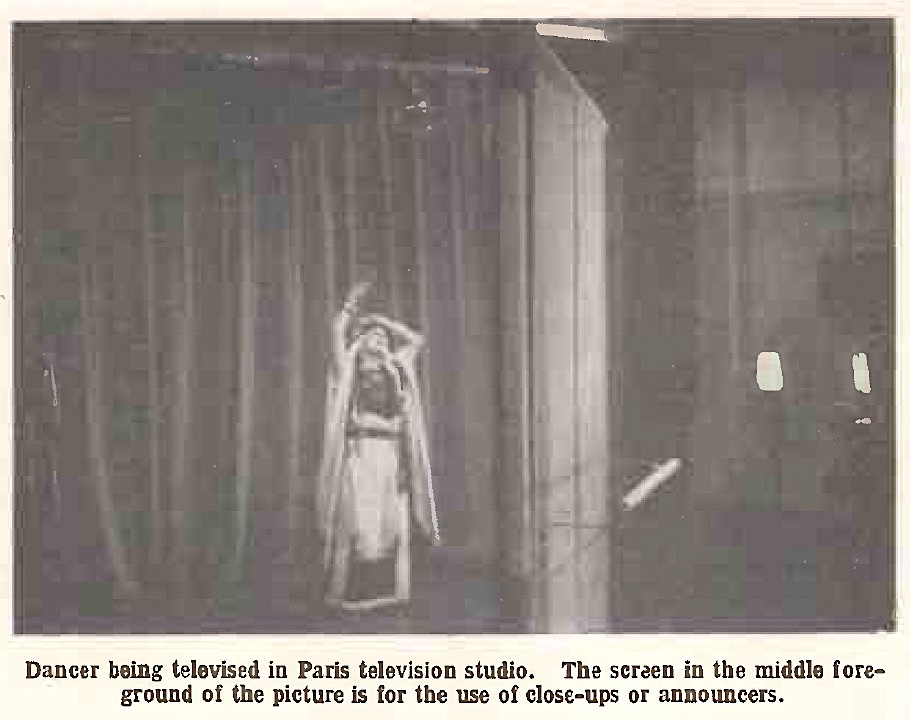
John Wyver writes: ‘Television seen 200 miles away’ ran the heading of a front-page story in The Era on Thursday 7 July 1938, along with the sub-heard, ‘Paris received on the South Downs’. And the report continued,
Startling possibilities are foreshadowed by the successful reception on the South Downs of a complete transmission from the Eiffel Tower 200 miles away.
This important chapter in the history of television was written on the screen at the Dyke Hotel, 700 feet above sea-level, where the transmissions from Alexandra Palace are regularly received at as good a quality as in London, though the receiver is twice the official effective distance from the transmitting station. The whole of the Paris programme, lasting for two hours, was successfully received.
read more »
6th July 2025
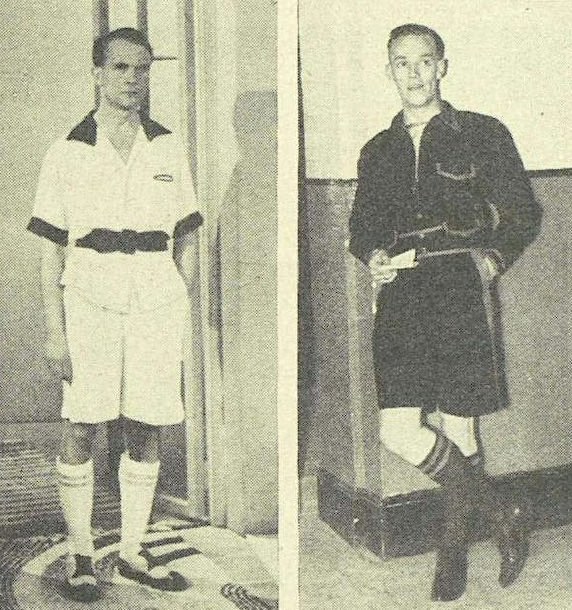
John Wyver writes: ‘Fashion’ in programmes from pre-war Alexandra Palace invariably meant clothes for women, but there was an outlier on the evening of Tuesday 6 July 1937. Men’s Dress Reform was a 17-minute programme produced by Mary Adams looking at costumes entered for the Coronation competition held under the auspices of the Men’s Dress Reform Party. It is fair to say that it was not a success.
Host Dr J.C. Flugel, author of The Psychology of Clothes, explained that the Men’s Dress Reform Party [MDRP] aimed to promote clothes which were healthy, attractive and practical. The competition was divided into two classes: (a) office, professional or other vocational wear, and (b) ceremonial or evening wear.
As an anonymous television reviewer commented drily in The Listener:
No first prize was awarded because the judges felt that no design reached the required standard…
read more »
5th July 2025
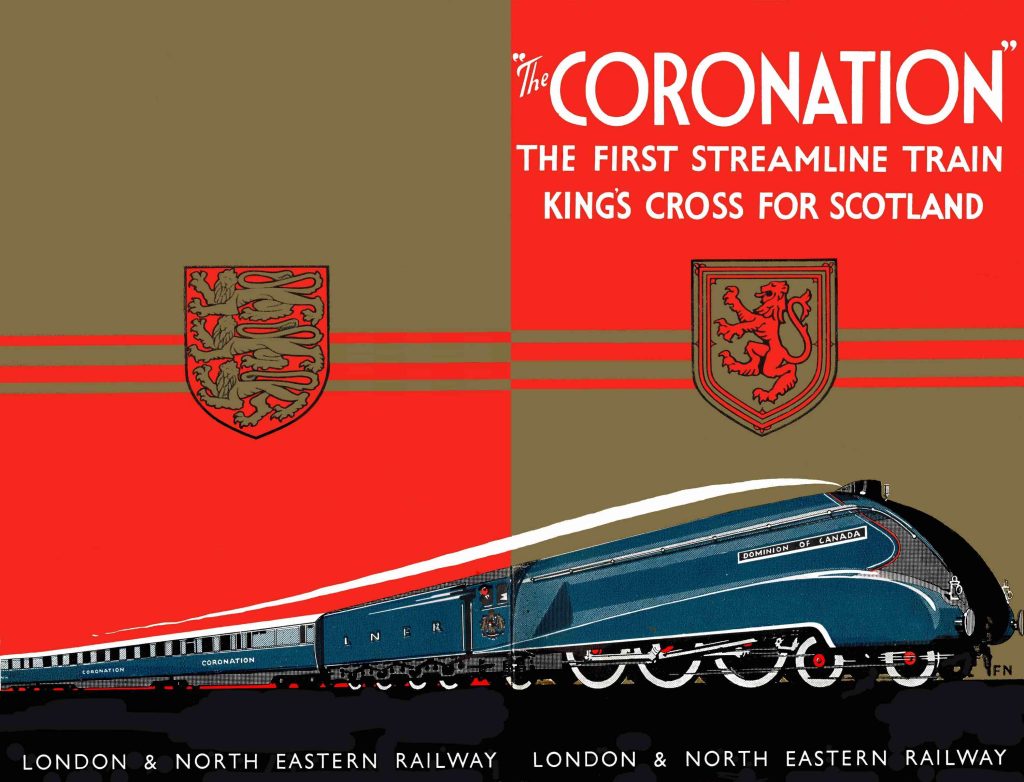
John Wyver writes: Tucked in at the end of the afternoon’s programming on Monday 5 July 1937 is a curious three-minute ‘local OB’ titled The Coronation Train. Goodness knows that the result was like but, with commentary by Leslie Mitchell, this was apparently a shot from a studio Emitron run out onto the balcony of Alexandra Palace of LNER’s ‘Coronation Train’ passing by in the distance.
LNER’s streamlined train had left King’s Cross at 4pm on its inaugural six-hour journey to Edinburgh. The header image is the cover of the marketing booklet issued by the train company.
read more »
4th July 2025

John Wyver writes: The late-night 30-line broadcast on Tuesday 4 July 1933 featured alongside comedian Sydney Arnold and Olive Groves with songs from John Gay’s The Beggar’s Opera, the Russo-Finnish dancer Cleo Nordi. Trained in St Petersburg, she had been a celebrated soloist with Anna Pavlova’s company between 1926 and 1931.
That night in July, in one of her many appearances on the 30-line service, she gave a rumba to a tune by Lewis Gensler, a ‘gypsy dance’ to a Riccardo Drigo composition, and a Glazunov ‘Bacchanale’. Accompanying her were a trio of piano (the ever-reliable Cyril Smith), harpsichord and drums.
read more »
3rd July 2025

John Wyver writes: Stage representations of the Great War were rare in the first decade after the Armistice, and it was R.C. Sherriff’s Journey’s End, which became a major hit after its premiere in late December 1928, that defined the theatrical representation of the western front. The play offered an unsentimental, tragic sense of the conflict, and in November 1937 this was the Television service’s first substantial dramatic presentation of the war.
Unsurprisingly perhaps, given the ways in which loss and grief marked the interwar period so deeply, there were then another ten or so AP dramas that engaged directly with the conflict and its legacies. These war plays included Ernst Johannsen’s Brigade Exchange, set in a German telephone dugout on the western front, which was first produced for radio in Munich in 1929.
read more »