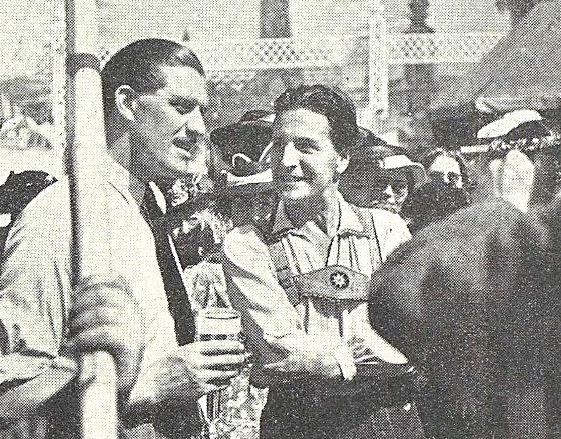
John Wyver writes: For the best part of an hour on the afternoon of Tuesday 6 June 1939 lookers-in were taken off to the gardens of the Ranelagh Club for the annual Theatrical Garden Party. Among those who were observed and encountered were Noel Coward, Ivor Novello (above, with Leslie Mitchell), Diana Wynyard and playwright Clemence Dane.
Also making appearances were Telegraph journalist L. Marsland Gander; Mrs Smithers, recorded as ‘a member of the public’; ‘a lady viewer’; and Euphan MacLaren’s children. No, me neither, but Ms MacLaren apparently ran a stage school for young people , but it’s unclear if the children were offspring or pupils.
John Wyver writes: Television’s main event on the evening of 5 June 1938 was a presentation of two modern dance works by the company Ballets Jooss. Founded in 1933 by choreographer Kurt Jooss, the group had fled Nazi Germany and been given a home in England at Dartington Hall. Touring extensively through the 1930s and during the war, Ballets Jooss was celebrated for a modernist combination of classical ballet and expressionist-inflected theatre.
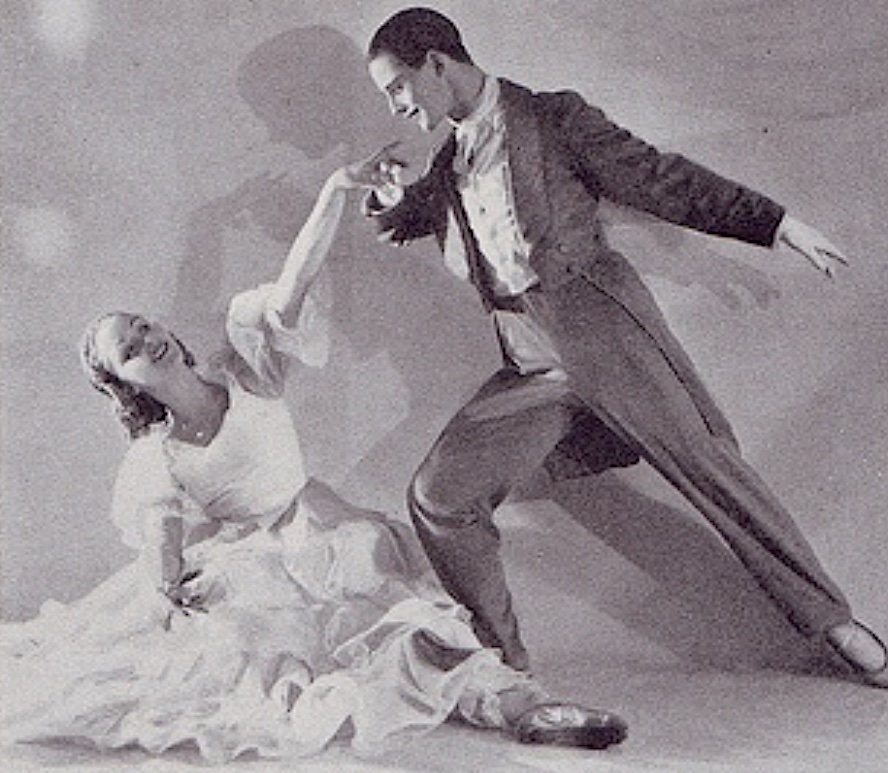
The broadcast on 5 June was the company’s second Alexandra Palace appearance, the first having been on the afternoon of Tuesday 24 May, when the comic ballet The Seven Heroes was given. For the second transmission, the programme was, first, The Big City and then A Ball in Old Vienna, a light-hearted work made by Jooss in 1932. This was danced for the cameras by a cast led by Noelle de Mosa as the debutante and Hans Zuellig as her admirer (above), while the same pair also led the company for The Big City.
John Wyver writes: One of the unremarked aspects of the pre-war television service (of which there are many) is the fact that from the start of 1939 around an hour of either the National of Regional Programme radio broadcasts were carried on the television frequency just ahead of the 9pm start of vision programming.
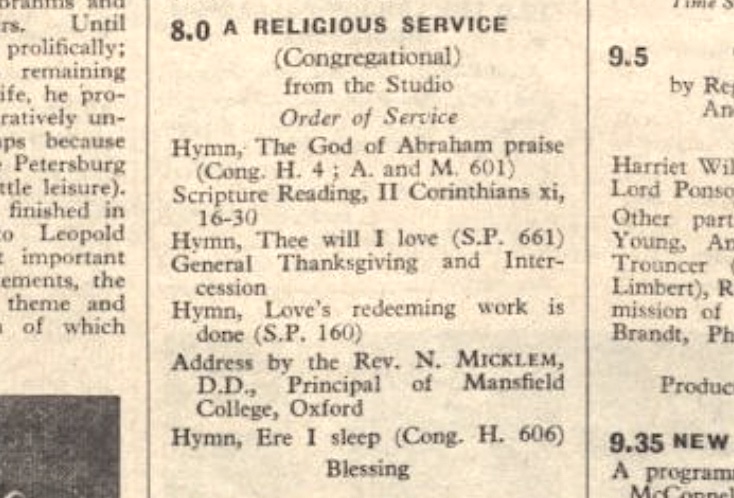
Mostly this hour was of classical music or variety, but on Sunday 4 June 1939 there was the religious service detailed in the Radio Times clipping above. Such services whether from the studio, as here, or as an OB from a church, were not otherwise carried on pre-war television, and only featured from late 1946 onwards.
The service was followed by The Week’s Good Cause, in this case on behalf of Central Council for the Care of Cripples, presented by (in language that is totally inappropriate today) ‘an unknown cripple’. After which there was ten minutes of the weather forecast, the forecast for shipping, and The Second News, broadcast simultaneously with the National Programme from the Daventry transmitter.
John Wyver writes: By the early summer of 1935 the BBC’s 30-line transmissions were and confident and on oc casion truly ambitious. Overseen by producer Eustace Robb, these broadcasts marshalled an extensive range of talents and technical capabilities that, by comparison with later systems, were basic and yet still with the capacity for striking visual effects.
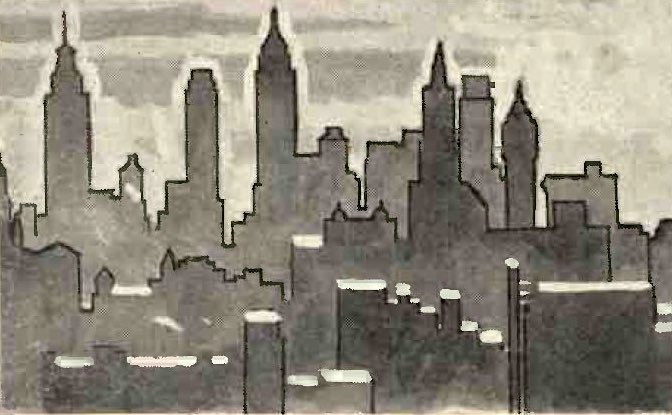
Perhaps the closest we can approach one of Robb’s ambitious broadcasts is through the camera script of the 45-minute broadcast Skyline, published by the monthly Television in July 1935. Transmitted at 11pm on Monday 3 June (and played again two evenings later), the programme was rehearsed for just two and a half hours that morning.
John Wyver writes: Some 18 months after its start, the official BBC Television service from Alexandra Palace was still struggling to attract viewers. On Thursday 2 June 1938, the Daily Telegraph’s well-informed radio correspondent L. Marsland Gander penned a detailed analysis of the challenges facing the Corporation’s new venture. As he wrote:
Judging from the criticisms that reach me, the BBC is still failing to please its television audience with any consistency. I think there may be a two-fold reason for this.
In the first place, although only two or 2 1/2 hours of transmission are given daily, the BBC is attempting to squeeze in items to appeal to all tastes. Secondly, the BBC programmes are so often built on more earnest and less popular lines than the typical cinema bill.
As an alternative to the impossible effort to please everybody, I suggest that it would be better to seek a common denominator and cater for the majority.
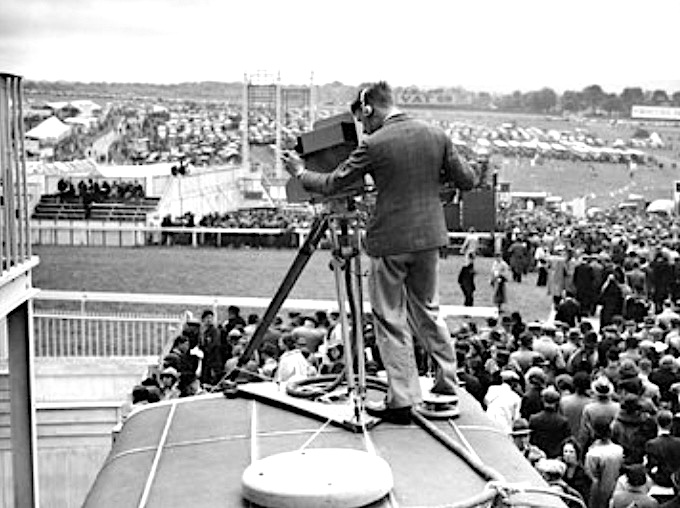
John Wyver writes: For nearly 50 minutes on the afternoon of Wednesday 1 June 1938 viewers in London were transported to Epsom for Derby Day scenes including limited shots of the race itself. But the broadcast was not seen solely on domestic receivers, since it was one of the first BBC broadcasts to be relayed to two large-screen ‘cinema projection’ systems.
‘The greatest thrill since we heard Al Jolson’s voice in the first talkie,’ was one journalist’s verdict after seeing, thanks to a Baird projector, the climax of the race from the comfort of a seat in the Tatler Theatre in London’s Charing Cross Road.
Across town, some 600 invited guests, seated in the Deco splendour of the Derry & Toms department store, also watched the unfancied Bois Roussel, making only the second start of his career, produce an astonishing burst of speed in the final furlong to win by four lengths. This rival Kensington screening employed the Scophony system, and was received similarly positively, despite one of the BBC’s three cameras having failed and a second operating well below its best.
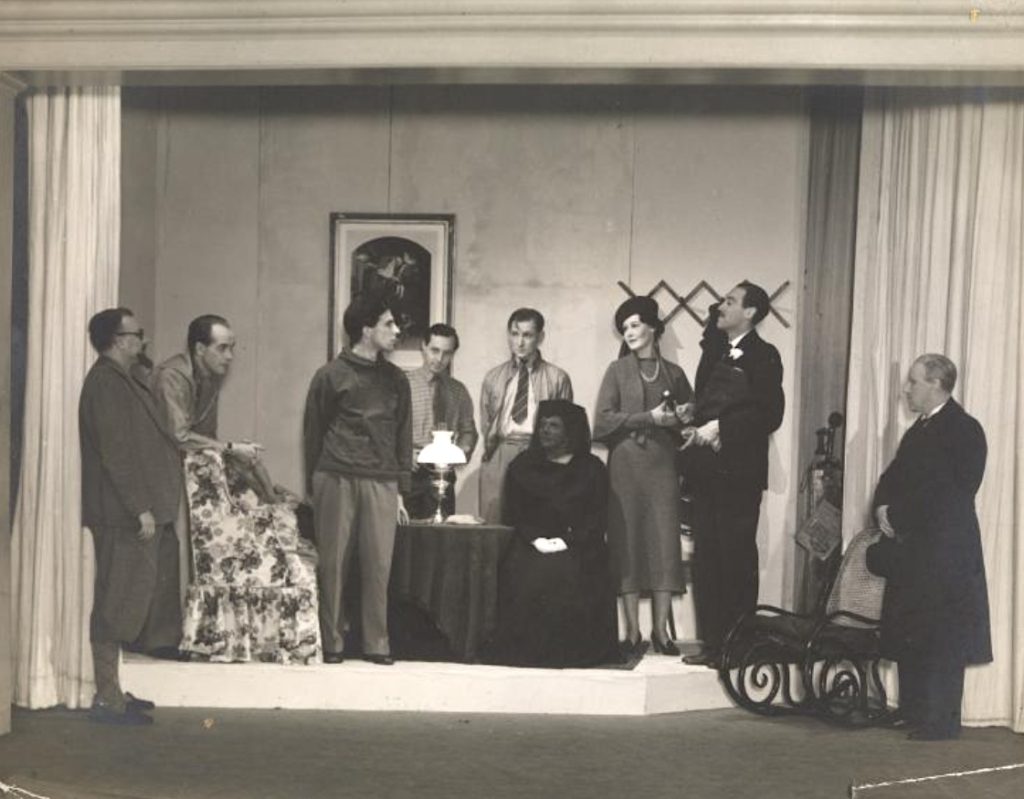
John Wyver writes: Unbilled in Radio Times, and so clearly organised at very short notice, in the afternoon of Monday 31 May 1937, AP broadcast a half-hour of scenes from Rupert Doone’s Group Theatre production at the Little Theatre of The Ascent of F6 by W.H. Auden and Christopher Isherwood.
Only a little over six months after the start of the official BBC service, producers were still scrabbling around for theatre shows that they could tempt in front of the cameras, and work from the theatrical fringe like the Little Theatre was easier to access than West End fare.
A key producer of modernist drama, the Group Theatre had been founded in 1932 by Doone and Robert Medley. In a rich Guardian article from 2023 (which includes a discussion of The Ascent of F6), Sam Kinchin-Smith characterises the enterprise as
one of the motliest and most distinctive gatherings of British and Irish genius of the first half of the 20th century, a dynamic collaboration between artists who transformed their fields and changed the course of modern literary, musical and artistic history.
And among those artists in the 1930s, in addition to Auden (who was a mainstay) and Isherwood, were writers T.S. Eliot, Christopher Fry and Louise MacNeice, composer Benjamin Britten, and designers Duncan Grant, Henry Moore, John Piper and Graham Sutherland.
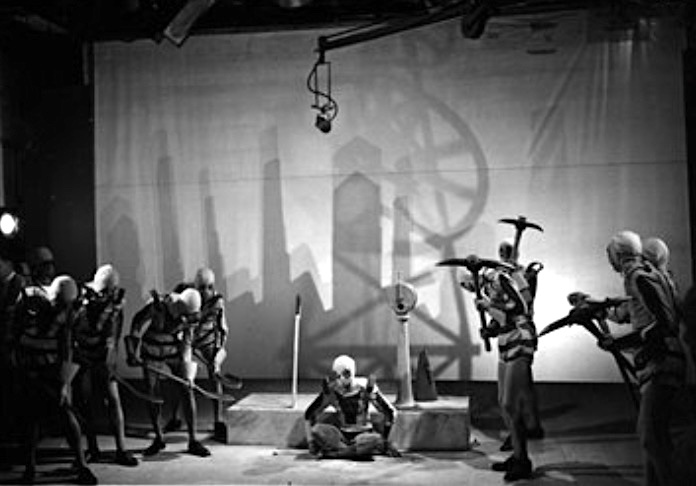
John Wyver writes: On Tuesday 30 May 1939 viewers could watch Jan Bussell’s 87-minute production of Arnold Bennett’s drama The Great Adventure in the afternoon and then, presumably in the other studio, an 82-minute adaptation of the Czech writers Karel and Josef Čapek’s satire The Insect Play in the evening.
Malcolm Baker-Smith’s settings, which clearly made imaginative use of the shadow projection system known as the ‘penumbrascope’, can be seen in these production photographs, as can Hugh Stevenson‘s striking costumes. Stevenson was better-known as a costume designer for ballet, and he worked frequently with choreographers Antony Tudor and Andrée Howard, both AP regulars, and the latter of whom provided dances for The Insect Play.
John Wyver writes: Although director of television Gerald Cock initially envisaged feature films being central to the schedule from Alexandra Palace, British and American producers and distributors refused almost without exception to supply product of any kind. Recognising television as a rival, and being especially concerned about broadcasts being screened in pubs and restaurants, the mainstream film industry refused all co-operation, and would not even permit Cock to screen trailers.
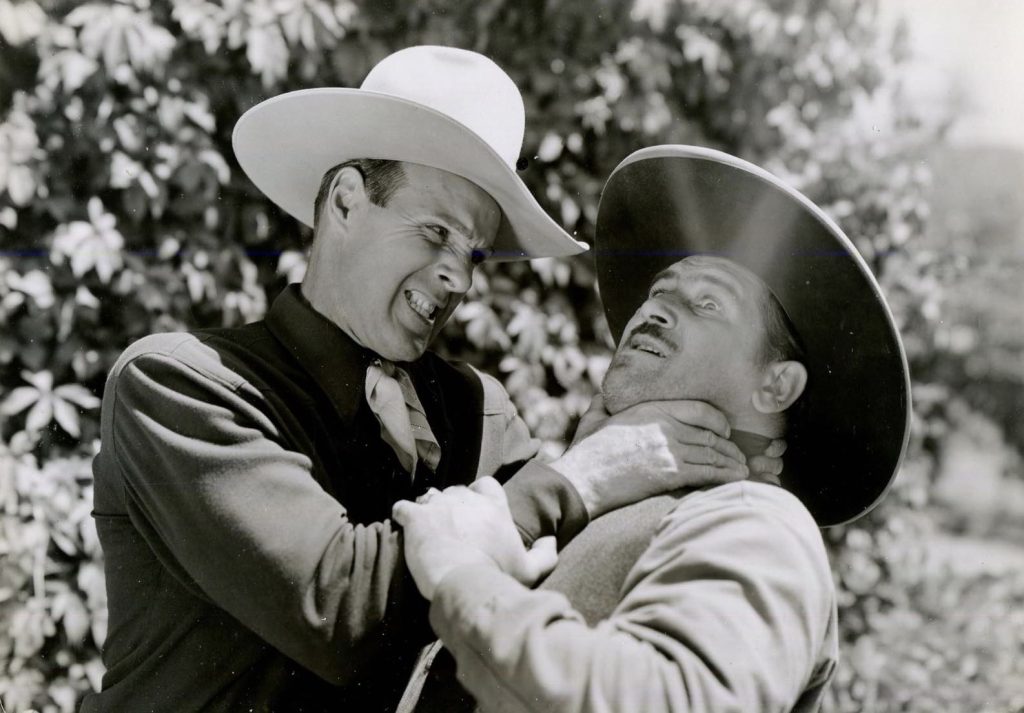
Among the handful of films shown by pre-war television were five low-budget westerns acquired from the tiny producer-distributor Exclusive Films, which also supplied shorts to AP. Two of these oaters starred Harry Carey and three featured the all-but-forgotten Kermit Maynard, including The Fighting Texan, shown on the evening of 29 May 1939. As Wikipedia details,
The story follows rancher Glenn Oliver [Maynard, natch], who has been noticing a decrease in his horse population, while a nearby ranch is getting more and more horses.
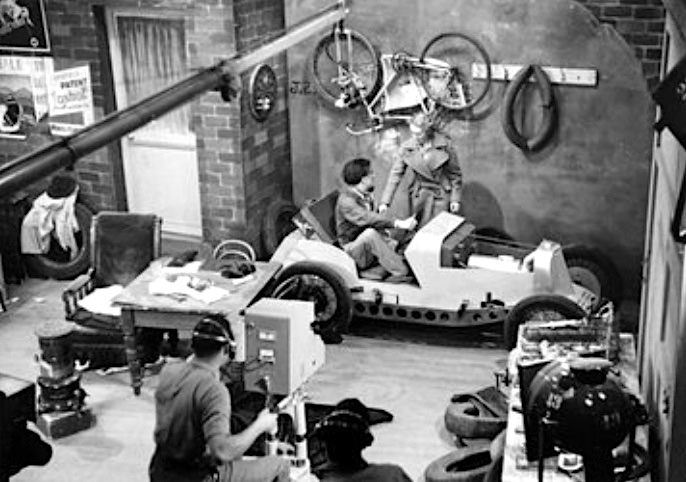
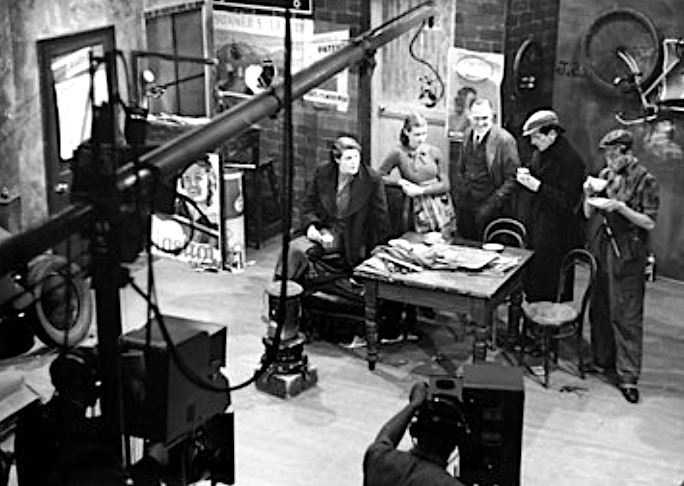
John Wyver writes: The idea of a Sunday evening play from Alexandra Palace was well-established by 28 May 1939 when the schedule was given over to Nicholas Phipps‘ crime drama First Stop North. Charles Hickman’s production, with the author in a key role, had been playing for a week at the King’s Theatre, Hammersmith, and what was clearly a relatively elaborate set, designed by Roger Furse, was de-rigged and re-assembled in less than 24 hours.
Set in a garage north of London that specialises in re-purposing stolen cars, the drama sounds as if it might have been a rare slice of pre-war televisual social realism. ‘E.H.R.’ in the Observer praised it as ‘good entertainment’. The author was celebrated for his contributions to revues, including for television, and in the late 1940s and 1950s, he scripted a run of British film comedies including Doctor in the House (1954), together with three sequels, and The Captain’s Table (1959).
The drama is notable for being one of series played by a repertory company run by Wilson Barrett and Esmond Knight, who also had a role in First Stop North. Presenting 24 plays on a weekly basis between January and July 1939, the venture appears to be been a moderate artistic success, although not an especially profitable one.
[OTD post no. 162; part of a long-running series leading up to the publication of my book Magic Rays of Light: The Early Years of Television in Britain in January 2026.]