
New strategic vision for archives highlights how BBC Written Archives Centre falls short
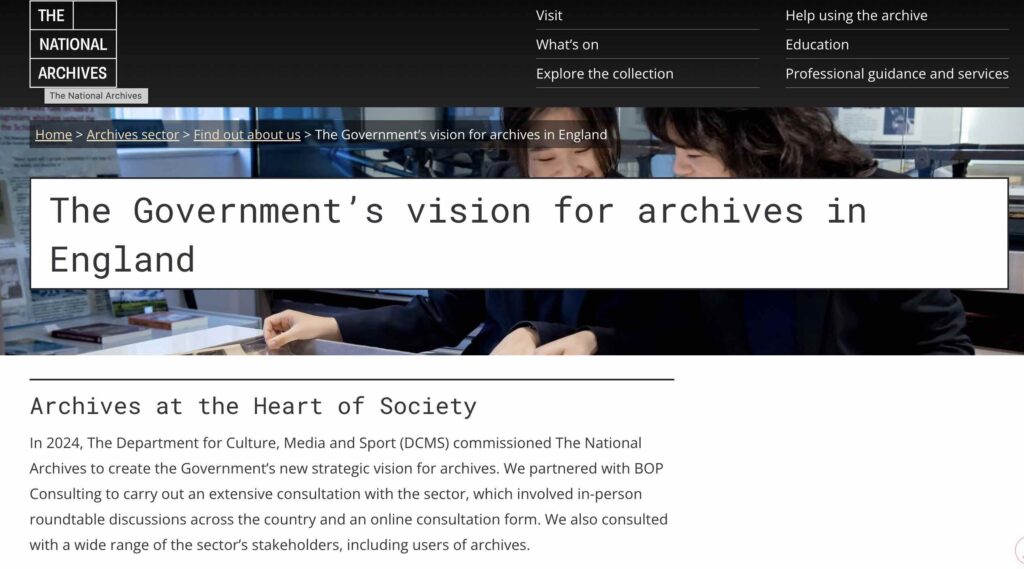
John Wyver writes: Ten days ago, with perhaps rather too little fanfare, the Government released a new strategic vision for archives. Commissioned from The National Archives (TNA) and launched by Baroness Twycross, Minister for Museums, Heritage and Gambling, this involved, as the project’s website notes, ‘an extensive consultation with the sector… in-person roundtable discussions across the country and an online consultation form. We also consulted with a wide range of the sector’s stakeholders, including users of archives.’
Given such thorough preparation, Archives at the Heart of Society is, in some ways, a comparatively modest (online) document. Nonetheless it makes a really strong and convincing case for the central importance of archives, and for why they must be accessible, inclusive and sustainable. Using it as a yardstick against which to measure the operation of the BBC Written Archives Centre (WAC) shows just how far short of best practice the Corporation’s archive falls.
Regular readers will know that Ian Greaves, Kate Murphy and I, with the support of some 600 scholars and story-tellers, have been campaigning against the changes made just over a year ago to the operation of WAC. We remain especially concerned about the withdrawal of ‘on request’ vetting of files from the two-thirds of the holdings that to date have not been made public, a decision which renders independent, curiosity-driven research all-but impossible.
We despair at how obdurate the WAC executives have been in their refusal to reconsider this, and at how they have demonstrated in on-line meetings and statements how little they appear to understand or to value the research of academics and others outside the BBC. This, despite extensive press coverage of these concerns.
At the same time, we profoundly regret the decision to stop responding to enquiries from members of the public. Also, it is entirely unsatisfactory that physical access for researchers via the Caversham reading room has been reduced from three to just two days each week.
Moreover, we disagree with WAC limiting use of its facilities to just ‘writers who have been commissioned to write a book or article; those undertaking research for a commercial project, [and] academics in higher education undertaking accredited research.’ The restrictions are detailed here, and are more tightly focussed than has been the case in the past.
Why archives matter
Now take a look at how the current WAC measures up against the Government’s (and TNA’s) new stategic vision, the first part of which is Why archives matter. In support of the statement that, ‘Archives matter because they empower people and shape society in countless ways’, the vision details eight excellent reasons, including
- Archives hold individuals and institutions to account, including by providing crucial evidence in public inquiries and other legal cases.
- Archives help communities to reclaim previously marginalised histories.
- Archives enable effective decision-making and inspire innovation in every field, from business and tourism to technology and city planning.
- Archives power the creative industries, inspiring books, plays, films, adverts, music, art and design.
All of which, the riches of WAC have unquestionably facilitated, and can potentially continue to contribute to do so, in vital and unique ways.
The core of the strategic vision is then laid out, with this statement at its heart:
Our vision is for archives to be valued and preserved as a source of inspiration for everyone. The foundation of this vision is the integral role of archives at the heart of society. Archives preserve the records of our shared past, deepen our understanding of the present, and plant the seeds of inspiration for our future.
Exactly.
The ways in which WAC falls short
WAC’s shortcomings, however, are revealed when measured against the next section, which argues for the central importance of archives being Accessible. ‘Archives,’ it states, ‘must be shared widely and be easy to use to remain integral to our society.’
This is the first count on which WAC falls short. With the closing down of ‘on request’ vetting, with the new limitations on opening times, with the ending of responses to enquiries from members of the public, and with the restrictions on who can use WAC, there is no sense in which its resources are available ‘to be shared widely’ and ‘easy to use’.
A supplementary concern here is that – and it still astonishes me to write this – there is no publicly available catalogue of the WAC holdings, further shutting down any possibility of its resources being ‘shared widely’ and ‘easy to use’.
We know, thanks to a Freedom of Information request, that a public-facing catalogue was developed with considerable resources in the early 2020s, and that a pilot version was ready to launch, but that internal nervousness, including from the person responsible for liason with the Royal Family, nixed this just ahead of it coming online.
Similarly, when at the end of last year a tranche of files were released for use by researchers without vetting, no detailed listing of these files was published, and we have been told that there are no plans to do so. Again, this significantly limits the value of this release for serious research. The end result of all this is that WAC access is now more strictly on the BBC’s terms, and in the BBC’s interests, than ever before.
All of which speaks to the second count against which WAC must be marked ‘fail’, namely the next section of the vision, headed Inclusive. Here, the key point is that, ‘Archives must be representative and welcoming of everyone to remain integral to all of our lives.’ Yet for the reasons detailed, there is once again no sense in which the current WAC can claim to be ‘welcoming of everyone’.
The third element of the vision is that archives must be Sustainable, by which the authors mean not only ‘environmentally sustainable’ (which is crucial, and which WAC is probably rather good at) but also
Archives of all types must have the necessary funding and conditions to remain integral in the future.
The necessity of new thinking and new relationships
Of course we recognise how challenging the times are for the BBC, and how budget cuts are impacting all of the activities of the Corporation. But here the vision makes an important argument for all archives:
These financial challenges demand new ways of working, entrepreneurial approaches and focused investment. This is a vision for growth, and securing additional resources by maximising grant opportunities, generating income and partnership working is vital to its success.
Similarly, in the Accessible section of the strategic vision, there is an important call for archives to ‘seek out innovative collaborations spanning academic institutions, cultural organisations and technology firms to provide access to an even wider variety of records for all’.
In our on-line meetings with WAC executives we have endeavoured to raise the idea of collaborating on grant applications and other initiatives to find ways of doing exactly this. But to date we have been met with a lack of interest bordering on outright rejection. Nonetheless, we persist in believing that this is an important way forward, which we will continue to explore.
With no new Government funding in prospect for archives, the challenge for TNA and the sector will be, as the final section is titled, Turning vision into action. The promise is that
The National Archives will develop a robust action plan to deliver on the three strategic themes of this vision. This plan will have clear goals, measurable outputs and transparent reporting on the progress of the archives sector. Throughout the life of the vision, task groups will be convened to focus on key challenges, spark innovation, and share best practice.
It feels vital that WAC recognises this, makes essential changes and begins to work more collaboratively and openly with academics, cultural organisations and others. Yet WAC is not currently represented on the steeering group, which otherwise has figures from ten external organisations, including London Metropolitan Archives, Museum of English Rural Life and Natural History Museum.
WAC, and the BBC more generally, should – must – be a leader in this field, and it is desperately disappointing that it is not, and that currently it appears to have little interest in being so.
Leave a Reply